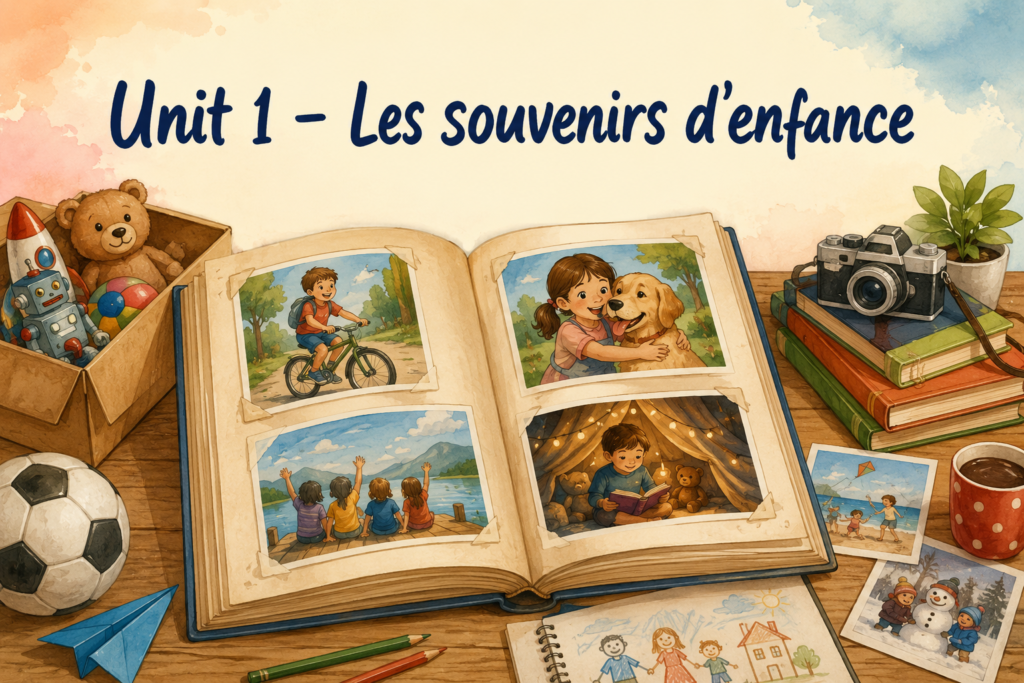
Childhood Memories
Unit Overview
Global Context: Identities & Relationships
Key Concept: Communication
Related Concepts: Message, Meaning
Statement of Inquiry:
Remembering childhood experiences helps us understand our identity and personal growth.
Learner Profile: Reflective, Communicators
What you will learn
In this unit, you will learn how to talk and write about your childhood memories and past experiences.
You will learn to:
- talk about things you did in the past;
- describe what your childhood was like;
- talk about repeated childhood habits;
- describe specific past events;
- use le passé composé to narrate completed events;
- use l’imparfait to describe habits, situations and background;
- understand the difference between passé composé and imparfait;
- use time expressions to put events in chronological order;
- use connectors to link events;
- express feelings and reflections about your childhood;
- compare your past experiences with someone else’s;
- develop a structured personal narrative.
These skills are progressively developed from the Emergent level through Capable and Proficient levels.
1. Vocabulary – L’enfance
You will build vocabulary that allows you to describe your childhood.
People
- un enfant – a child
- un garçon – a boy
- une fille – a girl
- les parents – parents
- la mère – mother
- le père – father
- les grands-parents – grandparents
- la grand-mère – grandmother
- le grand-père – grandfather
- un frère – brother
- une sœur – sister
- un ami / une amie – friend
Childhood
- mon enfance – my childhood
- quand j’étais petit(e) – when I was little
- quand j’étais enfant – when I was a child
- à cette époque – at that time
- avant – before
- autrefois – in the past
2. Childhood activities
You should be able to describe what you used to do and what you did.
Useful verbs include:
- jouer – to play
- regarder – to watch
- lire – to read
- écouter – to listen
- faire – to do/make
- aller – to go
- manger – to eat
- visiter – to visit
- voyager – to travel
- rencontrer – to meet
- apprendre – to learn
- regarder la télévision – to watch television
- jouer avec mes amis – to play with my friends
- faire du vélo – to ride a bicycle
- jouer au football – to play football
- aller au parc – to go to the park
Examples
Quand j’étais petit, je jouais au football.
Je regardais souvent la télévision.
Je faisais du vélo avec mes amis.
L’été dernier, je suis allé(e) à la plage.
3. Describing your childhood
You will need adjectives and expressions to explain what your childhood was like.
Useful adjectives
- heureux / heureuse – happy
- triste – sad
- joyeux / joyeuse – joyful
- amusant(e) – fun
- intéressant(e) – interesting
- difficile – difficult
- facile – easy
- calme – calm
- actif / active – active
- sportif / sportive – sporty
- timide – shy
- sociable – sociable
Sentence starters
Mon enfance était…
Quand j’étais petit(e), j’étais…
À cette époque, j’étais…
Mon enfance était heureuse parce que…
4. Grammar – Le Passé composé
The passé composé is one of the most important grammar points in this unit.
You will use it to talk about completed events in the past. The syllabus specifically expects you to identify, use and eventually combine the passé composé with the imparfait when narrating childhood experiences.
Basic structure
Subject + auxiliary + past participle
Most verbs use avoir:
J’ai joué.
Nous avons regardé.
Ils ont mangé.
Some verbs use être:
Je suis allé(e).
Elle est venue.
Nous sommes partis.
Examples
Hier, j’ai joué au football.
L’année dernière, j’ai visité Paris.
Samedi, nous avons regardé un film.
5. Grammar – L’Imparfait
The imparfait is used to describe:
- childhood habits;
- repeated actions;
- descriptions;
- background information;
- what things were like in the past.
Useful expressions
Quand j’étais petit(e)…
Quand j’étais enfant…
Avant…
Souvent…
Toujours…
Chaque week-end…
Examples
Quand j’étais petit, je jouais au football.
Je regardais souvent la télévision.
Nous allions au parc chaque week-end.
Ma famille habitait à Nairobi.
6. Passé composé vs Imparfait
This is one of the most important concepts in Unit 1.
Imparfait
Think:
What used to happen? What was happening? What was it like?
Quand j’étais petit, je jouais au football tous les samedis.
This describes a repeated habit.
Passé Composé
Think:
What happened? What was completed?
Samedi dernier, j’ai joué au football avec mes amis.
This describes a specific completed event.
Compare
Quand j’étais enfant, je regardais souvent des dessins animés.
Imparfait: repeated childhood habit.
Hier, j’ai regardé un film.
Passé Composé: completed event.
7. Using both tenses together
As you progress through the unit, you will learn to combine the two tenses in a narrative. This is specifically part of the Capable and Proficient expectations for Unit 1.
Example
Quand j’étais petit, je jouais souvent au parc avec mes amis. Un jour, je suis tombé et je me suis fait mal.
Je jouais → Imparfait: background/repeated activity.
Je suis tombé → Passé Composé: specific event.
Je me suis fait mal → Passé Composé: completed event.
8. Time expressions
Time expressions help you organize your memories chronologically.
Past
- quand j’étais petit(e) – when I was little
- quand j’étais enfant – when I was a child
- avant – before
- autrefois – in the past
- à cette époque – at that time
- un jour – one day
- hier – yesterday
- la semaine dernière – last week
- l’année dernière – last year
- il y a quelques années – a few years ago
Sequencing
- d’abord – first
- ensuite – next
- puis – then
- après – afterwards
- finalement – finally
Example
D’abord, nous sommes allés au parc. Ensuite, nous avons joué au football. Puis, nous avons mangé une glace. Finalement, nous sommes rentrés à la maison.
9. Connectors
Connectors help you create a longer and more organized narrative.
Basic connectors
- et – and
- mais – but
- parce que – because
- donc – therefore
- aussi – also
- ensuite – next
- puis – then
- après – afterwards
- finalement – finally
Example
J’aimais mon enfance parce que je passais beaucoup de temps avec ma famille.
10. Talking about feelings
At the higher levels of the unit, you should not simply describe what happened. You should also communicate feelings and reflections about your memories.
Useful expressions:
J’étais heureux/heureuse parce que…
J’étais triste quand…
J’aimais beaucoup…
Je n’aimais pas…
C’était une expérience importante pour moi.
C’était un souvenir inoubliable.
Je me sentais…
Je me souviens de…
11. Sentence starters
Use these to build your own sentences.
Introducing your childhood
Quand j’étais petit(e),…
Quand j’étais enfant,…
Mon enfance était…
À cette époque,…
Talking about habits
Je jouais souvent…
Je regardais toujours…
Chaque week-end, je…
Tous les étés, nous…
Talking about a specific event
Un jour, j’ai…
L’année dernière, j’ai…
Un été, nous sommes allés…
La semaine dernière, j’ai…
Expressing feelings
J’étais heureux/heureuse parce que…
J’ai aimé cette expérience parce que…
C’était important pour moi parce que…
Reflecting
Aujourd’hui, je pense que…
Ce souvenir est important pour moi parce que…
Cette expérience m’a appris que…
12. Speaking
During this unit, you will gradually learn to:
- talk about past events using the passé composé;
- describe your childhood using simple imparfait forms;
- sequence events using time expressions;
- narrate childhood memories using both tenses;
- express feelings and reflections;
- compare your experience with someone else’s.
Example
Quand j’étais petit, je jouais beaucoup avec mes cousins. Un jour, nous sommes allés à la plage. Nous avons joué dans l’eau et nous avons mangé ensemble. J’étais très heureux parce que toute ma famille était là.
13. Writing
Your writing will develop progressively.
Beginning of the unit
You should be able to write:
Quand j’étais petit, je jouais au football.
Developing
You should be able to write a connected narrative:
Quand j’étais petit, je jouais souvent au football avec mes amis. Un jour, nous avons organisé un match dans le parc. Nous avons beaucoup joué et nous avons gagné le match.
Higher level
You should eventually be able to produce an extended personal narrative combining passé composé and imparfait, expressing feelings or reflections and using a range of connectors and time expressions.
14. Reading and Listening
When you read or listen to a childhood narrative, look for:
Who?
Qui ?
Who is speaking?
When?
Quand ?
Look for time expressions.
Where?
Où ?
Identify the location.
What happened?
Qu’est-ce qui s’est passé ?
Look for passé composé verbs.
What was happening / what was it like?
Look for imparfait verbs.
How did the person feel?
Look for:
- heureux
- triste
- content
- surpris
- inquiet
- excité
15. The most important Grammar skill
Do not only memorize the two tenses separately.
You need to understand the relationship between them.
Background + Event
Il faisait beau quand nous sommes arrivés au parc.
Il faisait beau → Imparfait: background.
Nous sommes arrivés → Passé Composé: completed event.
Habit + Specific Event
Quand j’étais enfant, je jouais souvent au football. Un jour, j’ai marqué trois buts.
Je jouais → repeated habit.
J’ai marqué → specific event.
This is the key skill you will develop throughout Unit 1.
16. Unit 1 Learning progression
Week 1 – Childhood vocabulary and Past memories
You will learn:
- childhood vocabulary;
- activities;
- people;
- descriptions;
- basic past expressions;
- simple sentences about childhood.
Week 2 – Passé composé
You will learn:
- how to form the passé composé;
- avoir + past participle;
- common verbs;
- être + past participle;
- how to describe completed past events.
Week 3 – Imparfait
You will learn:
- how to form the imparfait;
- childhood habits;
- repeated actions;
- descriptions;
- background information.
Week 4 – Imparfait vs Passé composé
You will learn how to:
- distinguish the two tenses;
- combine them;
- sequence events;
- use time expressions;
- use connectors.
Week 5 – Personal memories and Reflection
You will develop your ability to:
- narrate a childhood memory;
- express feelings;
- reflect on past experiences;
- compare experiences;
- produce a structured written narrative.
This progression follows the five-week Unit 1 structure and the progression from simple past-event communication toward more developed narratives.
17. Final unit 1 Goals
By the end of this unit, you should be able to say:
Je peux parler de mon enfance.
Je peux raconter une expérience passée.
Je peux utiliser le passé composé.
Je peux utiliser l’imparfait.
Je peux expliquer la différence entre les deux temps.
Je peux utiliser les deux temps dans une même histoire.
Je peux organiser mes souvenirs chronologiquement.
Je peux utiliser des connecteurs et des expressions de temps.
Je peux exprimer mes sentiments.
Je peux réfléchir à l’importance de mes souvenirs.
The overall aim is to move from simple descriptions of past experiences toward a clear, organized and reflective personal narrative using both passé composé and imparfait effectively.
Absolutely. Before moving into the four MYP assessment criteria, I would structure the Unit 1 revision practice as a gradual student workbook: first grammar, then sentence formation, sentence starters, vocabulary, MCQs, and finally integrated practice.
Exercises
Dear students,
Before we begin the four assessment criteria, complete the following revision exercises. These activities will help you revise the grammar, vocabulary and structures you need to talk and write about your childhood memories.
Part 1 – Grammar revision
A. Le Passé composé
Exercise 1 – Complete with the correct auxiliary
Complete each sentence with avoir or être.
- J’________ joué au football.
- Nous ________ regardé un film.
- Elle ________ allé(e) au parc.
- Ils ________ mangé au restaurant.
- Tu ________ visité tes grands-parents.
- Nous ________ arrivé(e)s à huit heures.
- Il ________ fait du vélo.
- Elles ________ parties en vacances.
Exercise 2 – Conjugate the verbs in the Passé Composé
- Hier, j’__________________ au football.
(jouer) - Nous __________________ un film.
(regarder) - Elle __________________ ses grands-parents.
(visiter) - Ils __________________ une pizza.
(manger) - Je __________________ au parc.
(aller) - Nous __________________ beaucoup de photos.
(prendre) - Tu __________________ un cadeau.
(recevoir) - Elles __________________ à Paris.
(arriver)
Part 2 – L’Imparfait
Exercise 3 – Complete the verbs
Complete the sentences using the Imparfait.
- Quand j’étais petit, je __________________ au football.
(jouer) - Je __________________ souvent la télévision.
(regarder) - Nous __________________ au parc chaque week-end.
(aller) - Ma famille __________________ à Nairobi.
(habiter) - Je __________________ beaucoup les vacances.
(aimer) - Nous __________________ toujours ensemble.
(manger) - Mes amis et moi, nous __________________ souvent dehors.
(jouer) - Ma grand-mère __________________ toujours des histoires.
(raconter)
Part 3 – Imparfait or Passé composé?
Exercise 4 – Choose the correct tense
Complete each sentence using either Imparfait or Passé Composé.
- Quand j’étais enfant, je __________________ souvent au parc.
(jouer) - Hier, je __________________ au parc avec mes amis.
(aller) - Quand j’étais petit, nous __________________ toujours chez mes grands-parents.
(manger) - Samedi dernier, nous __________________ un grand repas.
(préparer) - Avant, ma famille __________________ à la campagne.
(habiter) - L’année dernière, nous __________________ Paris.
(visiter) - Quand j’étais jeune, j’__________________ beaucoup les dessins animés.
(aimer) - Hier soir, j’__________________ un film avec ma sœur.
(regarder)
Part 4 – Understand the difference
Exercise 5 – Choose the correct explanation
Choose A or B.
1. Quand j’étais petit, je jouais au football tous les samedis.
A. A specific completed event
B. A repeated past habit
Answer: ______
2. Samedi dernier, j’ai joué au football avec mes amis.
A. A specific completed event
B. A repeated past habit
Answer: ______
3. Ma famille habitait à Paris.
A. Background / description
B. One completed event
Answer: ______
4. Nous sommes allés à Paris l’année dernière.
A. A completed event
B. A repeated habit
Answer: ______
Part 5 – Correct the mistakes
Exercise 6
Correct the mistakes in the following sentences.
- Quand j’étais petit, je jouer au football.
→ __________________________________________________________
- Hier, nous regardions un film.
→ __________________________________________________________
- J’ai allé au parc.
→ __________________________________________________________
- Quand j’étais enfant, j’ai jouais souvent avec mes cousins.
→ __________________________________________________________
- Nous avons manger au restaurant.
→ __________________________________________________________
- Elle est regardé un film.
→ __________________________________________________________
- Avant, nous sommes allés souvent au parc.
→ __________________________________________________________
- L’année dernière, je visitais Paris.
→ __________________________________________________________
Part 6 – Sentence starters
Complete the sentences with your own ideas.
Talking about your childhood
- Quand j’étais petit(e), je…
- Quand j’étais enfant, j’aimais…
- À cette époque, ma famille…
- Avant, je…
- Tous les week-ends, nous…
Talking about a specific memory
- Un jour, j’ai…
- L’année dernière, j’ai…
- Un été, nous sommes…
- La semaine dernière, j’ai…
- Soudain,…
Part 7 – Complete the sentence
Choose an appropriate ending.
1.
Quand j’étais petit(e), je…
a. suis allé au cinéma hier.
b. jouais avec mes cousins.
c. vais au cinéma demain.
Answer: ______
2.
Hier, j’…
a. regardais souvent la télévision.
b. ai regardé un film.
c. regardais chaque jour.
Answer: ______
3.
Tous les étés, nous…
a. sommes allés à la plage une fois.
b. allions à la plage.
c. sommes partis hier.
Answer: ______
4.
Samedi dernier, nous…
a. avons visité nos grands-parents.
b. visitions souvent nos grands-parents.
c. allions toujours chez nos grands-parents.
Answer: ______
Part 8 – Vocabulary revision
Exercise 7 – Match the words
Match the French words with their English meanings.
| French | English |
|---|---|
| 1. l’enfance | a. grandparents |
| 2. un souvenir | b. childhood |
| 3. les grands-parents | c. memory |
| 4. jouer | d. to travel |
| 5. voyager | e. to play |
| 6. une expérience | f. experience |
| 7. heureux | g. shy |
| 8. timide | h. happy |
Answers:
Part 9 – Multiple choice questions
Exercise 8 – Choose the correct answer
1. What does l’enfance mean?
A. future
B. childhood
C. family
D. holiday
Answer: ______
2. Which expression normally introduces a childhood habit?
A. Hier
B. Demain
C. Quand j’étais petit(e)
D. La semaine prochaine
Answer: ______
3. Which sentence is in the Imparfait?
A. J’ai joué au football.
B. Je jouerai au football.
C. Je jouais au football.
D. Je vais jouer au football.
Answer: ______
4. Which sentence is in the Passé Composé?
A. Je regardais la télévision.
B. Je regarde la télévision.
C. J’ai regardé la télévision.
D. Je regarderai la télévision.
Answer: ______
5. Which expression usually indicates a specific completed past event?
A. Tous les jours
B. Souvent
C. Quand j’étais petit
D. Hier
Answer: ______
6. Which sentence is correct?
A. J’ai allé au parc.
B. Je suis allé au parc.
C. J’ai aller au parc.
D. Je suis aller au parc.
Answer: ______
7. Which sentence describes a repeated habit?
A. Hier, j’ai joué au football.
B. Samedi, j’ai joué au football.
C. Quand j’étais petit, je jouais au football.
D. L’année dernière, j’ai joué au football.
Answer: ______
8. What does un souvenir mean?
A. a celebration
B. a memory
C. a journey
D. a game
Answer: ______
9. Which connector means “then”?
A. mais
B. parce que
C. ensuite
D. cependant
Answer: ______
10. Which expression gives a reason?
A. ensuite
B. parce que
C. finalement
D. avant
Answer: ______
Part 10 – Choose the best sentence
Exercise 9
Choose the sentence that best completes the idea.
1. Quand j’étais petit…
A. j’ai joué au football hier.
B. je jouais au football tous les week-ends.
C. je jouerai au football demain.
Answer: ______
2. Hier…
A. je jouais souvent avec mes cousins.
B. j’ai joué avec mes cousins.
C. je jouerai avec mes cousins.
Answer: ______
3. Quand j’étais enfant, ma famille…
A. habitait à Paris.
B. a habité à Paris hier.
C. habitera à Paris.
Answer: ______
4. L’année dernière…
A. nous allions toujours à la plage.
B. nous sommes allés à la plage.
C. nous allons à la plage.
Answer: ______
Part 11 – Put the story in order
Exercise 10
Put the sentences in the correct chronological order.
Write numbers 1–5.
_____ Ensuite, nous avons mangé dans un restaurant.
_____ Finalement, nous sommes rentrés à la maison.
_____ D’abord, nous sommes allés au parc.
_____ Puis, nous avons pris beaucoup de photos.
_____ Après, nous avons joué au football.
Part 12 – Build sentences
Exercise 11
Put the words in the correct order.
1.
petit / jouais / Quand / j’étais / au football / je
→ __________________________________________________________
2.
avons / un film / hier / regardé / Nous
→ __________________________________________________________
3.
souvent / mes cousins / je / avec / jouais
→ __________________________________________________________
4.
l’année dernière / Paris / avons / visité / nous
→ __________________________________________________________
5.
parce que / j’aimais / mes amis / avec / jouer / c’était amusant
→ __________________________________________________________
Part 13 – Combine the sentences
Exercise 12
Join the sentences using the connector given.
1. J’étais petit. Je jouais au football.
Use: quand
→ __________________________________________________________
2. Nous sommes allés au parc. Nous avons joué au football.
Use: ensuite
→ __________________________________________________________
3. J’aimais mon enfance. J’étais avec ma famille.
Use: parce que
→ __________________________________________________________
4. Nous avons mangé. Nous sommes rentrés à la maison.
Use: après
→ __________________________________________________________
Part 14 – Choose the correct sentence starter
Which sentence starter is best?
1. To describe a childhood habit:
A. Hier, j’ai…
B. Quand j’étais petit(e), je…
C. Demain, je vais…
Answer: ______
2. To describe a specific past event:
A. L’année dernière, j’ai…
B. Tous les jours, je…
C. Quand j’étais enfant, je…
Answer: ______
3. To sequence events:
A. Ensuite,…
B. Parce que…
C. Quand…
Answer: ______
4. To give an opinion:
A. À mon avis,…
B. Hier,…
C. Avant,…
Answer: ______
5. To explain why:
A. Enfin,…
B. Parce que…
C. Puis,…
Answer: ______
Part 15 – Mini writing practice
Exercise 13
Write 8 sentences about your childhood.
Use the structure below.
- Quand j’étais petit(e),…
- J’aimais…
- Je jouais souvent…
- Ma famille…
- Un jour, j’ai…
- Ensuite,…
- J’étais heureux/heureuse parce que…
- Ce souvenir est important pour moi parce que…
Part 16 – Challenge exercise
Exercise 14 – Imparfait + Passé composé
Complete the story.
Quand j’__________________ petit, je __________________ souvent chez mes grands-parents.
(être / aller)
Ma grand-mère __________________ toujours de délicieux repas.
(préparer)
Un jour, mes cousins __________________ chez nous et nous __________________ de jouer dans le jardin.
(venir / décider)
Nous __________________ au football quand soudain, il __________________ à pleuvoir.
(jouer / commencer)
Nous __________________ rapidement dans la maison et nous __________________ tous ensemble.
(rentrer / rire)
Part 17 – Self-Check
Before moving to the four MYP assessment criteria, make sure you can answer yes to these questions:
Grammar
- Can I form the Passé Composé?
- Can I use avoir correctly?
- Can I use être with common verbs?
- Can I form the Imparfait?
- Can I explain when to use the Imparfait?
- Can I explain when to use the Passé Composé?
- Can I use both tenses in the same story?
Vocabulary
- Can I talk about my childhood?
- Can I describe childhood activities?
- Can I describe people?
- Can I describe feelings?
- Can I talk about memorable experiences?
Sentence Building
- Can I start a sentence about a childhood habit?
- Can I introduce a specific past event?
- Can I sequence events?
- Can I give an opinion?
- Can I give a reason?
- Can I describe my feelings?
Writing
- Can I write connected sentences?
- Can I use connectors?
- Can I organize a story chronologically?
- Can I combine Imparfait and Passé Composé?
- Can I explain why a memory is important to me?
Part 18 – Final challenge
Write a short paragraph of 80–100 words about un souvenir d’enfance.
Your paragraph must contain:
- 2 Imparfait verbs
- 3 Passé Composé verbs
- 3 time expressions
- 3 connectors
- 1 opinion
- 1 feeling
- 1 reason using parce que
Suggested structure
Introduction
Quand j’étais petit(e),…
Background
À cette époque,…
Specific event
Un jour,…
Sequence
Ensuite,… Puis,… Finalement,…
Feelings
J’étais…
Reflection
Ce souvenir est important pour moi parce que…
Key rule to remember
Imparfait
Habit / description / background
Quand j’étais petit, je jouais au football.
Passé composé
Completed event
Samedi dernier, j’ai joué au football.
Both together
Quand j’étais petit, je jouais au football quand un jour, je suis tombé.
Imparfait = the background
Passé Composé = the event
Once you are confident with these exercises, you will be ready to move on to the four MYP assessment criteria: Criterion A, Criterion B, Criterion C and Criterion D.