Before we start, I want you to understand something important:
You do NOT need to memorize a long speech for the TEF oral exam.
TEF oral can look difficult at first because there are many things to do.
So, we are not going to learn everything at once.
Instead, we are going to break the oral exam into small, easy communication skills.
We will learn:
What do I have to DO?
↓
What can I SAY?
↓
How can I KEEP THE CONVERSATION GOING?
Our goal is not to speak complicated French.
Our goal is to be able to communicate clearly, react to the other person, and keep speaking.
1. First, Let’s understand the TEF Oral
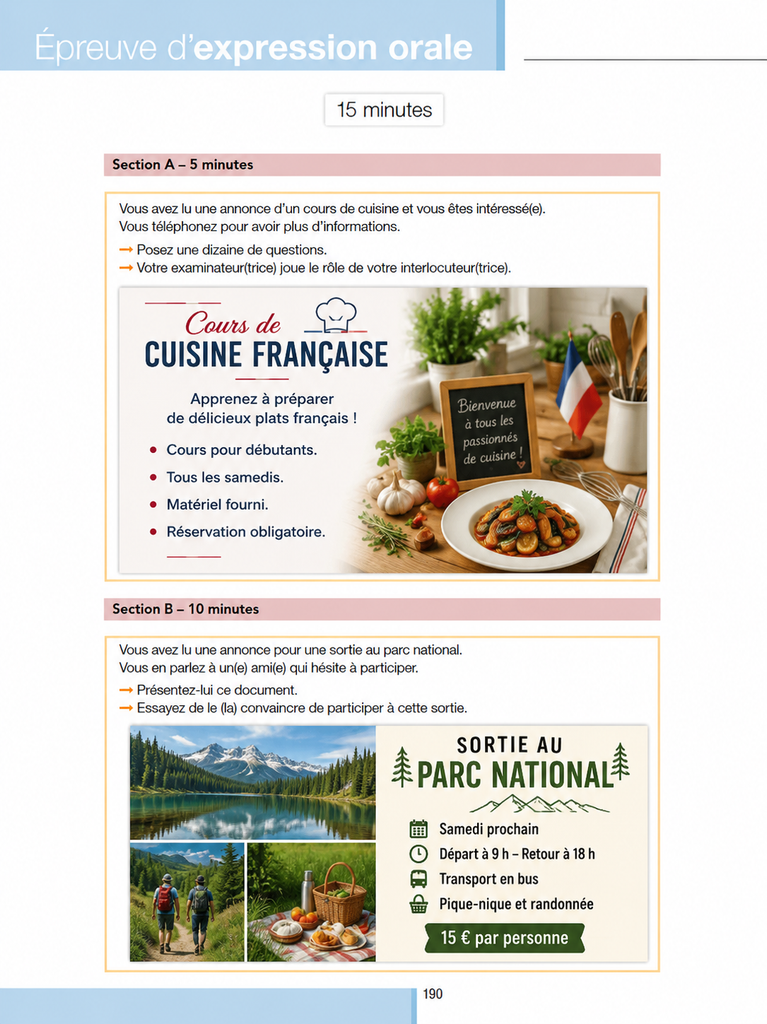
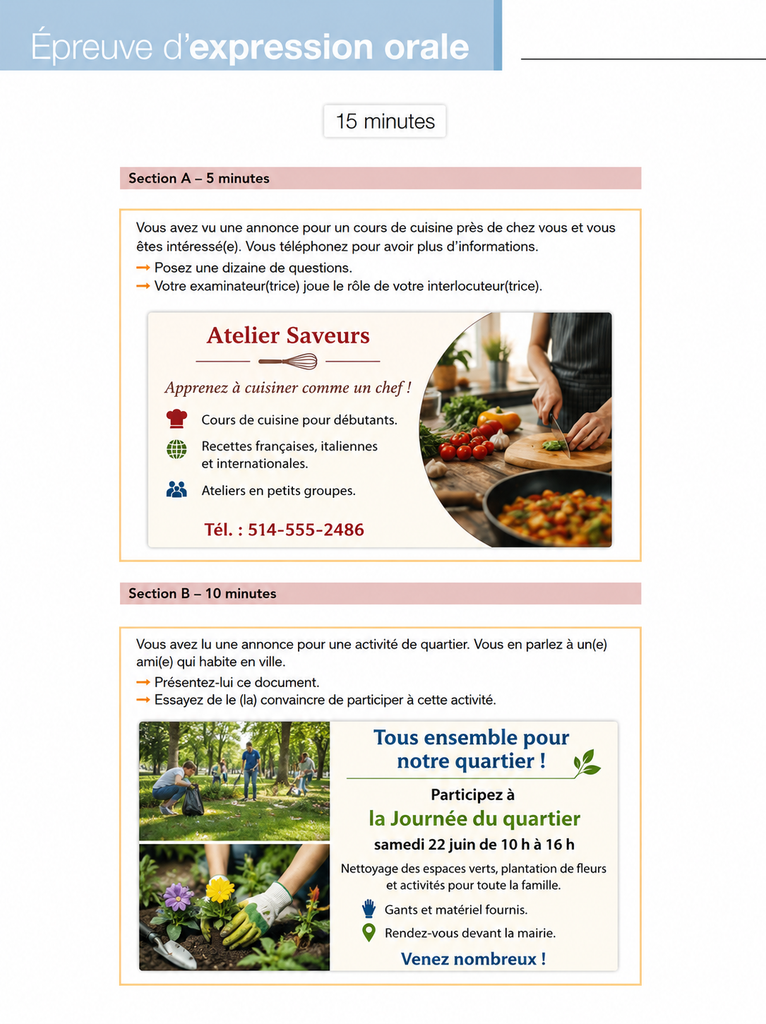
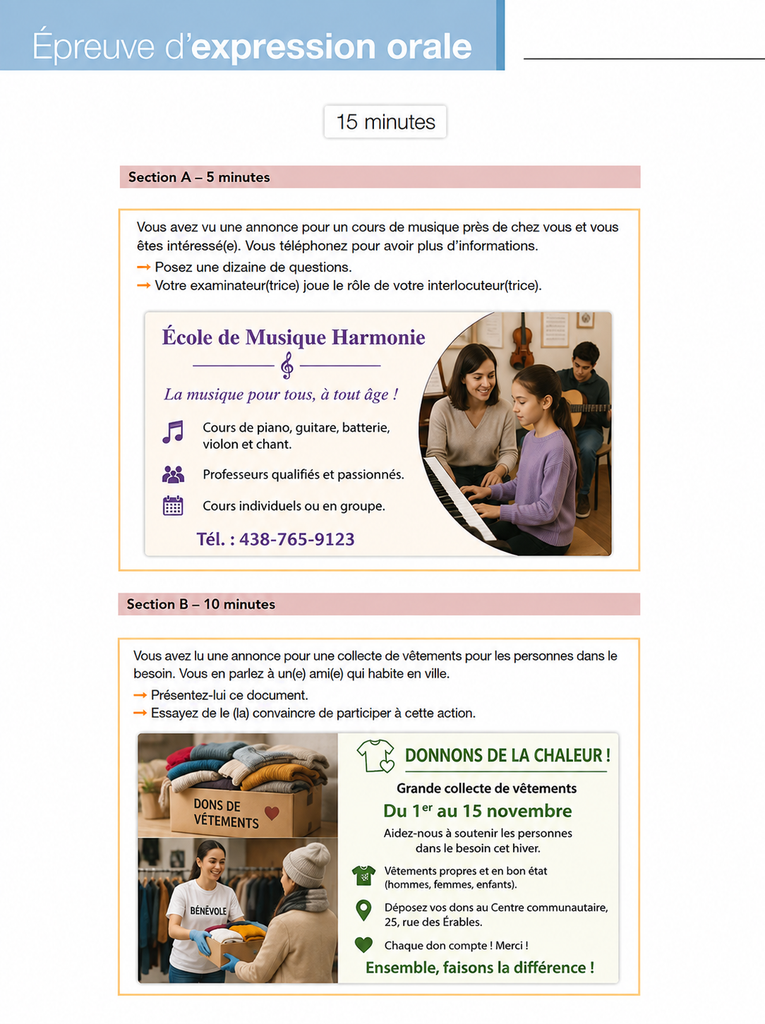
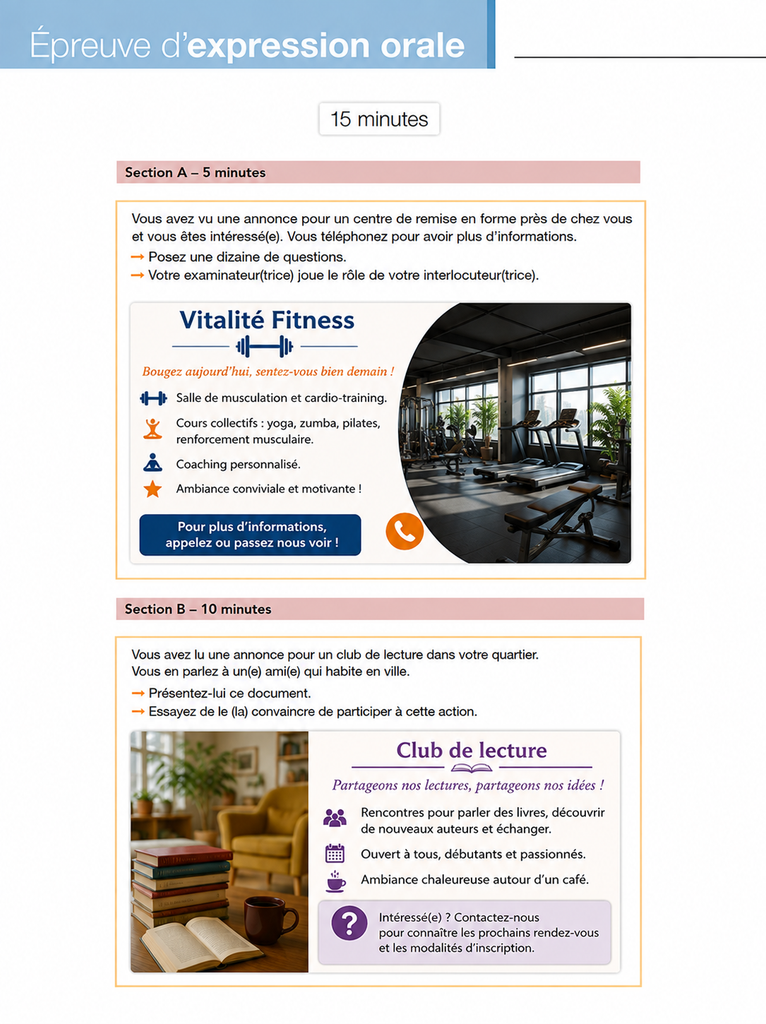
The TEF Expression Orale has two sections.
SECTION A – 5 minutes
You see an advertisement.
You are interested in it.
You call the person or company to get more information.
Your job:
ASK QUESTIONS
Think:
WHERE?
WHEN?
HOW MUCH?
WHAT?
HOW?
WHO?
SECTION B – 10 minutes
You see an advertisement.
You present it to a friend.
Your friend is not necessarily interested.
Your job is to:
CONVINCE YOUR FRIEND
Think:
WHAT? → OPINION → REASONS → OBJECTION → RESPONSE
So remember:
Section A = I WANT INFORMATION → I ASK QUESTIONS.
Section B = I WANT YOU TO PARTICIPATE → I GIVE REASONS AND CONVINCE YOU.
Don’t worry about memorizing everything today. We will build these skills step by step.
2. SECTION A – How to ask questions
Imagine that you see this advertisement:
Journée de la ville propre
Dimanche 15 mai
9 h – 17 h
Sacs et gants fournis
You are interested, so you call.
But look at the advertisement carefully.
What information do we already have?
We know:
- the activity is on Sunday;
- it is on May 15;
- it is from 9 a.m. to 5 p.m.;
- bags and gloves are provided.
But…
What DON’T we know?
Maybe:
Where is it?
How much does it cost?
Do I need to register?
Can children participate?
How can I get there?
These are the things we need to ask.
So our first important skill is:
Advertisement → Missing information → Question
3. Your question Toolbox
You don’t need to invent a new question every time.
We are going to use question categories.
1. WHERE?
Où se trouve… ?
Where is…?
Quelle est l’adresse ?
What is the address?
2. WHEN?
Quand est-ce que… ?
When…?
À quelle heure… ?
At what time…?
3. HOW MUCH?
Combien ça coûte ?
How much does it cost?
Quel est le prix ?
What is the price?
4. WHAT?
Quelles activités proposez-vous ?
What activities do you offer?
Qu’est-ce qu’on peut faire ?
What can we do?
5. HOW?
Comment est-ce que je peux venir ?
How can I get there?
Comment est-ce que je peux réserver ?
How can I make a reservation?
6. WHO?
Qui peut participer ?
Who can participate?
Est-ce que les enfants peuvent participer ?
Can children participate?
4. Your six question boxes
When you see an advertisement, think about these six questions:
| WHERE? | WHEN? | HOW MUCH? |
|---|---|---|
| Où ? | Quand ? | Combien ? |
| WHAT? | HOW? | WHO? |
|---|---|---|
| Quoi ? | Comment ? | Qui ? |
If you can think about these six categories, you will never have to think:
“Oh no! I don’t know what question to ask!”
You simply look at your six categories.
5. Don’t just ask question after question
This is very important.
The TEF oral is a conversation.
You don’t want to sound like this:
Question 1.
Answer.
Question 2.
Answer.
Question 3.
Answer.
Instead, we want:
ASK → LISTEN → REACT → ASK AGAIN
For example:
You:
Est-ce qu’il faut réserver ?
Examiner:
Oui, il faut réserver pour les ateliers.
Now don’t immediately ask a completely different question.
React first:
D’accord !
Then continue:
Et comment est-ce que je peux réserver ?
The examiner answers:
Vous pouvez réserver par téléphone.
You react:
Très bien.
And continue:
Et combien de temps à l’avance faut-il réserver ?
That is a real conversation.
6. Five expressions you should know
When the examiner answers, you can use:
D’accord.
Ah, d’accord.
Très bien.
Je comprends.
Je vois.
And then one of your most useful expressions:
Et… ?
For example:
Combien coûte l’activité ?
20 euros.
D’accord. Et est-ce que les enfants paient aussi ?
Very simple.
But this helps you keep the conversation going.
7. Your section A question bank
You can use this as your A2 survival sheet.
PLACE
Où se trouve… ?
Quelle est l’adresse ?
TIME
Quand est-ce que… ?
À quelle heure… ?
PRICE
Combien ça coûte ?
Quel est le prix ?
ACTIVITY
Quelles activités proposez-vous ?
Qu’est-ce qu’on peut faire ?
RESERVATION
Est-ce qu’il faut réserver ?
Comment est-ce que je peux réserver ?
PEOPLE
Est-ce que les enfants peuvent participer ?
TRANSPORT
Est-ce qu’il y a un parking ?
Comment est-ce que je peux venir ?
CONDITIONS
Est-ce qu’il faut apporter quelque chose ?
8. SECTION B – Now we change our Goal
Section B is different.
You are no longer asking:
“What information can I get?”
Now you are asking:
“How can I make my friend want to participate?”
Imagine your friend says:
Non, je ne veux pas.
Your job is not to stop.
Your job is to respond.
So remember:
FRIEND SAYS NO → YOU KEEP TRYING
9. Your Section B Five-step Plan
We are going to build your answer step by step.
STEP 1 – WHAT IS IT?
Start with:
J’ai trouvé une activité intéressante.
or:
Regarde cette annonce !
Then:
C’est la Journée de la ville propre.
STEP 2 – WHEN / WHERE?
Give the important information.
Ça aura lieu dimanche 15 mai, de 9 h à 17 h.
STEP 3 – WHAT DO YOU THINK?
Give your opinion.
Je pense que c’est une bonne idée.
or:
À mon avis, c’est très utile.
STEP 4 – WHY?
Now give reasons.
D’abord, c’est utile pour notre ville.
En plus, c’est bon pour l’environnement.
Et nous pouvons y aller ensemble.
STEP 5 – YOUR FRIEND SAYS NO
Your friend might say:
Je n’ai pas le temps.
You answer:
Je comprends, mais tu peux venir seulement quelques heures.
And you continue.
10. Don’t just say “Come with me!”
When you want to convince someone, you need to explain WHY.
Instead of:
Viens avec moi !
Say:
Je pense que c’est une bonne idée parce que c’est utile.
Then add another reason:
En plus, nous pouvons y aller ensemble.
Then another:
Et ça ne coûte pas cher.
Now you are actually convincing someone.
11. Your universal reasons
You don’t need a new argument for every topic.
We are going to build a bank of reasons that you can reuse.
You can say:
C’est intéressant.
C’est utile.
C’est facile.
C’est bon pour la santé.
C’est bon pour l’environnement.
On peut le faire ensemble.
On peut apprendre quelque chose.
On peut rencontrer de nouvelles personnes.
Ça ne coûte pas cher.
C’est gratuit.
These reasons can work for many different TEF topics.
12. Build your sentences
Don’t memorize a complete speech.
Instead, learn how to build a sentence.
Start with:
OPINION
Je pense que c’est une bonne idée.
Now ask:
WHY?
Parce que c’est utile.
Put them together:
Je pense que c’est une bonne idée parce que c’est utile.
Now add another argument:
En plus, nous pouvons y aller ensemble.
Now another:
Et ça ne coûte pas cher.
Look what happened:
Small blocks:
Je pense que…
parce que…
En plus…
Et…
↓
Complete response:
Je pense que c’est une bonne idée parce que c’est utile. En plus, nous pouvons y aller ensemble. Et ça ne coûte pas cher.
You are building, not memorizing.
13. Now let’s learn objections
Your friend can give you different reasons for saying no.
Your friend might say:
Je n’ai pas le temps.
I don’t have time.
C’est trop cher.
It’s too expensive.
Je n’aime pas ça.
I don’t like it.
Je suis fatigué(e).
I’m tired.
Je préfère rester chez moi.
I prefer to stay home.
C’est trop loin.
It’s too far.
Je ne connais personne.
I don’t know anyone.
Ça ne m’intéresse pas.
I’m not interested.
Now we need a strategy for answering.
14. The A2 Formula: JE COMPRENDS, MAIS…
This is one of the most useful structures for Section B.
Remember:
ACKNOWLEDGE → BUT → SOLUTION
1. Acknowledge
Je comprends.
2. But
Mais…
3. Give a solution
Tu peux…
Example 1
Friend:
Je n’ai pas le temps.
You:
Je comprends, mais tu peux venir seulement deux heures.
Example 2
Friend:
C’est trop cher.
You:
Je comprends, mais c’est seulement 10 euros.
Example 3
Friend:
C’est trop loin.
You:
Je comprends, mais on peut y aller en voiture ensemble.
Example 4
Friend:
Je n’aime pas cette activité.
You:
Je comprends, mais on peut essayer. Ça peut être intéressant.
This gives you a simple formula you can use again and again.
15. Connect your ideas
Once you are comfortable with your basic sentences, we will make your speech more organized.
Start with just four connectors:
D’abord = First
Ensuite = Next
En plus = In addition
Enfin = Finally
And three very useful words:
Parce que = Because
Mais = But
Donc = So
For example:
D’abord, c’est utile pour notre ville.
Ensuite, c’est bon pour l’environnement.
En plus, nous pouvons y aller ensemble.
Enfin, c’est une bonne occasion de rencontrer des personnes.
You don’t need complicated C1/C2 connectors.
Simple + correct + connected = good.
16. Now we put everything Together
Let’s take our Journée de la ville propre example.
BLOCK 1 – Introduce
Regarde cette annonce !
BLOCK 2 – What?
C’est la Journée de la ville propre.
BLOCK 3 – When?
Ça aura lieu dimanche 15 mai, de 9 h à 17 h.
BLOCK 4 – What happens?
Nous allons nettoyer les rues et ramasser les déchets.
BLOCK 5 – Opinion
Je pense que c’est une bonne idée.
BLOCK 6 – Reason
D’abord, c’est utile pour notre ville.
BLOCK 7 – Another reason
En plus, c’est bon pour l’environnement.
BLOCK 8 – Personal reason
Et nous pouvons y aller ensemble.
BLOCK 9 – Objection
Your friend:
Je n’ai pas le temps.
BLOCK 10 – Response
Je comprends, mais tu peux venir seulement quelques heures.
BLOCK 11 – Conclusion
Alors, tu viens avec moi ?
That’s it.
You have just built a complete interaction from small language blocks.
17. How we are going to practice
We are not going to start with a full 5-minute or 10-minute TEF task.
That would be too much.
We will build your confidence gradually.
SECTION A
Round 1
Ask 3 questions.
Round 2
Ask 5 questions.
Round 3
Ask 8 questions.
Round 4
Ask 10 questions.
Finally
Do a complete 5-minute Section A simulation.
18. Then we move to Section B
First, we learn:
Lesson 1
Give an opinion
Je pense que…
Je trouve que…
À mon avis…
Lesson 2
Give reasons
parce que…
En plus…
D’abord…
Ensuite…
Lesson 3
Answer objections
Je comprends, mais…
Tu peux…
On peut…
Lesson 4
Put everything together
PRESENT → OPINION → REASONS → OBJECTION → RESPONSE → CONCLUSION
Finally, we do the complete 10-minute Section B simulation.
19. Don’t memorize a perfect speech
This is very important.
You might be tempted to memorize one beautiful answer.
Don’t.
Why?
Because the advertisement will change.
Today it might be:
a farm.
Tomorrow:
a sports club.
Next week:
a concert.
Another day:
a language course.
The topic changes, but the communication functions stay the same.
So instead of memorizing:
“My perfect answer about the farm…”
you memorize:
Où se trouve… ?
Combien ça coûte ?
Est-ce qu’il faut réserver ?
Je pense que c’est une bonne idée.
Parce que…
En plus…
Je comprends, mais…
These expressions can be used with many different advertisements.
20. What I want you to Learn
By the end of our preparation, I don’t want you to think:
“I have to memorize a 5-minute speech.”
I want you to think:
SECTION A
I see an advertisement.
↓
What information is missing?
↓
I ask a question.
↓
I listen.
↓
I react.
↓
I ask another question.
SECTION B
I see an advertisement.
↓
What is it?
↓
What do I think?
↓
Why is it good?
↓
My friend says NO.
↓
Je comprends, mais…
↓
I give another reason or solution.
↓
I try again.
21. Your final A2 Speaking map
SECTION A = ASK
START
Bonjour, je vous appelle au sujet de…
ASK
Où ?
Quand ?
À quelle heure ?
Combien ?
Comment ?
Quoi ?
Qui ?
REACT
D’accord.
Très bien.
Je vois.
CONTINUE
Et… ?
Et concernant… ?
Et pour… ?
Remember:
ASK → LISTEN → REACT → ASK AGAIN
SECTION B = CONVINCE
START
Regarde cette annonce !
PRESENT
Il s’agit de…
Ça aura lieu…
OPINION
Je pense que c’est une bonne idée.
REASONS
D’abord…
Ensuite…
En plus…
Enfin…
Parce que…
OBJECTION
Je n’ai pas le temps.
RESPONSE
Je comprends, mais…
Tu peux…
On peut…
FINISH
Alors, tu viens avec moi ?
Remember:
PRESENT → OPINION → REASONS → OBJECTION → RESPONSE → CONVINCE
The most Important thing I want you to Remember
You do not need complicated French to communicate well at A2.
You need to be able to:
ask, listen, react, explain, give reasons and respond.
So don’t try to speak like a C1 student.
Don’t try to memorize huge paragraphs.
Instead, learn small, reusable French blocks and learn how to put those blocks together.
Our goal is:
From small sentences → to connected ideas → to real conversation → to a complete TEF performance.
And remember:
Section A: I am CURIOUS. I ask questions.
Section B: I am CONVINCING. I give reasons and respond.
Now that we understand the two sections, let’s practise one skill at a time: