Introduction
In the previous lesson, you learned how to turn a statement into a question.
You learned:
Tu travailles ici ?
Est-ce que tu travailles ici ?
Travailles-tu ici ?
These questions are useful when you want to know whether something is true.
But very often, you need specific information.
For example, you don’t simply want to know whether someone works.
You want to know:
Où travailles-tu ?
Where do you work?
Or:
Quand travailles-tu ?
When do you work?
Or:
Pourquoi travailles-tu ici ?
Why do you work here?
Or:
Avec qui travailles-tu ?
Who do you work with?
This is the next important step in sentence building.
You are going to learn how to build questions that ask for a specific piece of information.
The source course develops precise questions through interrogative words and structures such as qui est-ce qui, qui est-ce que, qu'est-ce qui, qu'est-ce que, and quel.
1. The main question Words
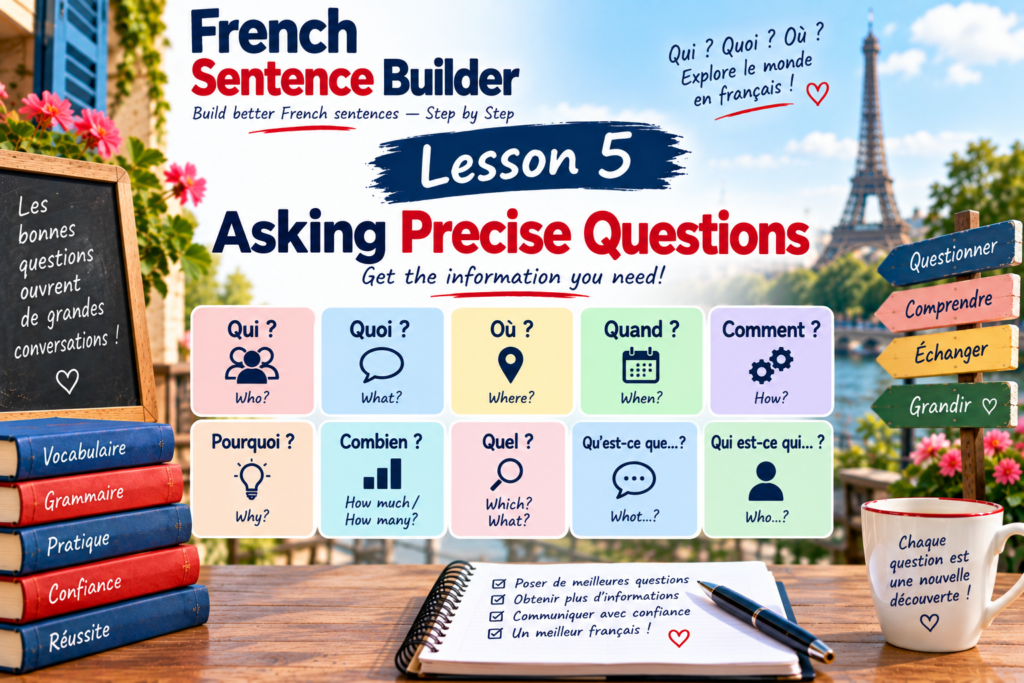
Here are the question words you need to know.
| French | English |
|---|---|
qui | who |
que / qu' | what |
quoi | what |
où | where |
quand | when |
comment | how |
pourquoi | why |
combien | how much / how many |
quel | which / what |
quelle | which / what |
quels | which / what |
quelles | which / what |
Don’t try to memorize them as isolated vocabulary.
Think of them as question-building blocks.
2. Qui ? — Who?
Use:
qui
when you want information about a person.
For example:
Qui est-ce ?
Who is it?
Qui travaille ici ?
Who works here?
Qui vient demain ?
Who is coming tomorrow?
Qui habite à Paris ?
Who lives in Paris?
Notice that qui can actually be the subject of the verb.
Qui travaille ici ?
The unknown person is doing the action.
3. Qui as the Object
Now compare:
Qui appelle Marie ?
This can mean:
Who is calling Marie?
Here, qui is the subject.
But:
Qui Marie appelle-t-elle ?
Who is Marie calling?
Now Marie is the subject, and qui represents the person receiving the action.
You can also use a simpler structure:
Qui est-ce que Marie appelle ?
Who is Marie calling?
This distinction is extremely important.
4. The most important Question: Who is Doing the Action?
When you see qui, ask yourself:
Is the unknown person doing the action?
If yes, qui is the subject.
Example
Qui travaille ici ?
Who works here?
The unknown person is doing the action:
Qui → travaille
So:
Qui + verbe
5. Who is Receiving the Action?
Now ask:
Is someone else doing the action?
For example:
Marie appelle Paul.
Who does Marie call?
The answer is:
Paul.
Paul receives the action.
So we can ask:
Qui est-ce que Marie appelle ?
Who does Marie call?
The structure is:
Qui est-ce que + subject + verb ?
Here:
qui = object
Marie = subject
appelle = verb
6. Qui est-ce qui...?
This structure is used when who is the subject.
The formula is:
Qui est-ce qui + verbe ?
Examples:
Qui est-ce qui vient demain ?
Who is coming tomorrow?
Qui est-ce qui parle français ?
Who speaks French?
Qui est-ce qui travaille ici ?
Who works here?
Qui est-ce qui a appelé ?
Who called?
Think:
WHO → does the action
Therefore:
Qui est-ce qui + verb
7. Qui est-ce que...?
Now we have the opposite structure.
Use:
Qui est-ce que + subject + verb ?
when you are asking about the person receiving the action.
For example:
Qui est-ce que tu invites ?
Who are you inviting?
Here:
tu = subject
invites = verb
qui = object
Another example:
Qui est-ce que vous cherchez ?
Who are you looking for?
Another:
Qui est-ce qu’elle appelle ?
Who is she calling?
Notice the elision:
que + elle → qu’elle
8. Compare Qui est-ce qui and Qui est-ce que
This is one of the most important distinctions in this lesson.
The unknown person does the action
Qui est-ce qui travaille ici ?
Who works here?
The unknown person receives the action
Qui est-ce que tu appelles ?
Who are you calling?
Use this simple question:
Who is doing the verb?
If the answer is the unknown person, use:
qui est-ce qui
If someone else is doing the verb, use:
qui est-ce que
9. A simple memory Trick
Look at the word immediately after the structure.
Qui est-ce qui
Usually:
qui + est-ce qui + VERB
Example:
Qui est-ce qui vient ?
Qui est-ce qui travaille ?
Qui est-ce qui parle ?
Qui est-ce que
Usually:
qui + est-ce que + SUBJECT + VERB
Example:
Qui est-ce que tu invites ?
Qui est-ce que Marie appelle ?
Qui est-ce que vous cherchez ?
So:
QUI EST-CE QUI → VERB
QUI EST-CE QUE → SUBJECT + VERB
10. Que and Quoi — What?
Now let’s talk about “what”.
French has several structures for asking “what”.
The most important ones are:
que
qu'est-ce que
qu'est-ce qui
quoi
Each one has a different position and function.
11. Qu'est-ce que...?
Use:
Qu’est-ce que + subject + verb ?
when what is the object of the verb.
For example:
Qu’est-ce que tu fais ?
What are you doing?
Break it down:
qu’est-ce que → what
tu → subject
fais → verb
Another:
Qu’est-ce que vous regardez ?
What are you watching?
Another:
Qu’est-ce qu’elle mange ?
What is she eating?
Another:
Qu’est-ce que tu veux ?
What do you want?
12. Qu'est-ce qui...?
Now suppose “what” is the subject.
Use:
Qu’est-ce qui + verb ?
Examples:
Qu’est-ce qui se passe ?
What is happening?
Qu’est-ce qui arrive ?
What is happening / arriving?
Qu’est-ce qui tombe ?
What is falling?
Qu’est-ce qui fonctionne ?
What is working?
The structure is:
Qu’est-ce qui + verb
Just like:
Qui est-ce qui + verb
13. Compare the Two
This distinction is essential.
Qu'est-ce qui
“What” is doing the action.
Qu’est-ce qui tombe ?
What is falling?
Qu'est-ce que
“What” receives the action.
Qu’est-ce que tu regardes ?
What are you watching?
Here:
tu = subject
regardes = verb
qu’est-ce que = object
14. The easy Test
Whenever you are unsure, look at the verb.
Ask:
Who or what is doing the action?
If the unknown thing is doing the action:
Qu’est-ce qui + verb
If someone else is doing the action:
Qu’est-ce que + subject + verb
Example
___ est arrivé ?
What happened?
The unknown thing is the subject.
Qu’est-ce qui est arrivé ?
Example
___ tu as acheté ?
What did you buy?
tu is doing the action.
Qu’est-ce que tu as acheté ?
15. Que at the Beginning of a Question
You can sometimes see:
Que fais-tu ?
What are you doing?
Que regardez-vous ?
What are you watching?
Que veux-tu ?
What do you want?
This is a more compact/formal question structure.
For everyday French, you will frequently hear:
Qu’est-ce que tu fais ?
Qu’est-ce que tu regardes ?
Qu’est-ce que tu veux ?
Both structures are useful.
16. Quoi — What?
Quoi is also used for “what”, but its position is different.
For example:
Tu fais quoi ?
What are you doing?
This is very common in spoken French.
You can also say:
Tu parles de quoi ?
What are you talking about?
Tu as besoin de quoi ?
What do you need?
Tu penses à quoi ?
What are you thinking about?
The important thing is that quoi is often used after a preposition or toward the end of a spoken question.
17. Compare Que and Quoi
More formal / structured
Que fais-tu ?
Neutral and very common
Qu’est-ce que tu fais ?
Common spoken French
Tu fais quoi ?
They can all ask:
What are you doing?
The structure changes, but the basic meaning remains.
18. Où ? — Where?
Use:
où
when you want information about a place.
Examples:
Où habites-tu ?
Where do you live?
Où est-ce que tu habites ?
Where do you live?
Où vas-tu ?
Where are you going?
Où est-ce que vous allez ?
Where are you going?
Où travaille-t-elle ?
Where does she work?
You can combine où with est-ce que:
Où est-ce que + subject + verb ?
19. Quand ? — When?
Use:
quand
to ask about time.
Examples:
Quand arrives-tu ?
When are you arriving?
Quand est-ce que tu arrives ?
When are you arriving?
Quand commence le cours ?
When does the class start?
Quand est-ce que vous partez ?
When are you leaving?
The structure is:
Quand + question structure
20. Comment ? — How?
Use:
comment
to ask about manner or method.
Examples:
Comment vas-tu ?
How are you?
Comment est-ce que tu apprends le français ?
How do you learn French?
Comment faites-vous cela ?
How do you do that?
Comment est-ce qu’elle vient au travail ?
How does she come to work?
You can use comment with:
intonation
est-ce que
inversion
21. Pourquoi ? — Why?
Use:
pourquoi
to ask for a reason.
Examples:
Pourquoi travailles-tu ici ?
Why do you work here?
Pourquoi est-ce que tu apprends le français ?
Why are you learning French?
Pourquoi part-il demain ?
Why is he leaving tomorrow?
A very common answer is:
Parce que…
For example:
Pourquoi apprends-tu le français ?
Parce que je veux travailler au Canada.
This creates an important connection:
Pourquoi ? → Parce que…
22. Combien ? — How Much / How Many?
Use:
combien
to ask about quantity.
How much?
Combien ça coûte ?
How much does it cost?
How many?
Combien de frères as-tu ?
How many brothers do you have?
Notice:
combien de + noun
Examples:
Combien de personnes viennent ?
How many people are coming?
Combien de langues parles-tu ?
How many languages do you speak?
Combien de temps travailles-tu ?
How much time do you work?
23. Quel — Which / What?
Quel is different because it agrees with the noun.
You have four forms:
| Masculine | Feminine |
|---|---|
quel | quelle |
quels | quelles |
Masculine singular
Quel film ?
Which film?
Feminine singular
Quelle voiture ?
Which car?
Masculine plural
Quels livres ?
Which books?
Feminine plural
Quelles langues ?
Which languages?
24. Quel + Noun
Quel must agree with the noun it describes.
Example
Quel travail ?
travail is masculine singular.
Therefore:
quel
Example
Quelle ville ?
ville is feminine singular.
Therefore:
quelle
Example
Quels pays ?
pays is masculine plural.
Therefore:
quels
Example
Quelles activités ?
activités is feminine plural.
Therefore:
quelles
25. Building questions with Quel
You can combine quel with different question structures.
Intonation
Tu préfères quel film ?
Est-ce que
Quel film est-ce que tu préfères ?
Inversion
Quel film préfères-tu ?
All three can work, although the second and third are more structured.
More examples:
Quelle langue est-ce que tu parles ?
Quel sport pratiques-tu ?
Quels pays avez-vous visités ?
Quelles activités aimez-vous ?
26. Question words + Est-ce que
You can build a very useful formula:
Question word + est-ce que + subject + verb
Examples:
Où est-ce que tu habites ?
Quand est-ce que tu travailles ?
Pourquoi est-ce que tu apprends le français ?
Comment est-ce que vous allez au travail ?
Combien de personnes est-ce que vous invitez ?
Quel film est-ce que tu regardes ?
This is a very practical structure.
27. Question words + Inversion
You can also combine question words with inversion.
Où
Où habites-tu ?
Quand
Quand arrives-tu ?
Pourquoi
Pourquoi travailles-tu ici ?
Comment
Comment vas-tu au travail ?
Quel
Quel livre lis-tu ?
This structure is concise and often more formal.
28. Question words + Intonation
In everyday spoken French, you can also use the question word with normal sentence order.
Examples:
Tu habites où ?
Tu travailles quand ?
Tu vas où ?
Tu fais quoi ?
Tu pars pourquoi ?
This is common in conversation.
However, when you are learning French and especially when you are writing, I want you to become comfortable with the more structured forms as well.
29. Three Ways to ask for the same Information
Let’s use:
You live in Paris.
Where do you live?
Intonation:
Tu habites où ?
Est-ce que:
Où est-ce que tu habites ?
Inversion:
Où habites-tu ?
Again, the three structures are not three different questions in meaning.
They are three different ways of constructing the question.
30. A question-building Map
When you want to ask a precise question, use this process.
Step 1 — Identify the information you need
Person?
qui
Thing?
que / quoi
Place?
où
Time?
quand
Method?
comment
Reason?
pourquoi
Quantity?
combien
Choice?
quel / quelle / quels / quelles
Step 2 — Build the basic sentence
For example:
Tu habites à Paris.
Step 3 — Replace the information you don’t know
Où…
Step 4 — Choose your question structure
Où est-ce que tu habites ?
31. The most important Distinction of this Lesson
I want you to become extremely comfortable with these four structures:
Person = subject
Qui est-ce qui + verbe ?
Qui est-ce qui vient ?
Person = object
Qui est-ce que + subject + verb ?
Qui est-ce que tu invites ?
Thing = subject
Qu’est-ce qui + verbe ?
Qu’est-ce qui se passe ?
Thing = object
Qu’est-ce que + subject + verb ?
Qu’est-ce que tu fais ?
If you understand these four structures, you have mastered one of the most important parts of French question formation.
32. Common mistakes
Mistake 1
Qui est-ce que vient ? ❌
If “who” is doing the action, use:
Qui est-ce qui vient ? ✓
Mistake 2
Qui est-ce qui tu invites ? ❌
Here tu is the subject.
Therefore:
Qui est-ce que tu invites ? ✓
Mistake 3
Qu’est-ce qui tu fais ? ❌
Here tu is doing the action.
Correct:
Qu’est-ce que tu fais ? ✓
Mistake 4
Qu’est-ce que se passe ? ❌
“What” is the subject of se passe.
Correct:
Qu’est-ce qui se passe ? ✓
Mistake 5
Quel ville ? ❌
ville is feminine.
Correct:
Quelle ville ? ✓
Mistake 6
Quels langue ? ❌
langue is feminine singular.
Correct:
Quelle langue ? ✓
33. Practice — Choose the Correct question Word
Choose from:
qui / où / quand / comment / pourquoi / combien / quel
1.
______ habites-tu ?
2.
______ travaille ici ?
3.
______ pars-tu demain ?
4.
______ apprends-tu le français ?
5.
______ vas-tu au travail ?
6.
______ de personnes viennent ?
7.
______ film regardes-tu ?
34. Practice — Qui est-ce qui or Qui est-ce que?
Choose the correct structure.
1.
______ vient demain ?
2.
______ tu invites ?
3.
______ travaille ici ?
4.
______ Marie appelle ?
5.
______ parle français ?
6.
______ vous cherchez ?
Ask yourself:
Who is doing the action?
before answering.
35. Practice — Qu'est-ce qui or Qu'est-ce que?
1.
______ se passe ?
2.
______ tu fais ?
3.
______ arrive ?
4.
______ vous cherchez ?
5.
______ fonctionne ?
6.
______ elle regarde ?
Again, use the same test:
Is “what” doing the action?
36. Practice — build the Question
Use the information in parentheses.
Example
Tu habites à Paris.
(place)
Question:
Où est-ce que tu habites ?
Now try:
1.
Tu travailles le lundi.
(time)
2.
Tu apprends le français parce que tu veux travailler au Canada.
(reason)
3.
Tu vas au travail en bus.
(method)
4.
Tu invites Marie.
(person)
5.
Tu regardes un film.
(thing)
6.
Tu as trois frères.
(quantity)
37. Mini communication Challenge
Imagine that you meet someone for the first time.
Instead of asking only:
Tu travailles ?
I want you to ask more precise questions.
For example:
Où travailles-tu ?
Quel est ton travail ?
Quand travailles-tu ?
Comment vas-tu au travail ?
Pourquoi apprends-tu le français ?
Combien de langues parles-tu ?
Now you are having a much more useful conversation.
38. Final sentence builder Summary
When you need information, choose the correct building block.
WHO? → qui
WHAT? → que / quoi
WHERE? → où
WHEN? → quand
HOW? → comment
WHY? → pourquoi
HOW MUCH / HOW MANY? → combien
WHICH / WHAT + NOUN? → quel / quelle / quels / quelles
Then choose your question structure.
Everyday spoken
Tu habites où ?
Neutral
Où est-ce que tu habites ?
Formal / structured
Où habites-tu ?
39. The Four structures you must Remember
Qui est-ce qui + verbe ?
Qui est-ce qui travaille ici ?
Qui est-ce que + sujet + verbe ?
Qui est-ce que tu invites ?
Qu’est-ce qui + verbe ?
Qu’est-ce qui se passe ?
Qu’est-ce que + sujet + verbe ?
Qu’est-ce que tu fais ?
These four structures will help you build a huge number of French questions.
What you can do Now
After this lesson, you should be able to:
- ask who;
- ask what;
- ask where;
- ask when;
- ask how;
- ask why;
- ask how much/how many;
- use
quel,quelle,quels, andquelles; - distinguish subject and object questions;
- use
qui est-ce qui; - use
qui est-ce que; - use
qu'est-ce qui; - use
qu'est-ce que; - use question words with
est-ce que; - use question words with inversion;
- use question words naturally in conversation;
- build precise questions instead of relying only on yes/no questions.
Next Lesson
Lesson 6 — Exclamatory Sentences
Now that you can state information, make negative sentences, and ask precise questions, we will add another important type of French sentence:
Quelle belle journée !
Comme c’est intéressant !
C’est incroyable !
You will learn how to use French to express surprise, happiness, anger, fear, admiration, pain, excitement, and other strong emotions.