
Introduction
You already know how to build affirmative and negative sentences.
For example:
Tu travailles à Paris.
You also know how to make it negative:
Tu ne travailles pas à Paris.
Now I want you to learn how to ask questions.
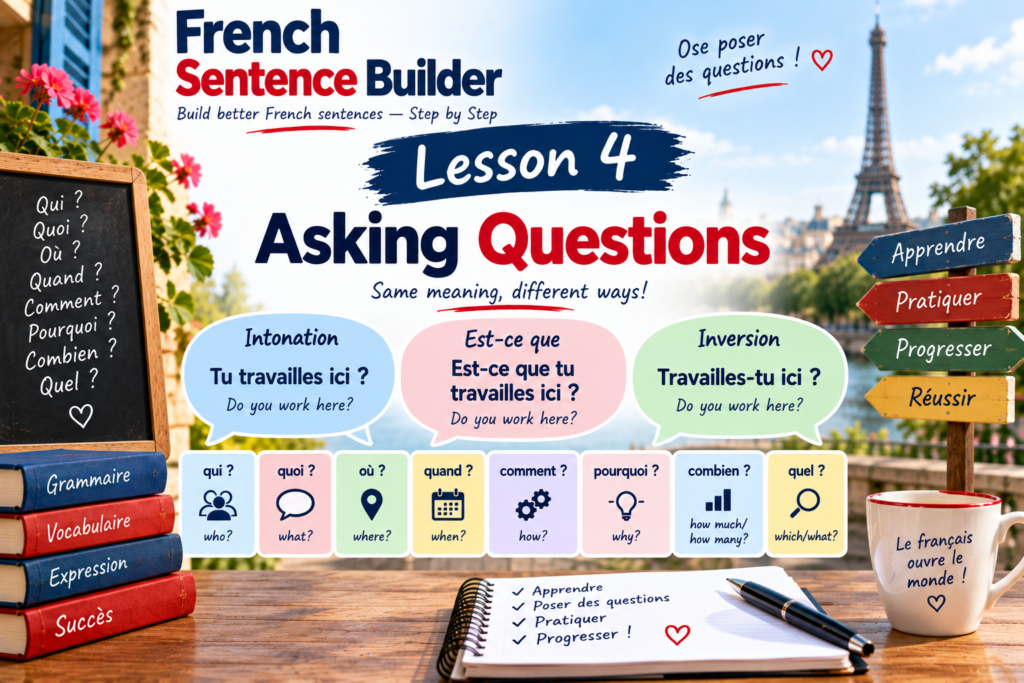
In French, there is more than one way to ask the same question. The meaning can stay the same, but the structure and level of formality can change.
For example:
Tu travailles ici ?
Est-ce que tu travailles ici ?
Travailles-tu ici ?
All three mean:
Do you work here?
The first two are especially useful in everyday communication. The third is more formal and is common in writing and formal speech.
The source course introduces question formation through intonation, est-ce que, and inversion, before moving to more precise question structures.
In this lesson, you will learn:
- how to ask questions with intonation;
- how to use
est-ce que; - how to use inversion;
- how to form questions with
être; - how to form questions with other verbs;
- how to handle
-erverbs; - why
-t-sometimes appears in inversion; - how to ask negative questions;
- when each structure is appropriate;
- common mistakes;
- how to transform statements into questions.
1. Start with a Statement
Let’s begin with a simple sentence:
Tu travailles ici.
You work here.
This is a statement.
To turn it into a question, French gives you several options.
Option 1 — Intonation
Tu travailles ici ?
Your voice rises at the end.
Option 2 — Est-ce que
Est-ce que tu travailles ici ?
Option 3 — Inversion
Travailles-tu ici ?
The meaning is essentially the same.
The important difference is how the question is formed and how formal it sounds.
2. Method 1 — Intonation
The easiest way to ask a question in French is often simply to use your normal statement structure and raise your voice at the end.
Statement
Tu habites à Paris.
Question
Tu habites à Paris ?
You don’t need to change the word order.
This is extremely common in everyday spoken French.
More examples
Tu travailles demain ?
Elle vient ce soir ?
Vous aimez le français ?
Ils habitent à Londres ?
Tu as une voiture ?
The structure remains:
Subject + Verb + Rest ?
This makes intonation the easiest question structure to learn.
3. Why Intonation is Important
When you speak French naturally, you will hear many questions formed with intonation.
For example:
Tu es français ?
Tu es français.
The words are exactly the same.
The difference is the intonation and punctuation.
Statement
Tu es français.
Your voice normally falls.
Question
Tu es français ?
Your voice rises.
So don’t assume that every question requires est-ce que.
French speakers very often use intonation in everyday conversation.
4. Method 2 — Est-ce que
The second important structure is:
Est-ce que + statement structure
Take:
Tu travailles ici.
Add:
Est-ce que
at the beginning.
You get:
Est-ce que tu travailles ici ?
This is one of the safest question structures for you because you generally do not need to change the word order of the sentence.
5. The Est-ce que Formula
Remember:
Est-ce que + sujet + verbe + reste ?
For example:
Est-ce que tu travailles demain ?
Est-ce que vous habitez à Paris ?
Est-ce qu’elle parle français ?
Est-ce qu’ils viennent ce soir ?
Est-ce que nous avons assez de temps ?
Notice something important.
You build the statement first:
Tu travailles demain.
Then you put:
Est-ce que
in front.
Result:
Est-ce que tu travailles demain ?
This is a very useful sentence-building technique.
6. Est-ce que before a Vowel
You have already learned that French uses elision.
The same thing happens here.
Est-ce que becomes:
Est-ce qu’
before a vowel sound.
Example
Est-ce que tu travailles ici ?
But:
Est-ce qu’il travaille ici ?
Not:
Est-ce que il travaille ici. ❌
Correct:
Est-ce qu’il travaille ici ? ✓
More examples:
Est-ce qu’elle arrive demain ?
Est-ce qu’on peut entrer ?
Est-ce qu’il habite à Paris ?
Est-ce qu’ils aiment voyager ?
7. Why Est-ce que is Useful
I want you to become comfortable with est-ce que because it allows you to ask questions without changing the basic sentence structure.
Compare:
Statement
Vous travaillez à Londres.
Question
Est-ce que vous travaillez à Londres ?
You simply add:
Est-ce que
This makes it easier to form questions accurately when you are still developing your French.
8. Method 3 — Inversion
The third method is called inversion.
Here, you reverse the position of the subject pronoun and the verb.
Statement
Tu travailles ici.
Inversion
Travailles-tu ici ?
So the formula is:
Verb + subject pronoun + rest ?
Examples:
Parles-tu français ?
Habitez-vous à Paris ?
Aimez-vous le sport ?
Vient-il demain ?
Travaille-t-elle ici ?
Sommes-nous en retard ?
This structure is more formal than ordinary intonation.
You will encounter it particularly in formal writing, announcements, interviews, and formal situations.
9. Compare the Three structures
Let’s take the same idea.
Intonation
Tu habites à Paris ?
Est-ce que
Est-ce que tu habites à Paris ?
Inversion
Habites-tu à Paris ?
All three ask the same basic question.
But they have different styles.
| Structure | Example | General use |
|---|---|---|
| Intonation | Tu habites à Paris ? | Very common in conversation |
Est-ce que | Est-ce que tu habites à Paris ? | Very common and neutral |
| Inversion | Habites-tu à Paris ? | More formal |
For your everyday French, I want you to become especially comfortable with the first two.
10. Inversion with Vous
Inversion becomes particularly easy with vous.
Statement
Vous travaillez ici.
Question
Travaillez-vous ici ?
Another:
Vous aimez voyager.
becomes:
Aimez-vous voyager ?
Another:
Vous parlez français.
becomes:
Parlez-vous français ?
This is a very useful formal question structure.
11. Inversion with Il, Elle, and On
Look at:
Il travaille ici.
Inversion:
Travaille-t-il ici ?
For elle:
Elle travaille ici.
becomes:
Travaille-t-elle ici ?
For on:
On peut entrer.
becomes:
Peut-on entrer ?
The structure is:
Verb + subject pronoun
12. Why do we sometimes see -t-?
You may notice:
Travaille-t-il ?
There is a t between the verb and il.
This is called euphonie. It helps the pronunciation flow naturally when the verb ends in a vowel and the subject pronoun begins with a vowel.
For example:
Il travaille.
→
Travaille-t-il ?
Similarly:
Elle parle.
→
Parle-t-elle français ?
And:
On va.
→
Va-t-on au cinéma ?
You should not think of this t as a new verb ending.
It is simply inserted to make the pronunciation smoother.
13. Inversion with Être
Être is particularly straightforward.
Statement
Il est français.
Question
Est-il français ?
Statement
Elle est prête.
Question
Est-elle prête ?
Statement
Vous êtes professeur.
Question
Êtes-vous professeur ?
Statement
Ils sont prêts.
Question
Sont-ils prêts ?
Notice:
Est-il…?
not:
Il est…? ❌
when using inversion.
14. Questions with Avoir
Let’s use avoir.
Intonation
Tu as une voiture ?
Est-ce que
Est-ce que tu as une voiture ?
Inversion
As-tu une voiture ?
All three are correct.
More examples:
Vous avez du temps ?
Est-ce que vous avez du temps ?
Avez-vous du temps ?
And:
Il a un problème ?
Est-ce qu’il a un problème ?
A-t-il un problème ?
Notice:
A-t-il
The t is inserted between a and il.
15. Questions with Aller
Let’s use aller.
Statement
Tu vas au travail.
Intonation
Tu vas au travail ?
Est-ce que
Est-ce que tu vas au travail ?
Inversion
Vas-tu au travail ?
Another:
Elle va au cinéma.
→
Va-t-elle au cinéma ?
Another:
Vous allez à Paris.
→
Allez-vous à Paris ?
16. Questions with -ER Verbs
Let’s use parler.
Statement
Tu parles français.
Intonation
Tu parles français ?
Est-ce que
Est-ce que tu parles français ?
Inversion
Parles-tu français ?
Notice the s remains:
parles-tu
The verb is still:
tu parles
We are simply changing the order.
17. More Inversion examples
aimer
Tu aimes le sport.
→
Aimes-tu le sport ?
travailler
Vous travaillez demain.
→
Travaillez-vous demain ?
habiter
Elle habite à Lyon.
→
Habite-t-elle à Lyon ?
regarder
Il regarde la télévision.
→
Regarde-t-il la télévision ?
venir
Ils viennent demain.
→
Viennent-ils demain ?
18. Questions with a Noun Subject
This is where you need to be careful.
Inversion normally works with a subject pronoun:
Parles-tu français ?
Travaillez-vous ici ?
Vient-il demain ?
But if the subject is a noun, French does not normally simply invert the noun and verb in ordinary usage.
Instead, you can use:
Est-ce que + subject + verb
For example:
Marie travaille ici.
Question:
Est-ce que Marie travaille ici ?
Or use intonation:
Marie travaille ici ?
In more formal structures, you may encounter constructions with a noun followed by a pronoun:
Marie travaille-t-elle ici ?
This is called complex inversion.
For now, I want you to focus on the simpler structures.
19. The Three question builders
When you see a statement, you can use this three-step system.
Statement
Tu habites à Victoria.
Builder 1 — Intonation
Tu habites à Victoria ?
Builder 2 — Est-ce que
Est-ce que tu habites à Victoria ?
Builder 3 — Inversion
Habites-tu à Victoria ?
This is one of the most useful sentence-building patterns in French.
20. Negative questions
You can also make a negative question.
Start with:
Tu travailles demain.
Negative:
Tu ne travailles pas demain.
Question:
Tu ne travailles pas demain ?
Or:
Est-ce que tu ne travailles pas demain ?
With inversion:
Ne travailles-tu pas demain ?
The meaning can change slightly depending on context and intonation, but structurally they are all possible.
21. Don’t forget the Question Mark
In written French, a direct question normally ends with:
?
For example:
Tu travailles demain ?
Est-ce que tu travailles demain ?
Travailles-tu demain ?
Remember the difference:
Tu travailles demain.
Statement.
Tu travailles demain ?
Question.
Punctuation and intonation help communicate the speaker’s intention.
22. Transform statements Into Questions
Let’s practice the sentence-building process.
Example 1
Statement:
Tu travailles ici.
Intonation:
Tu travailles ici ?
Est-ce que:
Est-ce que tu travailles ici ?
Inversion:
Travailles-tu ici ?
Example 2
Statement:
Vous aimez le français.
Intonation:
Vous aimez le français ?
Est-ce que:
Est-ce que vous aimez le français ?
Inversion:
Aimez-vous le français ?
Example 3
Statement:
Elle habite à Paris.
Intonation:
Elle habite à Paris ?
Est-ce que:
Est-ce qu’elle habite à Paris ?
Inversion:
Habite-t-elle à Paris ?
Example 4
Statement:
Il est français.
Intonation:
Il est français ?
Est-ce que:
Est-ce qu’il est français ?
Inversion:
Est-il français ?
23. Common mistakes
Mistake 1
Est-ce que tu travailles ici. ❌
Correct:
Est-ce que tu travailles ici ? ✓
Remember the question mark.
Mistake 2
Est-ce que tu travailles-tu ici ? ❌
Do not combine est-ce que and inversion.
Choose one:
Est-ce que tu travailles ici ? ✓
or:
Travailles-tu ici ? ✓
Mistake 3
Est-ce que il vient ? ❌
Correct:
Est-ce qu’il vient ? ✓
Use the elision:
que + il → qu'il
Mistake 4
Tu parles-français ? ❌
Don’t add a hyphen when using ordinary intonation.
Correct:
Tu parles français ? ✓
Mistake 5
Parle tu français ? ❌
For inversion, use a hyphen:
Parles-tu français ? ✓
Mistake 6
Est-il travaille ici ? ❌
You cannot combine est-il with another conjugated verb like that.
Correct:
Travaille-t-il ici ? ✓
Or:
Est-il au travail ? ✓
24. Which question structure should you Choose?
For everyday communication, I want you to think about your situation.
Casual conversation
Use:
Tu travailles demain ?
This is very natural.
Neutral conversation
Use:
Est-ce que tu travailles demain ?
This is also very natural and extremely useful.
Formal context
You can use:
Travailles-tu demain ?
or, depending on the context:
Travaillez-vous demain ?
The important thing is not to think that one structure is always “correct” and the others are “wrong.”
They are different ways of forming a question.
25. Your question-building Formula
Whenever you want to ask a question, start with your basic sentence.
For example:
Tu regardes la télévision.
Then choose your question builder.
Builder A
Statement + ?
Tu regardes la télévision ?
Builder B
Est-ce que + statement + ?
Est-ce que tu regardes la télévision ?
Builder C
Verb + subject pronoun + rest + ?
Regardes-tu la télévision ?
26. Practice — Choose the Correct structure
Turn these statements into questions using all three methods.
1.
Tu habites à Paris.
2.
Vous travaillez le samedi.
3.
Elle aime voyager.
4.
Il parle anglais.
5.
Nous allons au cinéma.
6.
Ils viennent demain.
For each sentence, try:
A. Intonation
Tu habites à Paris ?
B. Est-ce que
Est-ce que tu habites à Paris ?
C. Inversion
Habites-tu à Paris ?
27. Practice — Complete the Question
Complete each question.
1.
______ tu travailles ici ?
2.
Est-ce que vous ______ français ?
3.
______-tu le sport ?
4.
Est-ce qu’il ______ demain ?
5.
______-elle à Paris ?
6.
Est-ce que nous ______ au cinéma ?
Think about:
- the subject;
- the verb;
- the correct conjugation;
- the question structure.
28. Practice — Correct the Mistakes
Correct these sentences.
1.
Est-ce que tu travailles-tu ici ?
2.
Est-ce que il vient demain ?
3.
Parle tu français ?
4.
Tu ne travailles demain ?
5.
Est-il travaille ici ?
6.
Aime tu le français ?
Take your time.
Don’t simply correct the sentence mechanically. Identify which question-building rule has been broken.
29. Your sentence builder Challenge
I want you to take five statements from your everyday life.
For example:
Je travaille à l’école.
Now transform each statement into:
Form 1 — Intonation
Je travaille à l’école ?
Form 2 — Est-ce que
Est-ce que je travaille à l’école ?
Form 3 — Inversion
If the subject is je, don’t force inversion. Instead, use est-ce que or another appropriate question structure.
This is important.
30. A special note about Je
Inversion with je is much more restricted than with other subject pronouns.
You should not try to mechanically create questions such as:
Travaille-je ici ?
Although some first-person inversion forms exist in formal or literary French, they are not the structure I want you to rely on for normal communication.
Instead, use:
Est-ce que je travaille ici ?
or:
Je travaille ici ?
There are also established forms such as:
Puis-je entrer ?
Ai-je besoin de… ?
These are more formal and should be learned as specific structures rather than as your basic question-building method.
31. Final review
Before moving forward, make sure you understand the three main ways to ask a question.
1. Intonation
Tu travailles ici ?
Structure:
Subject + verb + rest ?
2. Est-ce que
Est-ce que tu travailles ici ?
Structure:
Est-ce que + subject + verb + rest ?
3. Inversion
Travailles-tu ici ?
Structure:
Verb + subject pronoun + rest ?
32. The most important Rule
When you don’t know which structure to use, don’t panic.
Start with a correct statement.
For example:
Tu habites à Paris.
Then choose:
Tu habites à Paris ?
or:
Est-ce que tu habites à Paris ?
or:
Habites-tu à Paris ?
The foundation is always the same:
BUILD THE SENTENCE FIRST.
Then turn the sentence into a question.
This is the central idea of the Sentence Builder course.
What you can do Now
After this lesson, you should be able to:
- identify a statement and turn it into a question;
- use intonation;
- use
est-ce que; - use
est-ce qu'; - form basic inversion questions;
- use inversion with
tu,vous,il,elle,ils, andelles; - understand the use of
-t-in forms such astravaille-t-il; - ask questions with
être,avoir,aller, and regular verbs; - form basic negative questions;
- recognize the difference between casual, neutral, and formal question structures;
- avoid combining
est-ce quewith inversion incorrectly.
Next Lesson
Lesson 5 — Asking Precise Questions
Now that you know how to form a basic question, we are going to learn how to ask for specific information.
You will learn how to build questions with:
Qui ? — Who?
Que / Quoi ? — What?
Où ? — Where?
Quand ? — When?
Comment ? — How?
Pourquoi ? — Why?
Combien ? — How much / How many?
Quel / Quelle / Quels / Quelles ? — Which / What?
And you will learn the important structures:
Qu’est-ce que…?
Qu’est-ce qui…?
Qui est-ce que…?
Qui est-ce qui…?
The goal will be to move from simply asking “Is this true?” to asking exactly the information you need.