Introduction
You already know how to:
- build affirmative sentences;
- build negative sentences;
- ask basic questions;
- ask precise questions.
Now I want you to add another important type of French sentence to your toolbox:
the exclamatory sentence
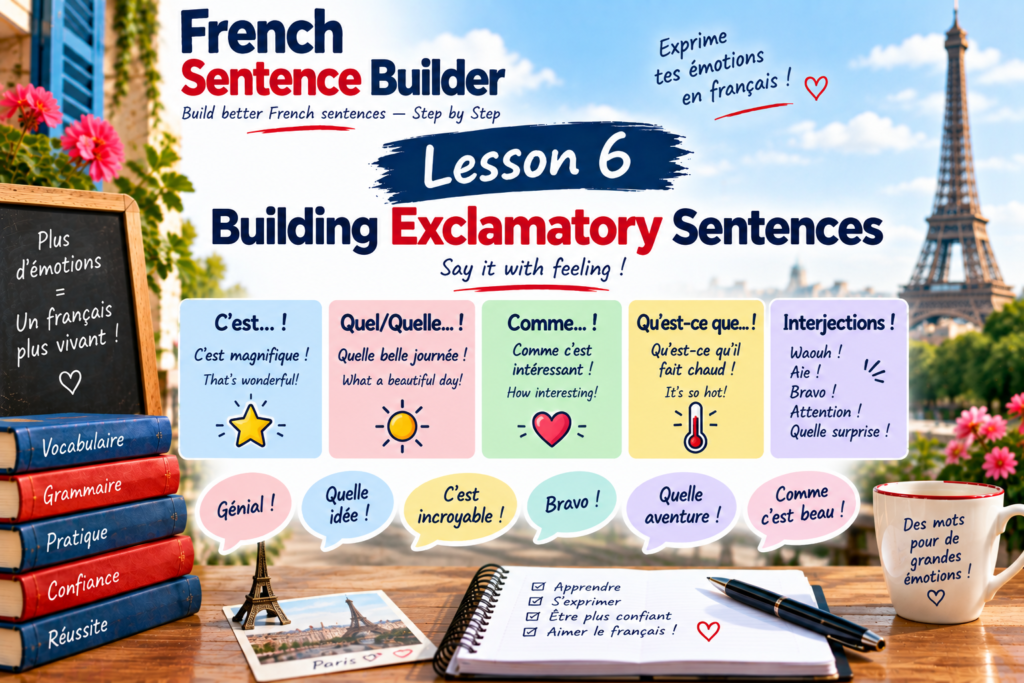
An exclamatory sentence allows you to express a strong reaction or emotion.
For example:
C’est magnifique !
That’s wonderful!
Quelle belle journée !
What a beautiful day!
Comme c’est intéressant !
How interesting!
C’est incroyable !
That’s incredible!
When you speak French, you don’t only give information. You also react to information.
You can show:
- surprise;
- happiness;
- excitement;
- admiration;
- anger;
- fear;
- disappointment;
- pain;
- frustration;
- enthusiasm.
In this lesson, I want you to learn how to turn a simple statement into a sentence that communicates emotion and intensity.
The source course treats exclamatory sentences as a distinct sentence type and includes structures involving exclamatory expressions and interjections.
1. What is an Exclamatory sentence?
An exclamatory sentence expresses a strong feeling or reaction.
Compare:
Simple statement
Cette voiture est belle.
This car is beautiful.
Exclamation
Cette voiture est magnifique !
This car is magnificent!
The first sentence gives information.
The second sentence expresses a stronger reaction.
Another example:
Statement
Il fait chaud.
It is hot.
Exclamation
Qu’est-ce qu’il fait chaud !
It’s so hot!
The difference is not simply grammar.
It is also emotion.
2. The Exclamation mark
In writing, an exclamatory sentence normally ends with:
!
For example:
C’est incroyable !
Quelle surprise !
Comme c’est beau !
Attention !
Arrête !
The exclamation mark tells the reader that the speaker is expressing a strong reaction, feeling, or emphasis.
But remember: not every sentence ending in ! has the same grammatical structure.
You will learn several ways to create exclamations.
3. The simplest Structure: C'est... !
One of the easiest ways to express a strong reaction is:
C’est + adjective + !
For example:
C’est magnifique !
That’s magnificent!
C’est incroyable !
That’s incredible!
C’est génial !
That’s great!
C’est fantastique !
That’s fantastic!
C’est terrible !
That’s terrible!
C’est extraordinaire !
That’s extraordinary!
This is a very useful structure because you can use vocabulary you already know.
4. Build the Exclamation Step by Step
Start with a basic sentence:
Le film est intéressant.
The film is interesting.
Now make your reaction stronger:
Le film est très intéressant !
The film is very interesting!
You can also use:
C’est intéressant !
And for a stronger reaction:
C’est vraiment intéressant !
It’s really interesting!
The important idea is:
basic idea → stronger description → emotional reaction
5. Quel / Quelle / Quels / Quelles for Exclamations
You already learned:
quel
quelle
quels
quelles
when asking questions.
But these words can also be used to make exclamations.
The structure is:
Quel + noun + !
or:
Quelle + noun + !
or:
Quels + noun + !
or:
Quelles + noun + !
For example:
Quel beau film !
What a beautiful film!
Quelle belle journée !
What a beautiful day!
Quels beaux paysages !
What beautiful landscapes!
Quelles belles photos !
What beautiful photos!
6. Remember agreement
Just as with questions, quel agrees with the noun.
Masculine singular
Quel
Quel beau jour !
What a beautiful day!
Feminine singular
Quelle
Quelle belle ville !
What a beautiful city!
Masculine plural
Quels
Quels beaux paysages !
What beautiful landscapes!
Feminine plural
Quelles
Quelles belles fleurs !
What beautiful flowers!
So always ask yourself:
What noun am I describing?
Then choose the correct form.
7. Quel + Adjective + Noun
A very common exclamatory structure is:
Quel + adjective + noun !
For example:
Quel beau spectacle !
What a beautiful show!
Quelle belle maison !
What a beautiful house!
Quels grands bâtiments !
What large buildings!
Quelles magnifiques vacances !
What wonderful holidays!
Notice the order:
Quel + adjective + noun
8. Don’t forget Adjective Agreement
The adjective must agree with the noun too.
For example:
Quelle belle maison !
because:
maison = feminine singular
Compare:
Quel beau bâtiment !
because:
bâtiment = masculine singular
And:
Quelles belles maisons !
because:
maisons = feminine plural
So there can be two agreements to think about:
Quel → agrees with the noun
Adjective → agrees with the noun
9. Que / Qu'est-ce que in Exclamations
You may also hear exclamatory structures such as:
Qu’est-ce que c’est beau !
That’s so beautiful!
Qu’est-ce qu’il fait chaud !
It’s so hot!
Qu’est-ce que tu es gentil !
You’re so kind!
Here, qu'est-ce que is not asking a question.
The intonation and context make it an exclamation.
Compare:
Question
Qu’est-ce que tu fais ?
What are you doing?
Exclamation
Qu’est-ce que tu es gentil !
You’re so kind!
The same words can appear in different structures, so you need to pay attention to meaning, punctuation, and intonation.
10. Comme... !
Another useful exclamatory structure is:
Comme + adjective/adverb + subject + verb !
It can express a strong reaction such as admiration or surprise.
Examples:
Comme c’est beau !
How beautiful!
Comme il est grand !
How tall he is!
Comme elle est gentille !
How kind she is!
Comme tu travailles vite !
How quickly you work!
Comme cette ville est magnifique !
How beautiful this city is!
This structure is especially useful when you want to emphasize a quality.
11. Compare C'est, Quel, and Comme
You now have several ways to express the same general reaction.
With C'est
C’est magnifique !
It’s magnificent!
With Quel
Quel magnifique paysage !
What a magnificent landscape!
With Comme
Comme ce paysage est magnifique !
How magnificent this landscape is!
The idea is similar, but the grammatical structure is different.
12. Expressing surprise
Let’s start with surprise.
You can use:
C’est incroyable !
C’est surprenant !
Quelle surprise !
Qu’est-ce que c’est étonnant !
Comme c’est surprenant !
You can also use short interjections:
Oh !
Ah !
Waouh !
Mince !
The exact expression depends on the situation and the level of informality.
13. Expressing happiness
You can use:
C’est génial !
That’s great!
C’est fantastique !
That’s fantastic!
Quelle bonne nouvelle !
What great news!
Quelle joie !
What joy!
Comme je suis heureux !
How happy I am!
Comme je suis contente !
How happy I am!
Remember that adjectives describing you need to agree with your gender.
For example:
Je suis heureux.
or:
Je suis heureuse.
14. Expressing admiration
When you see something beautiful or impressive, you can say:
C’est magnifique !
C’est superbe !
Quel beau paysage !
Quelle belle maison !
Comme c’est beau !
Quelle magnifique photo !
These structures are especially useful when describing:
- places;
- buildings;
- photographs;
- landscapes;
- artwork;
- performances;
- experiences.
15. Expressing anger
Exclamations can also communicate anger.
For example:
C’est impossible !
C’est injuste !
Quelle injustice !
Ça suffit !
That’s enough!
Arrête !
Stop!
Non mais vraiment !
Come on, seriously!
Be careful with the level of language you choose.
Some expressions can sound very direct or aggressive depending on your tone.
16. Expressing fear
You can use:
J’ai peur !
I’m scared!
Quelle horreur !
How horrible!
C’est dangereux !
It’s dangerous!
Attention !
Be careful!
Au secours !
Help!
Notice that some expressions are complete sentences while others are short exclamatory phrases.
17. Expressing pain
When you experience physical pain, French has several common exclamations.
For example:
Aïe !
Ouch!
Aïe, ça fait mal !
Ouch, it hurts!
J’ai mal !
I’m in pain!
Quelle douleur !
What pain!
The short expression:
Aïe !
is an interjection.
An interjection is a short expression used to communicate an immediate emotional reaction.
18. Common French interjections
You don’t need hundreds of interjections.
I want you to become familiar with a useful selection.
| French | Possible meaning |
|---|---|
Ah ! | Ah! |
Oh ! | Oh! |
Aïe ! | Ouch! |
Bravo ! | Well done! |
Attention ! | Watch out! |
Super ! | Great! |
Zut ! | Darn! |
Mince ! | Darn! / Oh no! |
Waouh ! | Wow! |
Au secours ! | Help! |
Ça suffit ! | That’s enough! |
Some of these are informal, so use them according to the situation.
19. Short Exclamatory phrases
An exclamatory expression does not always need a complete subject + verb sentence.
For example:
Quelle surprise !
What a surprise!
Quel dommage !
What a shame!
Quelle horreur !
How horrible!
Bravo !
Well done!
Attention !
Watch out!
Au secours !
Help!
These are useful because real French communication is not made only of long grammatical sentences.
Sometimes a short reaction communicates everything you need.
20. Statement → Exclamation
Let’s practise transforming ordinary statements into stronger reactions.
Example 1
Statement:
La journée est belle.
Stronger:
La journée est très belle !
Exclamation:
Quelle belle journée !
Example 2
Statement:
Le paysage est magnifique.
Exclamation:
Quel magnifique paysage !
or:
Comme le paysage est magnifique !
Example 3
Statement:
Cette ville est grande.
Exclamation:
Quelle grande ville !
Example 4
Statement:
Le film est intéressant.
Exclamation:
Comme ce film est intéressant !
or:
Qu’est-ce que ce film est intéressant !
21. Quel vs Quelle
Let’s focus on one of the most common mistakes.
Look at:
______ belle maison !
maison is feminine singular.
Therefore:
Quelle belle maison !
Not:
Quel belle maison ! ❌
Now:
______ beau restaurant !
restaurant is masculine singular.
Therefore:
Quel beau restaurant !
Now:
______ belles maisons !
maisons is feminine plural.
Therefore:
Quelles belles maisons !
22. Practice — Choose the Correct Form
Choose:
quel / quelle / quels / quelles
1.
______ belle journée !
2.
______ beau film !
3.
______ magnifiques photos !
4.
______ grands bâtiments !
5.
______ bonne idée !
6.
______ belles vacances !
7.
______ excellent restaurant !
23. Practice — Build an Exclamation
Use the words to build a complete exclamatory sentence.
1.
quel / beau / paysage
2.
quelle / belle / ville
3.
quels / grands / bâtiments
4.
quelles / magnifiques / photos
5.
comme / beau / être / ce lieu
6.
c’est / incroyable
24. Practice — Choose the Best structure
Choose an appropriate structure:
C'est... !
Quel/Quelle... !
Comme... !
1.
You see a beautiful landscape.
2.
Your friend tells you some amazing news.
3.
You see a very beautiful city.
4.
Someone gives you an unexpected gift.
5.
You see an impressive building.
There may be more than one possible answer.
The important thing is to communicate the emotion naturally.
25. Practice — Match the Emotion
Match each expression with the emotion it most naturally communicates.
| Expression | Emotion |
|---|---|
Aïe ! | ? |
Bravo ! | ? |
Quelle surprise ! | ? |
Quelle horreur ! | ? |
Waouh ! | ? |
Au secours ! | ? |
Ça suffit ! | ? |
Possible emotions:
- pain
- admiration/surprise
- congratulations
- surprise
- fear/horror
- request for help
- anger/frustration
26. Practice — React to a Situation
Imagine that I give you a situation.
You need to react naturally in French.
Situation 1
You receive excellent news.
__________________________ !
Situation 2
You hurt your finger.
__________________________ !
Situation 3
You see an incredibly beautiful building.
__________________________ !
Situation 4
Someone is making too much noise.
__________________________ !
Situation 5
You see a beautiful landscape.
__________________________ !
Situation 6
Your friend wins a competition.
__________________________ !
Don’t worry about producing complicated French.
A natural short reaction is often better than a long sentence that sounds unnatural.
27. Building a stronger Exclamation
Let’s take a simple idea:
Cette maison est belle.
Now build it step by step.
Step 1 — Basic description
Cette maison est belle.
Step 2 — Add intensity
Cette maison est très belle.
Step 3 — Express a reaction
Cette maison est vraiment magnifique !
Step 4 — Use an exclamatory structure
Quelle magnifique maison !
Now you have moved from simply describing something to reacting to it.
That is an important difference.
28. Exclamations in Conversation
Imagine that you are walking through Paris and see a beautiful building.
You could say:
C’est magnifique !
Your friend might say:
Quelle belle architecture !
You could respond:
Comme c’est beau !
This is natural communication because you are reacting to what you see.
You don’t always need to produce a long grammatical sentence.
Sometimes:
Waouh !
is enough.
29. Don’t turn every Exclamation into a question
This is important.
Compare:
Qu’est-ce que tu fais ?
This is a question.
You are asking for information.
But:
Qu’est-ce que c’est beau !
This is an exclamation.
You are expressing a reaction.
The punctuation and context matter:
?→ question
!→ exclamation
However, remember that spoken French depends heavily on intonation and context, so you should listen to how native speakers actually use these expressions.
30. Common mistakes
Mistake 1
Quel belle maison ! ❌
Correct:
Quelle belle maison ! ✓
maison is feminine singular.
Mistake 2
Quelle beau paysage ! ❌
Correct:
Quel beau paysage ! ✓
paysage is masculine singular.
Mistake 3
Quels belle photos ! ❌
Correct:
Quelles belles photos ! ✓
photos is feminine plural.
Mistake 4
Quel belles vacances ! ❌
Correct:
Quelles belles vacances ! ✓
vacances is feminine plural.
Mistake 5
Quelle magnifique ! ❌
If you use quelle, you normally need a noun after it:
Quelle magnifique ville !
or use:
C’est magnifique !
31. Exclamation builder
When you want to build an exclamation, you can choose one of these patterns.
Pattern 1
C’est + adjective !
C’est magnifique !
Pattern 2
Quel/Quelle/Quels/Quelles + adjective + noun !
Quelle belle journée !
Pattern 3
Comme + subject + verb + adjective !
Comme cette ville est belle !
Pattern 4
Qu’est-ce que + subject + verb + adjective !
Qu’est-ce que cette ville est belle !
Pattern 5
Interjection !
Waouh !
Aïe !
Bravo !
Attention !
32. Your personal reaction Challenge
I want you to imagine five situations from your own life.
For each situation, write one French exclamation.
Try to use different structures.
For example:
Situation
You see an amazing view.
Quel magnifique paysage !
Situation
You receive good news.
C’est fantastique !
Situation
You hurt yourself.
Aïe !
Situation
You see a beautiful city.
Comme cette ville est belle !
Situation
Someone does something impressive.
Bravo !
Now create five of your own.
33. Communication Challenge
Imagine that you are travelling in a French-speaking country.
You arrive at a beautiful location.
Your friend asks:
Alors, qu’est-ce que tu en penses ?
You can respond:
Waouh ! C’est magnifique ! Quelle belle vue ! Comme c’est beau ici !
Notice how several short structures can work together.
You don’t need to choose only one.
You can build a natural reaction:
Interjection → reaction → specific description → stronger reaction
For example:
Waouh ! C’est magnifique ! Quelle belle ville ! Comme l’architecture est belle !
34. Final review
Let’s review the structures you have learned.
C'est... !
C’est incroyable !
Quel... !
Quel beau film !
Quelle... !
Quelle belle journée !
Quels... !
Quels beaux paysages !
Quelles... !
Quelles belles photos !
Comme... !
Comme c’est beau !
Qu'est-ce que... !
Qu’est-ce que c’est intéressant !
Interjection
Waouh !
Aïe !
Bravo !
Attention !
35. The sentence builder Rule
You already know that French sentences are built from blocks.
For exclamations, think:
REACTION → INTENSITY → DESCRIPTION
For example:
Waouh ! → quelle → belle → ville !
Result:
Waouh ! Quelle belle ville !
Or:
C’est → vraiment → magnifique !
Result:
C’est vraiment magnifique !
Or:
Comme → cette ville → est → belle !
Result:
Comme cette ville est belle !
You are still building sentences step by step.
The difference is that now you are adding emotion.
What you can do Now
After this lesson, you should be able to:
- recognize an exclamatory sentence;
- use the exclamation mark correctly;
- express surprise;
- express happiness;
- express admiration;
- express anger;
- express fear;
- express pain;
- use common French interjections;
- use
c'est + adjective; - use
quel / quelle / quels / quelles; - make adjective and noun agreements;
- use
commein exclamatory structures; - recognize exclamatory uses of
qu'est-ce que; - turn ordinary descriptions into stronger reactions;
- react naturally to everyday situations.
Next Lesson
Lesson 7 — Giving Orders and Instructions
Now you know how to state information, negate information, ask questions, ask precise questions, and express emotions.
Next, I want you to learn how to tell someone what to do, give instructions, make suggestions, and give commands.
You will learn:
Écoute ! — Listen!
Regardez ! — Look!
Prenons le bus ! — Let’s take the bus!
Ne parle pas ! — Don’t speak!
N’oubliez pas ! — Don’t forget!
We will build these structures carefully and learn how the imperative works in French.