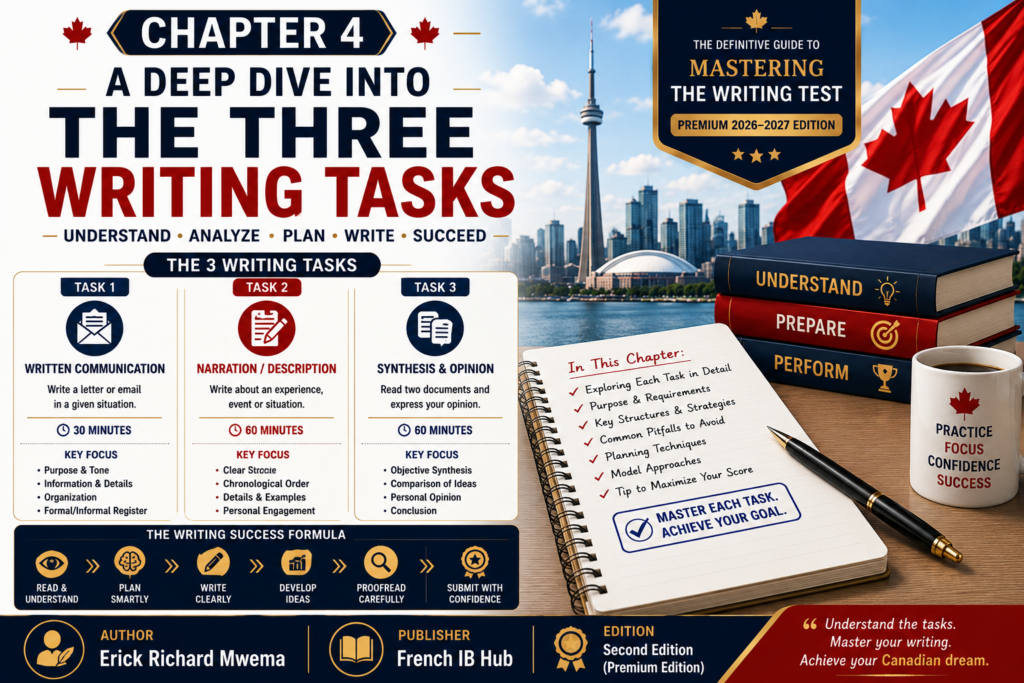
Understanding What Every Task really measures
“Before you can write successfully, you must understand the purpose behind every task.”
Many candidates approach the TCF Canada Expression Écrite as if it were simply three unrelated writing exercises.
It is not.
The three tasks have been carefully designed to evaluate different aspects of written communication. Together, they measure your ability to use French in practical, personal, and analytical contexts.
One of the biggest mistakes candidates make is using the same writing style for every task.
For example:
- writing an informal email as if it were an opinion article;
- narrating an experience when the task requires objective reporting;
- expressing personal opinions when the instructions require neutrality.
Every task has its own objective, audience, structure, and assessment criteria.
This chapter will help you understand exactly what is expected before you begin learning the detailed strategies in later chapters.
Important Reminder
The official TCF Canada examination may evolve over time. Always follow the instructions provided on your examination paper. If the wording or structure differs slightly from examples in preparation materials, the official exam instructions always take priority.
Learning objectives
By the end of this chapter, you will be able to:
- Understand the purpose of each writing task.
- Recognize the differences between the three tasks.
- Identify the communication skills assessed in each task.
- Select the appropriate register.
- Avoid confusing one task with another.
- Prepare mentally before writing.
The Logic behind the Examination
The examination follows a progression from simple communication to independent written expression.
Think of it as climbing a staircase.
              Highest Level
                   ▲
             Task 3
      Analysis • Synthesis
      Personal Position
                   ▲
             Task 2
      Narration • Description
                   ▲
             Task 1
      Everyday Communication
                   ▲
           Basic Communication
Each step requires greater independence.
Notice that the examination is not asking increasingly difficult grammar questions.
Instead, it asks you to communicate more effectively.
The Three Tasks Compared
| Feature | Task 1 | Task 2 | Task 3 |
|---|---|---|---|
| Main purpose | Functional communication | Narration / description | Analysis, synthesis & opinion |
| Audience | One specific reader | General reader | General audience |
| Register | Formal or informal | Neutral | Neutral to formal |
| Creativity | Low | Moderate | High |
| Organization | Simple | Structured | Highly structured |
| Critical thinking | Limited | Moderate | High |
Understanding these differences immediately improves your writing strategy.
Task 1
Everyday Functional Communication
What is Task 1?
Task 1 simulates situations that occur in everyday life.
You are asked to communicate with another person to solve a practical problem.
Examples include:
- requesting information;
- making a reservation;
- cancelling an appointment;
- writing a complaint;
- thanking someone;
- confirming participation;
- asking for clarification.
The emphasis is on communication that is:
- clear;
- polite;
- complete;
- appropriate.
What is the Examiner looking for?
The examiner wants to know whether you can function in everyday written communication.
Specifically:
- Have you answered every instruction?
- Is the register appropriate?
- Is your message easy to understand?
- Is the email organized logically?
- Is your language polite?
Typical structure
Greeting

↓

Purpose

↓

Required Information

↓

Polite Closing

↓

Signature
Simple.
Clear.
Efficient.
Example situation
You wish to register for a French course.
Write an email asking:
- dates;
- prices;
- schedules;
- registration procedure.
This task measures practical communication—not creativity.
Common mistakes
❌ Forgetting the greeting.
❌ Missing one question.
❌ Using informal language.
❌ Writing only three sentences.
❌ Giving unnecessary personal stories.
Success formula
Purpose

↓

Questions

↓

Politeness

↓

Closing
Task 2
Narration and Description
Task 2 introduces a different challenge.
Instead of solving a practical problem, you must tell a story or describe an experience.
The examiner now evaluates your ability to organize information over several connected paragraphs.
Common topics
You may be asked to describe:
- a memorable journey;
- your hometown;
- an important celebration;
- a volunteer experience;
- your first day at work;
- an inspiring person;
- a difficult challenge;
- a cultural event.
What is being Assessed?
The examiner wants to see whether you can:
- describe events logically;
- organize chronology;
- explain feelings;
- provide details;
- conclude naturally.
This is much more than simply listing events.
Typical structure
Introduction

↓

Context

↓

Main Events

↓

Personal Reflection

↓

Conclusion
Good narrative Writing
Instead of writing:
Je suis allé à Paris.
Develop the idea.
L’été dernier, j’ai eu l’occasion de visiter Paris avec ma famille. Ce voyage m’a permis de découvrir de nombreux monuments historiques et d’améliorer mon français en échangeant avec les habitants.
Notice the difference.
One sentence informs.
The other communicates.
Common mistakes
❌ Listing events.
❌ Forgetting chronology.
❌ No personal reflection.
❌ No conclusion.
❌ Repeating the same verbs.
Success formula
Situation

↓

Events

↓

Feelings

↓

Reflection

↓

Conclusion
Task 3
Analysis, Synthesis and Personal Position
Task 3 is the most demanding section of the examination.
It evaluates not only your French but also your ability to process information and communicate your ideas effectively.
Unlike Tasks 1 and 2, Task 3 requires you to think critically.
The Modern Task 3
In recent versions of the examination, candidates may be asked to work from source documents presenting different perspectives on a topic.
Your task may involve:
- identifying the central ideas;
- comparing viewpoints;
- summarizing information objectively;
- expressing your own opinion with justification.
The exact wording of the prompt should always guide your response.
A Typical Workflow
Read the documents

↓

Identify key ideas

↓

Compare viewpoints

↓

Write an objective synthesis

↓

Present your opinion

↓

Support your opinion

↓

Conclude
This is fundamentally different from simply writing an opinion essay.
Objective summary vs Personal opinion
One of the biggest challenges in Task 3 is separating these two stages.
Objective summary
Your goal is to explain what the documents say.
Not what you think.
Example:
Le premier document souligne les avantages du télétravail, tandis que le second met en avant les difficultés liées à l’isolement professionnel.
Notice that the writer remains neutral.
Personal opinion
Now your own position becomes appropriate.
Example:
Pour ma part, je pense que le télétravail représente une excellente solution lorsqu’il est combiné avec quelques jours de présence au bureau.
The shift from objective reporting to personal argument must be clear.
Comparing viewpoints
Many Task 3 prompts involve contrasting ideas.
Useful comparison language includes:
- tandis que…
- en revanche…
- contrairement à…
- les deux documents…
- le premier auteur…
- le second document…
These expressions help organize your synthesis naturally.
What the Examiner is looking for
In Task 3, the examiner wants to see:
- accurate understanding of the documents;
- objective presentation of ideas;
- logical organization;
- clear transition to personal opinion;
- well-developed arguments;
- relevant examples;
- coherent conclusion.
Common mistakes
❌ Giving your opinion in the summary.
❌ Ignoring one document.
❌ Copying sentences from the source texts.
❌ Writing only personal opinions.
❌ Forgetting to justify your position.
Success formula
Understand

↓

Summarize

↓

Compare

↓

Transition

↓

Opinion

↓

Arguments

↓

Conclusion
The Three tasks work together
Although each task has its own objective, they all evaluate the same essential communication skills.
                Communication
                     │
      ┌──────────────┼──────────────┐
      │              │              │
 Organization   Vocabulary     Grammar
      │              │              │
      └──────────────┼──────────────┘
                     │
                  Success
Whether you are writing an email, describing an experience, or analyzing documents, these four pillars remain constant.
Choosing the Right Register
Before writing any task, ask yourself:
| Question | Why It Matters |
|---|---|
| Who is my reader? | Determines tone |
| Why am I writing? | Determines purpose |
| Should I be formal or informal? | Determines register |
| Am I informing, describing, or arguing? | Determines structure |
These questions prevent many avoidable mistakes.
Reflection activity
Read the following situations and identify the correct task type.
- You want to complain about a damaged product.
- You describe your first visit to Montréal.
- You compare two texts discussing online education before expressing your own opinion.
Answers
- Task 1
- Task 2
- Task 3
If you can recognize the task immediately, planning becomes much easier.
Chapter summary
You now understand that:
- Task 1 evaluates functional communication.
- Task 2 evaluates narration and description.
- Task 3 evaluates analysis, synthesis, and reasoned opinion.
- Each task has a different communicative purpose.
- Organization, register, and clarity are essential in every response.
- Following the instructions is just as important as writing good French.
This understanding forms the foundation for the detailed strategies in the chapters that follow.
Key takeaways
- Adapt your writing style to the task.
- Read every instruction carefully.
- Do not confuse objective reporting with personal opinion.
- Choose the correct register before you begin writing.
- Every task measures communication—not simply grammar.
Coming Up Next: Chapter 5 – How Examiners Really Evaluate Your Writing
In the next chapter, we’ll go beyond general marking criteria and explore the evaluation process from the examiner’s perspective. You’ll learn how scripts are assessed, what distinguishes different CEFR levels, which mistakes matter most, and how to write in a way that consistently earns higher scores. This chapter will help you think like an examiner and use that insight to improve every piece of writing you produce.