
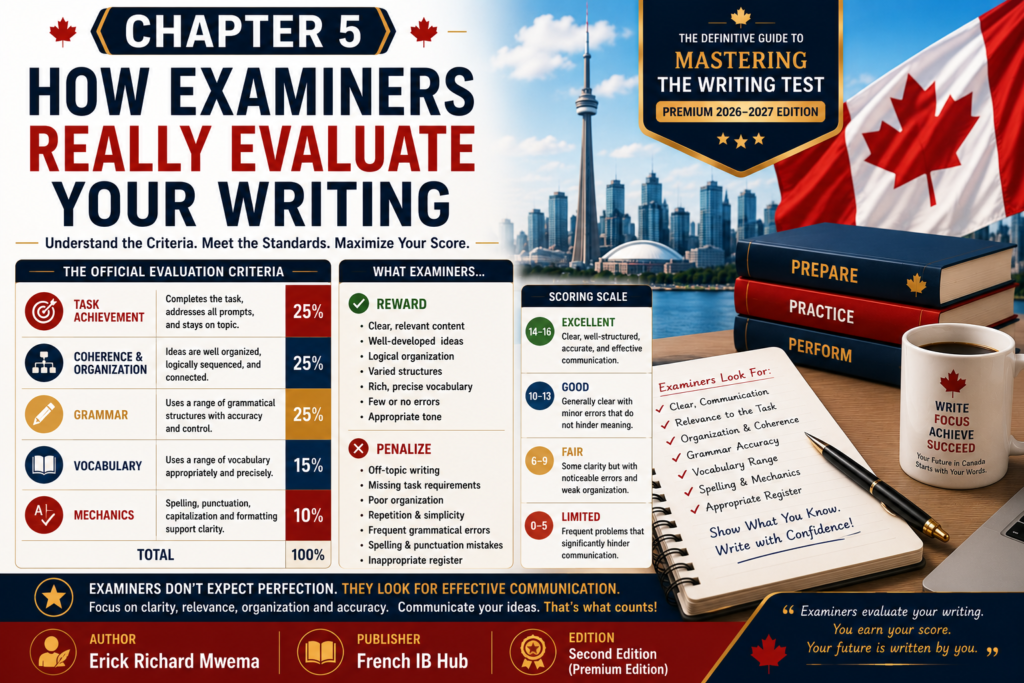
Think like an Examiner, Write like a High-scoring Candidate
“The examiner is not searching for reasons to fail you. They are searching for evidence of what you can do.”
One of the greatest misconceptions about the TCF Canada Expression Écrite is that examiners sit with a red pen looking for mistakes.
This is simply not true.
Professional examiners are trained to evaluate your overall ability to communicate effectively in French, not to count every grammatical error.
Imagine reading two compositions.
The first contains almost perfect grammar but does not answer the question.
The second contains a few minor mistakes but communicates ideas clearly, develops arguments logically, and fully addresses the task.
Which one deserves the higher score?
In most cases, the second composition.
This chapter will take you inside the examiner’s perspective. By understanding how your writing is assessed, you will know exactly where to focus your efforts and avoid wasting time on things that have little impact on your final performance.
Learning objectives
By the end of this chapter, you will be able to:
- Understand how examiners evaluate writing.
- Recognize the qualities of high-scoring responses.
- Identify the most common reasons candidates lose marks.
- Learn how CEFR levels are reflected in writing performance.
- Develop habits that consistently improve your score.
The Examiner’s mission
An examiner asks one fundamental question:
“Can this candidate communicate effectively in written French?”
Everything else—grammar, vocabulary, spelling, organization—supports the answer to that question.
Examiners are trained to evaluate your writing holistically, meaning they consider the text as a whole rather than focusing on isolated mistakes.
What Happens after you finish Writing?
Once your paper is submitted, the examiner does not immediately begin counting grammar mistakes.
Instead, they first form an overall impression.
They ask themselves questions such as:
- Did the candidate understand the task?
- Is the text coherent?
- Is the communication effective?
- Is the language appropriate for the situation?
Only after this initial impression do they examine the details more closely.
The Five Pillars of Assessment
Although the wording of official assessment criteria may vary, successful writing consistently demonstrates excellence in five key areas.
                Overall Performance
                       │
 ┌─────────────────────┼─────────────────────┐
 │                     │                     │
Task Achievement   Organization        Language
                                           │
                         ┌─────────────────┴─────────────────┐
                         │                                   │
                  Vocabulary                          Grammar
                                           │
                                           ▼
                                    Communication
These pillars work together.
A weakness in one area can often affect another.
1. Task achievement
This is the first thing an examiner notices.
Did you actually do what the instructions asked?
Suppose the prompt asks you to:
- request information;
- ask three questions;
- explain your situation.
If you forget one question, your response is incomplete.
Even excellent grammar cannot compensate for an incomplete task.
Strong example
- Explains the situation.
- Asks every required question.
- Uses the correct register.
- Ends politely.
Weak example
✔ Excellent grammar.
❌ Only answers half the task.
Result?
The second response is unlikely to receive a high evaluation.
2. Organization and Coherence
Good writing should guide the reader naturally from one idea to the next.
Examiners look for:
- logical paragraphs;
- clear introductions;
- smooth transitions;
- appropriate conclusions.
Imagine two houses.
One has every room connected logically.
The other requires climbing through windows to reach the kitchen.
Both contain the same furniture.
Which is easier to use?
Writing works exactly the same way.
Example
Weak organization
Je suis allé à Lyon. C’était magnifique. Les hôtels étaient chers. J’aime voyager. Il faisait chaud. Les restaurants étaient excellents.
The ideas feel disconnected.
Better organization
L’été dernier, je suis allé à Lyon avec mes amis. Dès notre arrivée, nous avons découvert une ville magnifique. Même si les hôtels étaient assez chers, les excellents restaurants et l’ambiance chaleureuse ont largement compensé cette dépense.
The information flows naturally.
3. Vocabulary
Examiners appreciate vocabulary that is:
- accurate;
- appropriate;
- varied;
- natural.
Many candidates believe they must impress the examiner with difficult words.
This often produces awkward writing.
Instead of writing:
Cette problématique est excessivement multifactorielle…
Consider writing:
Ce problème est complexe et touche plusieurs aspects de la société.
Simple language used well is always preferable to complicated language used incorrectly.
Vocabulary Range
A stronger response avoids repeating the same words.
Instead of:
important
Consider alternatives such as:
- essentiel;
- primordial;
- significatif;
- majeur;
- indispensable;
- capital.
Likewise, instead of repeating:
intéressant
You might use:
- fascinant;
- enrichissant;
- captivant;
- utile;
- stimulant.
Variety demonstrates flexibility.
4. Grammar
Grammar remains important.
However, examiners evaluate control, not perfection.
A composition containing one or two agreement mistakes can still demonstrate a high level of communication.
On the other hand, repeated grammar errors that interfere with understanding become more serious.
Minor errors
These usually do not prevent communication.
Example:
Les personne sont sympathique.
The reader still understands.
Serious errors
Example:
Hier demain je partir mange maison.
Communication becomes impossible.
Grammar matters because it affects meaning.
5. Register
One of the easiest ways to lose marks is choosing the wrong tone.
Imagine writing to a university admissions office.
Which greeting is appropriate?
Incorrect
Salut !
Appropriate
Madame, Monsieur,
Likewise, when writing to a close friend, using overly formal language can sound unnatural.
Always adapt your language to your audience.
What makes a High-Scoring script?
High-performing candidates consistently demonstrate the following qualities:
- Every instruction is answered.
- Ideas are logically organized.
- Vocabulary is varied and appropriate.
- Grammar supports communication.
- Paragraphs are balanced.
- Connectors are used naturally.
- The conclusion feels complete.
Notice that none of these qualities require perfect French.
They require effective communication.
The importance of Coherence
Coherence means your ideas connect smoothly.
Transitions help your reader follow your thinking.
Useful connectors include:
Addition
- de plus;
- en outre;
- également;
- par ailleurs.
Contrast
- cependant;
- toutefois;
- en revanche;
- pourtant.
Cause
- parce que;
- puisque;
- en raison de.
Consequence
- donc;
- par conséquent;
- ainsi;
- c’est pourquoi.
Conclusion
- enfin;
- pour conclure;
- en résumé;
- en définitive.
A text without connectors often feels like a list.
A coherent text feels like a conversation.
CEFR Progression
As your CEFR level increases, examiners expect greater independence.
| Level | Examiner Expects |
|---|---|
| A1 | Simple isolated sentences |
| A2 | Short connected messages |
| B1 | Organized paragraphs with basic arguments |
| B2 | Well-developed ideas with clear justification |
| C1 | Sophisticated organization and precise language |
| C2 | Near-native fluency and flexibility |
Notice that the progression is not just about grammar.
It is about increasingly effective communication.
The Ten most common reasons Candidates lose Marks
- Misreading the instructions.
- Forgetting required information.
- Using the wrong register.
- Poor paragraph organization.
- Repeating the same vocabulary.
- Writing sentences that are too short or too long.
- Weak transitions between ideas.
- Ignoring one of the source documents in Task 3.
- Failing to justify opinions.
- Not proofreading before finishing.
Most of these mistakes are avoidable with practice.
Examiner’s mental checklist
As you write, imagine the examiner asking these questions:
✓ Did the candidate answer the question?

✓ Is the writing easy to follow?

✓ Is the vocabulary appropriate?

✓ Is the grammar generally accurate?

✓ Is the register suitable?

✓ Does the text feel complete?
If the answer is “yes” to each question, your writing is likely moving toward a stronger performance.
Self-Evaluation checklist
Before submitting any practice composition, ask yourself:
| Question | Yes | No |
|---|---|---|
| Did I answer every instruction? | □ | □ |
| Did I organize my ideas logically? | □ | □ |
| Did I use appropriate vocabulary? | □ | □ |
| Did I vary my sentence structure? | □ | □ |
| Did I check my grammar? | □ | □ |
| Did I use the correct register? | □ | □ |
| Did I proofread my work? | □ | □ |
Use this checklist every time you practice. Over time, these questions will become automatic.
Reflection activity
Read one of your previous French writing tasks.
Without correcting the grammar first, evaluate it using the five pillars:
- Task Achievement
- Organization
- Vocabulary
- Grammar
- Register
Which area is your greatest strength?
Which area needs the most improvement?
Write one concrete action you will take before your next practice session.
Chapter summary
In this chapter, you learned that:
- Examiners assess your overall ability to communicate, not just your grammar.
- High-scoring responses successfully complete the task, organize ideas clearly, use appropriate vocabulary, maintain suitable grammar, and adopt the correct register.
- Communication is evaluated holistically, with clarity and coherence playing a central role.
- Many lost marks result from avoidable issues such as ignoring instructions, poor organization, or inadequate proofreading.
- Thinking like an examiner helps you write more effectively and strategically.
Key takeaways
- Always complete every part of the task.
- Prioritize clarity over complexity.
- Organize ideas into logical paragraphs.
- Use varied vocabulary naturally.
- Proofread every composition before finishing.
- Remember: effective communication is the ultimate goal.
Coming Up Next: Chapter 6 – Time Management Strategies for the Writing Test
Knowing French is not enough if you cannot finish the examination on time. In the next chapter, you will learn how to allocate your time across the three tasks, plan efficiently, avoid common time traps, and develop a practical writing routine that allows you to complete every task with confidence, even under exam pressure.