Understanding the Test before you take it
“A successful candidate never wonders what comes next during the exam. They already know the structure so well that every minute is used effectively.”
Imagine entering the examination room and seeing the writing tasks for the first time.
Some candidates immediately begin writing.
Others stop, breathe, read the instructions carefully, and already know how they will divide their time.
Who has the advantage?
Almost always, the second candidate.
Knowing the structure of the examination reduces stress, improves confidence, and helps you make better decisions under time pressure.
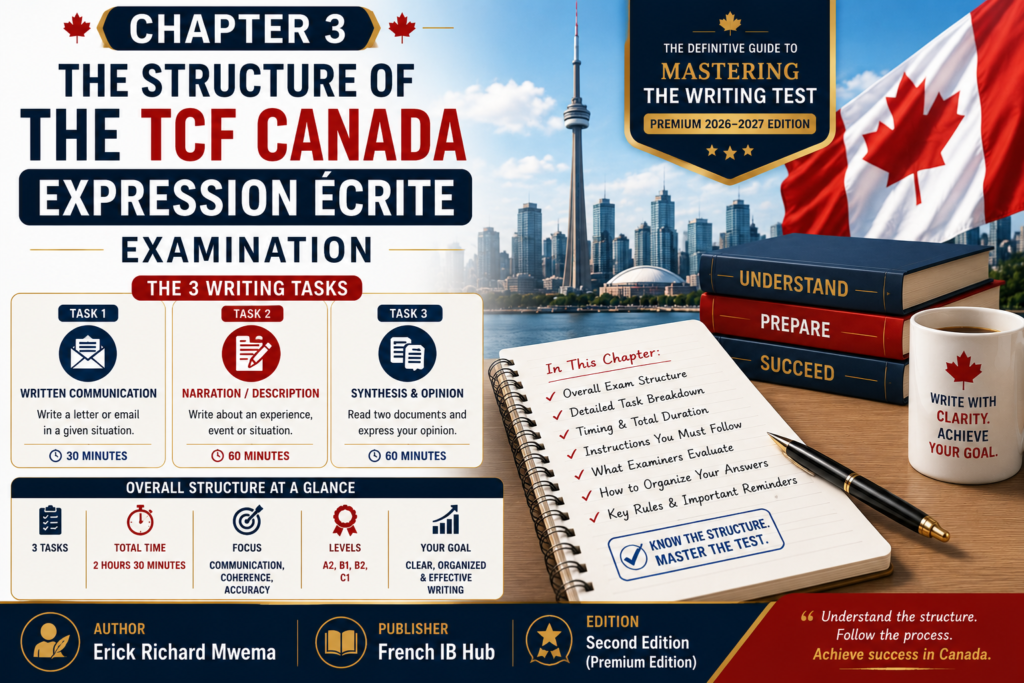
This chapter explains how the writing examination is organized, how the tasks relate to one another, and how you can use that knowledge to maximize your performance.
Important Note
The TCF Canada examination may be updated periodically by the official test provider. Always verify the latest administrative instructions, task descriptions, and word-count requirements with your authorized examination centre or the official TCF Canada documentation before your test date. This guide reflects the current examination principles and preparation strategies while encouraging candidates to confirm the latest official specifications.
Learning objectives
By the end of this chapter, you will be able to:
- Understand the overall structure of the writing examination.
- Recognize the purpose of each writing task.
- Understand how the tasks progress in complexity.
- Plan your time efficiently.
- Avoid common structural mistakes before the exam begins.
A Progressive Examination
The Expression Écrite test is carefully designed.
It does not begin with the most difficult task.
Instead, each task builds upon the previous one.
Task 1
Functional Communication
        │
        ▼
Task 2
Narration & Description
        │
        ▼
Task 3
Analysis, Synthesis & Personal Opinion
The examination gradually moves from everyday communication toward more advanced writing that requires greater independence and critical thinking.
This progression allows candidates to demonstrate a wider range of language abilities.
The three Writing tasks at a Glance
| Task | Main Objective | Primary Skills |
|---|---|---|
| Task 1 | Communicate in an everyday situation | Requesting, informing, thanking, complaining, reserving |
| Task 2 | Describe or narrate | Organizing events, describing experiences, expressing feelings |
| Task 3 | Analyze and express ideas | Understanding information, organizing arguments, presenting a justified opinion |
Notice that every task evaluates communication—but in a different context.
Why are there Three Different Tasks?
A single writing task cannot measure every aspect of written communication.
For example:
Someone may write an excellent formal email but struggle to explain a personal experience.
Another person may tell stories well but find it difficult to organize arguments.
By including three different tasks, the examination provides a broader picture of your writing ability.
Task 1: Everyday Communication
Task 1 reflects situations that many people encounter in daily life.
Examples include:
- requesting information;
- booking accommodation;
- making a complaint;
- asking for clarification;
- confirming a reservation;
- writing a thank-you message.
This task evaluates whether you can communicate politely, clearly, and efficiently.
The examiner is looking for practical communication rather than creativity.
Task 2: Narrating and Describing
Task 2 moves beyond simple communication.
Now you must develop ideas over several connected paragraphs.
Typical situations include:
- describing an important event;
- explaining an experience;
- recounting a memorable journey;
- describing a person or place;
- reflecting on a lesson learned.
This task evaluates your ability to:
- organize ideas chronologically;
- use descriptive language;
- combine different verb tenses appropriately;
- explain rather than simply list information.
Task 3: Higher-Level Writing
Task 3 is the most intellectually demanding section.
Here you are expected to demonstrate mature written communication.
Depending on the current official format, this may involve:
- understanding one or more written documents;
- identifying key information;
- comparing different viewpoints;
- producing an objective synthesis;
- expressing and justifying your own opinion.
Unlike Task 1, there is no single formula that works for every question.
Instead, you must adapt your writing to the specific prompt.
The increasing Level of Independence
One useful way to understand the examination is to look at how much support each task gives you.
| Task | Guidance from the Prompt | Candidate Independence |
|---|---|---|
| Task 1 | High | Moderate |
| Task 2 | Moderate | High |
| Task 3 | Lower | Very High |
As the examination progresses, you become increasingly responsible for organizing, selecting, and developing your own ideas.
Managing Your Time
Time management is one of the most important skills in the writing examination.
Many candidates make the same mistake:
They spend too much time trying to perfect the first task.
By the time they reach the final task, they are tired and rushed.
Instead, think of your time as an investment.
Each task deserves careful attention.
A balanced approach is generally more effective than aiming for perfection in one section while neglecting another.
A practical strategy is:
Read Instructions Carefully
          │
          ▼
Plan Briefly
          │
          ▼
Write
          │
          ▼
Review
This cycle should be repeated for every task.
Why Planning saves Time
Planning often feels like a delay.
In reality, it prevents larger problems later.
Without planning, candidates frequently:
- forget required information;
- repeat the same idea;
- write disorganized paragraphs;
- exceed or fall below the expected length.
Even one or two minutes of planning can produce a more coherent response.
Word Count: Quality before Quantity
Every writing task has an expected length.
These limits exist for an important reason.
Writing too little usually means you have not developed your ideas sufficiently.
Writing far beyond the expected range often leads to:
- repetition;
- unnecessary details;
- increased grammar mistakes;
- poor time management.
Your objective is not to write the longest answer.
Your objective is to write the most complete and effective answer within the expected length.
The Relationship between the Tasks
Although the tasks appear different, they share several common principles.
Every response should include:
- a clear purpose;
- logical organization;
- appropriate vocabulary;
- suitable grammar;
- accurate register;
- complete task fulfillment.
Think of the three tasks as different branches growing from the same tree.
            Effective Writing
                   │
    ┌──────────────┼──────────────┐
    │              │              │
 Task 1         Task 2         Task 3
 Everyday     Description     Analysis
Communication  Narration      Opinion
Mastering these shared principles improves your performance across the entire examination.
Common structural Mistakes
Many candidates lose marks because they misunderstand the structure of the test rather than because of weak French.
Typical mistakes include:
- spending too long on the first task;
- failing to read every instruction;
- forgetting to organize ideas into paragraphs;
- changing register within the same text;
- leaving no time for proofreading.
Most of these mistakes are entirely preventable.
Before you begin each Task
Develop the habit of asking yourself these questions:
- What is my objective?
- Who is my reader?
- Which register should I use?
- Which information is essential?
- How will I organize my ideas?
- How much time should I spend on this task?
These six questions become a mental checklist that keeps you focused throughout the examination.
Reflection activity
Take a blank sheet of paper.
Without looking back at this chapter, draw the structure of the examination from memory.
Include:
- the three tasks;
- the purpose of each task;
- the communication skills assessed;
- your personal time allocation strategy.
If you can recreate the structure accurately, you already understand the architecture of the examination.
Chapter summary
In this chapter, you learned that:
- The writing examination is progressive rather than random.
- Each task evaluates a different aspect of written communication.
- The level of independence increases throughout the test.
- Balanced time management is essential.
- Planning improves both organization and accuracy.
- Every task shares the same foundation: clear communication.
Understanding the structure of the examination allows you to approach every writing task with confidence rather than uncertainty.
Key takeaways
- Learn the structure before practicing individual tasks.
- Treat every task as part of a complete communication assessment.
- Allocate your time wisely.
- Plan briefly before writing.
- Focus on clarity, organization, and purpose in every response.
Coming Up Next: Chapter 4 – A Deep Dive into the Three Writing Tasks
In the next chapter, we will examine each writing task individually, exploring the communicative purpose, expected structure, assessment criteria, planning strategies, and common pitfalls. Special attention will be given to the latest format of Task 3, including how to analyze source documents, write an objective synthesis, and present a well-supported personal opinion. This chapter will serve as the bridge between understanding the examination and mastering each task individually.