Everything you need to know before you start Writing
“The best-prepared candidates do not begin by writing. They begin by understanding exactly what the examination expects.”
One of the biggest differences between average candidates and high-scoring candidates is not their grammar knowledge or vocabulary size—it is their understanding of the examination itself.
Many learners spend weeks practicing compositions without fully understanding:
- why each task exists;
- what each task is designed to assess;
- how the tasks differ from one another;
- what examiners expect in each response.
As a result, they often use the wrong writing style, the wrong register, or the wrong organization.
Before learning advanced writing techniques, you must first understand the architecture of the examination.
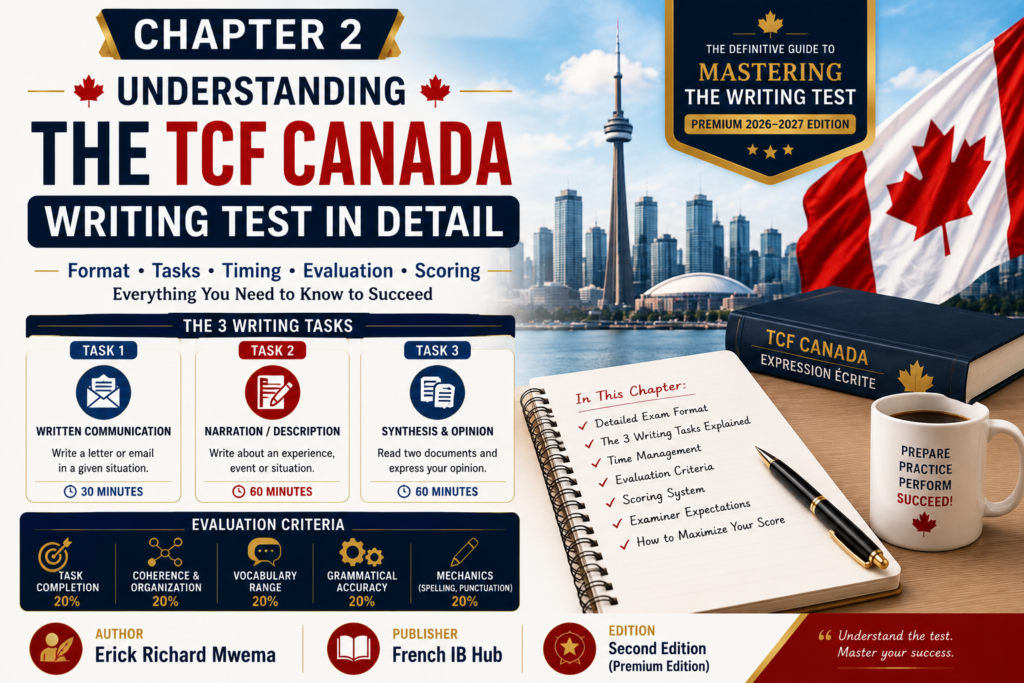
This chapter explains exactly how the writing test is designed, what skills it measures, and how you should approach each task strategically.
Learning objectives
By the end of this chapter, you will be able to:
- Understand the purpose of every writing task.
- Identify the communication skills being assessed.
- Recognize the progression in difficulty across the examination.
- Understand the relationship between writing tasks and CEFR levels.
- Develop an effective strategy before beginning your preparation.
Why does the Writing Test exist?
The writing test is not intended to identify candidates who can memorize grammar rules.
Instead, it measures whether you can communicate effectively through written French in realistic situations.
Imagine that you have recently moved to a French-speaking environment.
You may need to:
- request information;
- make a reservation;
- describe an experience;
- explain a problem;
- express your opinion;
- compare different viewpoints;
- summarize information objectively.
These are practical communication skills that people use every day.
The examination reflects these real-life situations.
What Skills are actually being Assessed?
Although each writing task is different, they all evaluate the same core competencies.
1. Understanding the instructions
Before writing a single sentence, you must understand:
- your objective;
- your audience;
- the required register;
- the information you must include.
Many candidates lose marks simply because they answer a different question from the one being asked.
2. Communicating clearly
Every response should communicate your ideas without forcing the reader to guess your meaning.
Good communication means:
- complete ideas;
- logical progression;
- relevant information;
- clear sentences.
3. Organizing information
Ideas should flow naturally.
Readers should immediately understand:
- where your text begins;
- how your ideas develop;
- how your conclusion connects to everything that came before.
Organization is just as important as grammar.
4. Using appropriate language
Your vocabulary should suit:
- the topic;
- the situation;
- the intended reader.
A formal email should not sound like a conversation with a friend.
Likewise, an opinion article should not resemble a complaint letter.
5. Controlling Grammar
Grammar is evaluated because it supports communication.
Examiners look for:
- accurate verb tenses;
- agreement;
- sentence variety;
- punctuation;
- spelling.
Perfect grammar is not required.
Consistent control is.
Understanding the Progression of the Tasks
The writing examination is designed progressively.
Each task requires greater independence than the previous one.
Task 1
Basic Functional Communication
          │
          ▼
Task 2
Narration and Description
          │
          ▼
Task 3
Analysis, Synthesis, and Argumentation
Notice that the examination does not become more difficult by introducing harder grammar.
Instead, it asks you to communicate more independently and more effectively.
Task 1 – Functional Communication
Task 1 assesses your ability to write in practical situations.
Examples include:
- requesting information;
- making a reservation;
- cancelling an appointment;
- writing a complaint;
- thanking someone;
- asking for clarification.
The examiner expects:
- politeness;
- clarity;
- completeness;
- appropriate register.
This task measures whether you can solve everyday communication problems.
Task 2 – Narration and Description
Task 2 requires you to write a connected text describing an event, an experience, or a situation.
You may need to:
- describe a journey;
- explain an experience;
- recount an important event;
- describe a memorable person;
- explain what you learned.
The examiner expects:
- logical chronology;
- descriptive vocabulary;
- varied verb tenses;
- personal reflection.
Here, writing becomes more expressive.
Task 3 – Analysis and Personal Position
Task 3 is the most demanding part of the examination.
Rather than simply expressing an opinion, candidates may be asked to work with source material and demonstrate higher-level writing skills.
Depending on the current examination format, this can involve:
- understanding one or more documents;
- identifying key ideas;
- comparing viewpoints;
- writing an objective synthesis;
- presenting and justifying a personal opinion.
The focus is no longer only on language.
It is also on critical thinking.
Later in this guide, an entire section will be devoted to mastering this task step by step.
The importance of Register
One of the easiest ways to lose marks is by using the wrong register.
Register refers to the level of formality appropriate for the situation.
Consider these examples.
Informal
Salut Julien,
Merci pour ton invitation !
Suitable for:
- friends;
- classmates;
- family.
Formal
Madame, Monsieur,
Je vous remercie de l’attention portée à ma demande.
Suitable for:
- companies;
- institutions;
- universities;
- customer service.
Choosing the correct register immediately demonstrates communicative competence.
The role of planning
Many candidates believe planning wastes valuable time.
In reality, planning saves time.
Without a plan:
- ideas become repetitive;
- paragraphs become disorganized;
- important information is forgotten.
A simple two-minute outline often improves the quality of an entire composition.
For example:
Read the instructions
          │
Identify key points
          │
Organize ideas
          │
Select vocabulary
          │
Write
Planning reduces stress because you always know what comes next.
What Examiners want to See
Throughout the examination, assessors consistently look for evidence of the following:
| Skill | What the Examiner Looks For |
|---|---|
| Task Achievement | Every instruction has been addressed. |
| Organization | Ideas are presented logically. |
| Vocabulary | Appropriate and sufficiently varied. |
| Grammar | Accurate enough to communicate effectively. |
| Register | Suitable for the audience and purpose. |
| Coherence | Ideas connect naturally. |
Notice that these criteria focus on communication rather than perfection.
Common mistakes before Candidates even start Writing
Many problems occur before the first sentence is written.
Some candidates:
- ignore part of the instructions;
- misunderstand the audience;
- choose the wrong register;
- begin writing immediately without planning;
- forget the required word count.
Developing good preparation habits eliminates many of these avoidable errors.
The Candidate’s Mindset
Before every writing task, ask yourself five questions:
- Who am I writing to?
- Why am I writing?
- What information must I include?
- What register should I use?
- How should I organize my ideas?
If you can answer these questions before writing, you have already completed much of the work.
Reflection activity
Choose any writing prompt you have seen before.
Without writing the full response, identify:
- the audience;
- the purpose;
- the register;
- three key ideas to include;
- the overall structure.
This simple exercise develops planning skills that will benefit every future composition.
Chapter summary
In this chapter, you discovered that:
- The writing test measures practical communication skills.
- Every task has a different communicative purpose.
- Difficulty increases through independence rather than grammar complexity.
- Register, organization, and planning are essential components of successful writing.
- Understanding the task before writing greatly improves performance.
These principles will guide every strategy introduced throughout the rest of this book.
Key takeaways
- Read every instruction carefully before writing.
- Adapt your language to the intended audience.
- Plan before you write.
- Organize your ideas logically.
- Remember that communication, not perfection, is the examiner’s primary concern.
Coming Up Next: Chapter 3 – The Structure of the TCF Canada Expression Écrite Examination
In the next chapter, we will examine the complete structure of the writing test in detail, including the timing, task progression, word-count expectations, assessment logic, and practical strategies for approaching the examination efficiently from the first minute to the last.