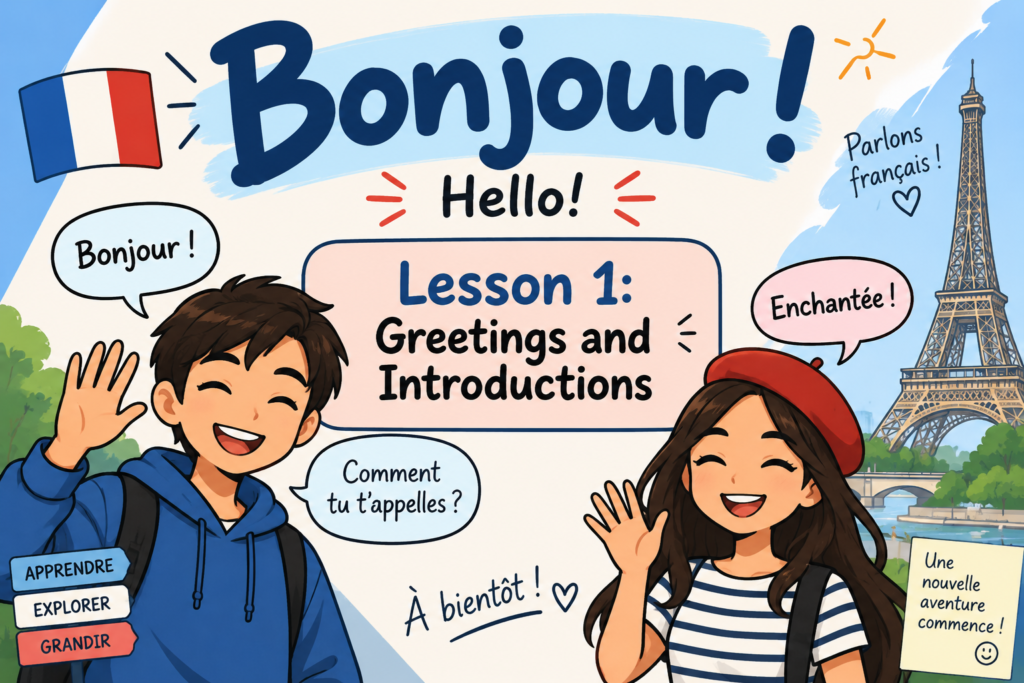
Lesson 1: Greetings and Introductions
Level: Emergent / Beginner
Unit: 1 – Bonjour !
Key Concept: Communication
Related Concepts: Message, Convention
Global Context: Identities & Relationships
Statement of Inquiry
Learning a new language helps us express our identity and build relationships through meaningful communication.
1. Lesson overview
This is your first French lesson, and you may have no prior knowledge of French. You are not expected to know any French before beginning.
By the end of this lesson, you will be able to:
- understand what a greeting is;
- use Bonjour and Salut appropriately;
- understand the difference between formal and informal greetings;
- ask someone’s name;
- say your own name;
- ask how someone is;
- respond to a simple greeting;
- say goodbye;
- recognize the basic structure of a short French introduction.
2. Learning objectives
By the end of the lesson, I can:
Knowledge
☐ Explain what a greeting is.
☐ Explain the difference between Bonjour and Salut.
☐ Identify a formal and an informal greeting.
Understanding
☐ Understand a simple French greeting exchange.
☐ Understand the question Comment tu t’appelles ?
Application
☐ Say Je m’appelle…
☐ Ask Comment tu t’appelles ?
☐ Say Bonjour, Salut and Au revoir appropriately.
Communication
☐ Introduce myself to a classmate in French.
3. Key vocabulary
You will first learn a small number of expressions.
| French | English | Use |
|---|---|---|
| Bonjour ! | Hello! / Good morning! | General/daytime greeting |
| Salut ! | Hi! | Informal |
| Bonsoir ! | Good evening! | Evening |
| Au revoir ! | Goodbye! | Leaving |
| À bientôt ! | See you soon! | Informal/friendly |
| Merci ! | Thank you! | Thanking someone |
| Ça va ? | How are you? | Asking how someone is |
| Ça va bien. | I am doing well. | Positive response |
| Comme ci, comme ça. | So-so. | Neutral response |
| Ça va mal. | I am not doing well. | Negative response |
| Je m’appelle… | My name is… | Introducing yourself |
| Comment tu t’appelles ? | What is your name? | Asking someone’s name |
| Enchanté ! / Enchantée ! | Nice to meet you! | Meeting someone |
Remember
You do not need to memorize all of these immediately.
For your first lesson, focus on:
Bonjour !
Salut !
Comment tu t’appelles ?
Je m’appelle…
Ça va ?
Ça va bien.
Au revoir !
4. What is a Greeting?
Definition
A greeting is a word or expression we use when we meet or speak to someone.
For example, in English:
Hello!
Hi!
Good morning!
French has different greetings too.
French:
Bonjour !
Salut !
Bonsoir !
5. Understanding French Greetings
A. Bonjour
Bonjour !
Definition: Hello / Good morning
Usage
Use Bonjour when greeting someone during the day.
You can use it with:
- teachers
- adults
- classmates
- people you do not know
- people you know
Examples
Bonjour, Madame !
Bonjour, Monsieur !
Bonjour, Emma !
Remember
Bonjour is a safe and polite greeting.
6. Salut
Salut !
Definition: Hi / Hello
Usage
Salut is generally informal.
Use it with:
- friends
- classmates
- people you know well
Example
Student → friend:
Salut, Lucas !
Teacher → student:
Bonjour, Lucas !
For now, remember this simple rule:
Bonjour = polite/general
Salut = informal/friendly
7. Bonjour vs Salut
| Situation | Correct expression |
|---|---|
| Meeting your teacher | Bonjour ! |
| Meeting your friend | Salut ! |
| Meeting someone you don’t know | Bonjour ! |
| Meeting your classmate | Bonjour ! / Salut ! |
| Greeting someone formally | Bonjour ! |
Think about these situations:
If you meet your French teacher in the morning, would you say Salut or Bonjour?
Bonjour !
If you meet your best friend?
Salut !
8. Bonsoir
Bonsoir !
Definition: Good evening
Usage
Use Bonsoir when greeting someone in the evening.
Compare:
Bonjour ! → daytime
Bonsoir ! → evening
Remember
Do not say:
- Bonjour soir
Instead:
- Bonsoir
9. Saying Goodbye
Au revoir
Au revoir !
Definition: Goodbye
Usage
Use Au revoir when leaving or ending an interaction.
Example:
Bonjour, Madame !
Au revoir, Madame !
À bientôt
À bientôt !
Definition: See you soon!
This is another friendly way to end a conversation.
10. Introducing Yourself
Now you will move from greeting to identity.
When you meet someone for the first time, you usually introduce yourself.
In English:
Hello. My name is Emma.
In French:
Bonjour. Je m’appelle Emma.
11. Asking someone’s Name
Structure
Comment tu t’appelles ?
Definition
What is your name?
Let’s look at the expression:
- Comment = how
- tu = you
- t’appelles = are called / call yourself
At this level, you do not need to understand the grammatical history of t’appelles.
You simply need to recognize the expression as a fixed question meaning:
What is your name?
You ask:
Comment tu t’appelles ?
You respond:
Je m’appelle ______.
12. Saying your Name
Structure
Je m’appelle + name.
Definition
My name is…
Formation
Je m’appelle + your name
Examples:
Je m’appelle Sarah.
Je m’appelle Adam.
Je m’appelle Maria.
13. Important beginner Point
You may be tempted to translate English word-for-word.
You might say:
- Je suis Emma.
For this lesson, use the standard introduction:
- Je m’appelle Emma.
Remember:
French uses the expression Je m’appelle… to introduce your name.
Learn this as one useful expression.
14. Asking how someone is
Ça va ?
Definition
Ça va ? = How are you? / Are you okay?
This is a very common everyday expression.
Basic response
Ça va bien.
= I am doing well.
Other responses:
Ça va.
I’m okay.
Comme ci, comme ça.
So-so.
Ça va mal.
I’m not doing well.
For now, focus first on:
Ça va ?
Ça va bien.
15. Complete beginner conversation
Look at this conversation.
Dialogue 1
Student A: Bonjour !
Student B: Bonjour !
Student A: Comment tu t’appelles ?
Student B: Je m’appelle Emma. Et toi ?
Student A: Je m’appelle Lucas.
Student B: Enchanté !
Student A: Enchanté !
Student B: Ça va ?
Student A: Ça va bien, merci !
Student B: Au revoir !
Student A: Au revoir !
16. Understand the structure
A simple conversation has a sequence.
Greeting → Name → Response → Well-being → Goodbye
BONJOUR !
     ↓
Comment tu t'appelles ?
     ↓
Je m'appelle...
     ↓
Ça va ?
     ↓
Ça va bien.
     ↓
Au revoir !
This gives you a communication framework, rather than asking you to memorize disconnected vocabulary.
17. Listen and Repeat
First, listen carefully. Don’t repeat yet.
Bonjour !
Pause.
Je m’appelle ______.
Pause.
Comment tu t’appelles ?
Pause.
Ça va ?
Pause.
Ça va bien.
Pause.
Au revoir !
Now repeat each expression after your teacher.
18. Pronunciation practice
Keep your pronunciation simple and confident.
Bonjour
Approximate pronunciation:
bon-zhoor
Repeat:
Bonjour.
Salut
sa-lü
Repeat:
Salut.
Au revoir
oh ruh-vwar
Repeat:
Au revoir.
Je m’appelle
zhuh mah-pell
Repeat:
Je m’appelle.
Comment tu t’appelles ?
koh-mahn tü tah-pell
Repeat.
Ça va ?
sa va
Repeat.
19. Activity 1 – Greeting detective
Time: 5 minutes
You will see different situations.
Situation 1
You meet your teacher at school.
Your answer:
Bonjour !
Situation 2
You meet your best friend.
Your answer:
Salut !
Situation 3
It is evening and you meet your neighbour.
Your answer:
Bonsoir !
Situation 4
You are leaving school.
Your answer:
Au revoir !
20. Activity 2 – Repeat and respond
Teacher:
Bonjour !
You:
Bonjour !
Teacher:
Comment tu t’appelles ?
You:
Je m’appelle _________.
Teacher:
Ça va ?
You:
Ça va bien !
Teacher:
Au revoir !
You:
Au revoir !
Repeat several times, gradually increasing speed.
21. Activity 3 – Meet your classmate
Online version
You will work in pairs/breakout rooms.
Use this dialogue:
Student A
Bonjour !
Comment tu t’appelles ?
Student B
Bonjour !
Je m’appelle _________.
Student A
Ça va ?
Student B
Ça va bien, merci !
Student B
Et toi ?
Student A
Ça va bien !
Both
Au revoir !
22. Online classroom variation
If breakout rooms are not practical, we will practise together.
Imagine that your classmate is a new student.
Student 1:
Bonjour !
Student 2:
Bonjour !
Student 1:
Comment tu t’appelles ?
Student 2:
Je m’appelle _________.
Student 1:
Enchanté(e) !
Student 2:
Enchanté(e) !
23. Activity 4 – My French Name Card
Take a blank piece of paper.
Create:
MA CARTE
Include:
Bonjour !
Je m’appelle __________________.
You can decorate your card.
Extension
If you are confident, add:
Ça va bien !
24. Mini writing task
Copy and complete:
Bonjour !
Je m’appelle __________________________.
Ça va bien.
Au revoir !
Keep your writing short. You are beginning French today, so accuracy is more important than writing a lot.
25. Formative check
Complete these independently.
Match:
| French | English |
|---|---|
| Bonjour | Goodbye |
| Salut | Hello |
| Au revoir | Hi |
| Ça va ? | How are you? |
Then complete:
1.
Je m’appelle __________________.
2.
__________________ ! = Hello
3.
__________________ ! = Goodbye
4.
Comment __________________ t’appelles ?
26. Exit ticket
Before leaving the lesson, type this in the chat:
Bonjour ! Je m’appelle __________________. Au revoir !
If you are confident, you can add:
Ça va bien !
27. Common beginner mistakes
Mistake 1
❌ Je appelle…
✅ Je m’appelle…
Learn the complete expression rather than trying to construct it independently.
Mistake 2
❌ Bonjour = Goodbye
✅ Bonjour = Hello
Mistake 3
❌ Au revoir = Hello
✅ Au revoir = Goodbye
Mistake 4
You may pronounce Salut like the English word “salute.”
Model it as:
sa-lü
Mistake 5
You may use Salut with everyone.
Remember:
Bonjour is the safer polite/general greeting.
Salut is informal.
28. Board plan
Keep the board visually simple.
UNIT 1 – BONJOUR !

1. GREET

Bonjour ! = Hello
Salut ! = Hi
Bonsoir ! = Good evening

2. INTRODUCE

Comment tu t'appelles ?
= What is your name?

Je m'appelle...
= My name is...

3. ASK HOW SOMEONE IS

Ça va ?
= How are you?

Ça va bien.
= I'm doing well.

4. SAY GOODBYE

Au revoir !
= Goodbye!

À bientôt !
= See you soon!
29. Learning check
At the end of the lesson, complete this conversation:
A: ______________________________ !
B: Bonjour !
A: Comment tu t’appelles ?
B: ______________________________________________.
A: Ça va ?
B: ______________________________________________.
A: Au revoir !
B: ______________________________________________.
Expected answers:
Bonjour !
Je m’appelle __________________.
Ça va bien.
Au revoir !
30. Homework
My First French Introduction
Write:
Bonjour !
Je m’appelle __________________.
Ça va bien.
Au revoir !
Optional challenge
Add:
Enchanté(e) !
31. Success criteria
Today I can…
| I can… | |
|---|---|
| Say hello in French. | ☐ |
| Say goodbye in French. | ☐ |
| Ask someone’s name. | ☐ |
| Say my name. | ☐ |
| Ask how someone is. | ☐ |
| Say that I am doing well. | ☐ |
| Use Bonjour and Salut appropriately. | ☐ |
32. Closing
“Excellent work today, everyone!”
“Today you learned your first French conversation.”
“You can now greet someone, ask their name, introduce yourself, ask how they are and say goodbye.”
“You don’t need to know everything today. Learning a language happens step by step.”
“Before we finish, everyone type one sentence in the chat.”
Bonjour ! Je m’appelle __________________.
“Très bien ! Excellent travail !”
Au revoir et à bientôt ! 🇫🇷
Lesson 1 Takeaway
You should leave Lesson 1 confidently knowing this core exchange:
Bonjour !
Comment tu t’appelles ?
Je m’appelle __________________.
Ça va ?
Ça va bien, merci !
Au revoir !
This provides the foundation for Lesson 2, where you will move from simply saying your name to using subject pronouns + the verb être to describe yourself.