Description
Learn how to identify and use French subject pronouns correctly with simple English explanations, examples, pronunciation tips, classroom practice, and beginner-friendly activities for MYP French learners.
What Are Subject Pronouns?
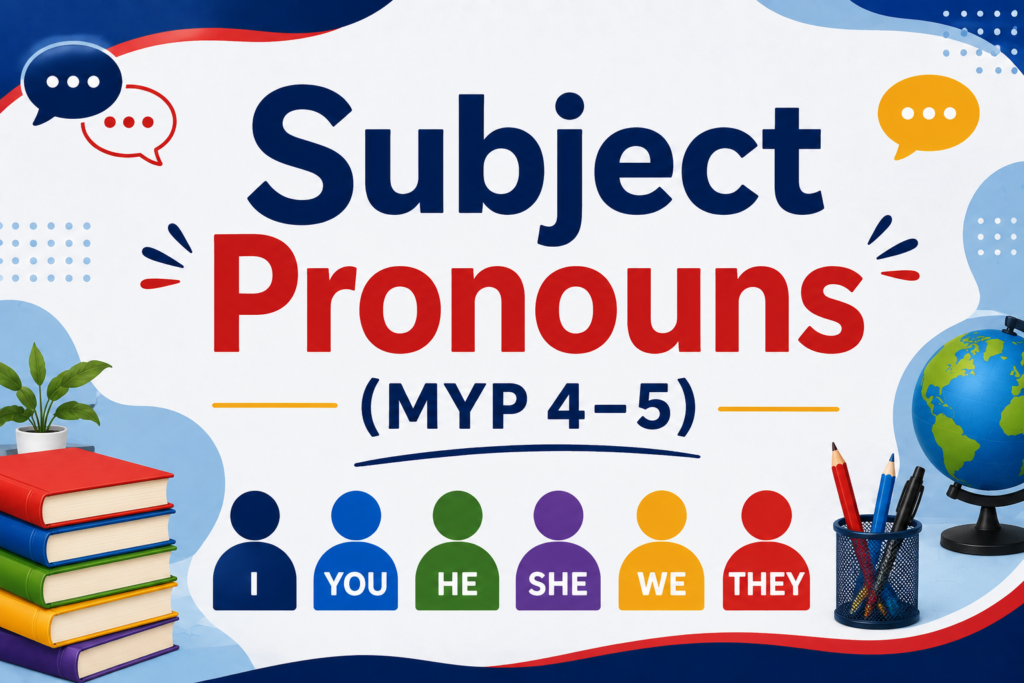
Subject pronouns are words that replace the name of a person, animal, place, or thing.
In English, subject pronouns are:
- I
- you
- he
- she
- we
- they
In French, subject pronouns are extremely important because every verb changes depending on the pronoun used.
The French Subject Pronouns
| French | English |
|---|---|
| je | I |
| tu | you (singular / informal) |
| il | he |
| elle | she |
| nous | we |
| vous | you (formal or plural) |
| ils | they (masculine or mixed group) |
| elles | they (feminine group) |
Why Are Subject Pronouns Important?
In French:
- every sentence usually needs a subject pronoun
- verbs change according to the pronoun
- pronouns help identify who is doing the action
Example:
- Je parle français.
(I speak French.) - Nous parlons français.
(We speak French.)
The verb changes because the subject pronoun changes.
1. Je — I
Meaning
“Je” means “I.”
Use it when talking about yourself.
Examples
- Je suis élève.
(I am a student.) - Je parle anglais et français.
(I speak English and French.) - J’aime le football.
(I like football.)
IMPORTANT RULE — Je becomes J’
When “je” comes before a vowel or silent h, it becomes:
j’
Example:
- J’habite à Delhi.
(I live in Delhi.) - J’aime la musique.
(I like music.)
2. Tu — You (informal singular)
Meaning
“Tu” is used:
- with friends
- family members
- classmates
- people your age
It is informal.
Examples
- Tu es intelligent.
(You are intelligent.) - Tu habites où ?
(Where do you live?) - Tu aimes les jeux vidéo ?
(Do you like video games?)
3. Il — He
Meaning
“Il” replaces a masculine person or noun.
Examples
- Il est gentil.
(He is nice.) - Il joue au basket.
(He plays basketball.) - Il aime les voyages.
(He likes traveling.)
4. Elle — She
Meaning
“Elle” replaces a feminine person or noun.
Examples
- Elle est sympathique.
(She is friendly.) - Elle parle espagnol.
(She speaks Spanish.) - Elle adore la musique.
(She loves music.)
5. Nous — We
Meaning
“Nous” means “we.”
Use it when speaking about yourself and other people together.
Examples
- Nous sommes amis.
(We are friends.) - Nous étudions le français.
(We study French.) - Nous allons à l’école.
(We go to school.)
6. Vous — You (formal or plural)
Meaning
“Vous” has TWO uses.
A. Formal singular “you”
Use with:
- teachers
- adults
- strangers
- formal situations
Example:
- Vous êtes professeur ?
(Are you a teacher?)
B. Plural “you”
Use when talking to more than one person.
Example:
- Vous aimez le sport ?
(Do you all like sports?)
7. Ils — They (masculine or mixed group)
Meaning
“Ils” is used for:
- a group of boys
- a mixed group (boys and girls)
Examples
- Ils jouent au football.
(They play football.) - Ils sont contents.
(They are happy.) - Ils regardent un film.
(They are watching a movie.)
8. Elles — They (feminine group)
Meaning
“Elles” is ONLY used for a group of females.
Examples
- Elles sont françaises.
(They are French.) - Elles aiment danser.
(They like dancing.) - Elles étudient ensemble.
(They study together.)
Pronunciation Tips
| Pronoun | Pronunciation |
|---|---|
| je | zhuh |
| tu | too |
| il | eel |
| elle | el |
| nous | noo |
| vous | voo |
| ils | eel |
| elles | el |
Subject Pronouns + Être
| Pronoun | Être |
|---|---|
| je | suis |
| tu | es |
| il / elle | est |
| nous | sommes |
| vous | êtes |
| ils / elles | sont |
Examples with Être
- Je suis étudiant.
- Tu es gentil.
- Elle est contente.
- Nous sommes fatigués.
- Vous êtes en classe.
- Ils sont sportifs.
Subject Pronouns + Avoir
| Pronoun | Avoir |
|---|---|
| j’ | ai |
| tu | as |
| il / elle | a |
| nous | avons |
| vous | avez |
| ils / elles | ont |
Examples with Avoir
- J’ai un livre.
- Tu as un chien.
- Il a une voiture.
- Nous avons des devoirs.
- Vous avez une question.
- Elles ont des amis.
Common Beginner Mistakes
Mistake 1
Incorrect: Je est étudiant.
Correct: Je suis étudiant.
Mistake 2
Incorrect: Tu suis intelligent.
Correct: Tu es intelligent.
Mistake 3
Incorrect: Elles sont intelligent.
Correct: Elles sont intelligentes.
Quick Identification Technique
Ask yourself:
Who is doing the action?
- I → je
- you → tu / vous
- he → il
- she → elle
- we → nous
- they → ils / elles
Mini Practice
Choose the correct pronoun
- ___ suis français.
- ___ êtes professeur.
- ___ aiment la musique. (girls)
- ___ allons au cinéma.
- ___ habites à Mumbai.
Answers
- Je
- Vous
- Elles
- Nous
- Tu
Speaking Practice
Why This Lesson Is Important
Subject pronouns are one of the most important foundations in French because they help you:
- build sentences correctly
- conjugate verbs
- communicate clearly
- speak naturally
You will use subject pronouns in EVERY French lesson.
Continue Your Learning
After studying French subject pronouns, continue with these important beginner lessons:
➜ Être in French — learn how to say who you are, describe people, and identify objects
➜ Avoir in French — learn how to talk about possession, age, and everyday expressions
➜ Aller in French — learn how to talk about places and movement
➜ Faire in French — learn how to describe activities, hobbies, and routines
➜ Definite and indefinite articles — learn how to use le, la, les, un, une, des correctly
➜ French adjectives — learn adjective agreement and description vocabulary
These lessons will help you:
- improve sentence building
- strengthen grammar foundations
- communicate more confidently
- prepare for speaking and writing activities