
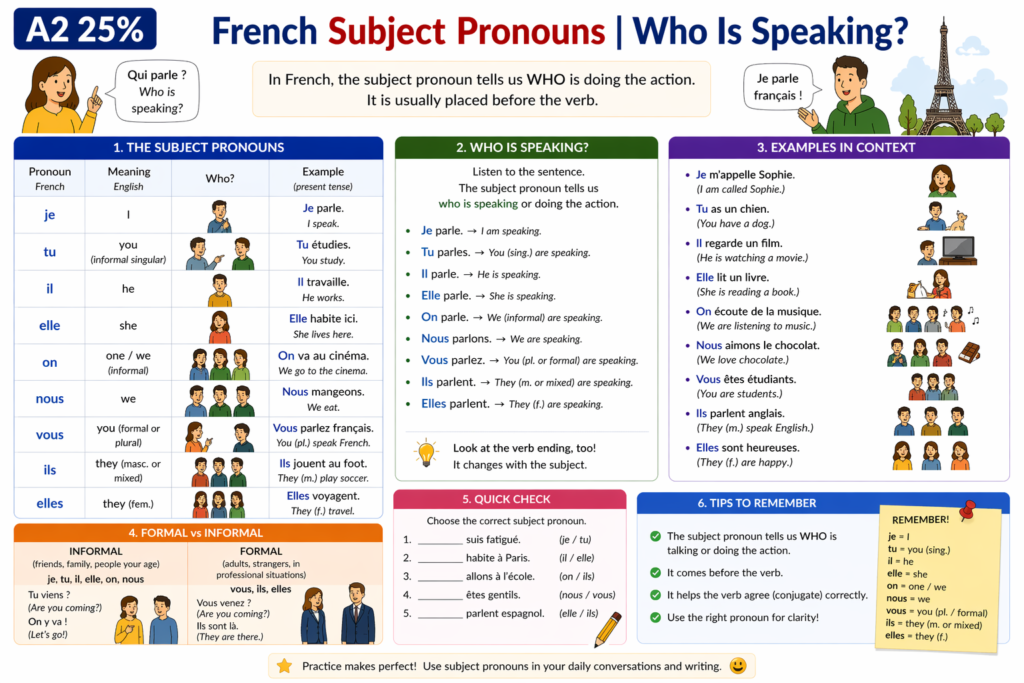
Description
Learn French subject pronouns (je, tu, il, elle, nous, vous, ils, elles) with clear rules, agreement, and examples for A2 learners and TEF Canada.
Introduction: Why Subject Pronouns Matter at A2
In this lesson on French subject pronouns, you will learn how to build correct and complete sentences.
At A1, you could sometimes say short answers.
At A2, this is no longer enough.
You must:
- speak in full sentences
- choose the correct subject
- match the verb correctly
Mastering French subject pronouns will help you:
- avoid basic grammar mistakes
- speak clearly and naturally
- improve your TEF Canada score
What Are French Subject Pronouns?
French subject pronouns replace a person or thing and show who is doing the action.
Simple Idea
Instead of repeating a name, you use a pronoun.
Examples
- Marie travaille → Elle travaille
- Paul et Ali habitent ici → Ils habitent ici
The pronoun replaces the name.
1. List of French Subject Pronouns
In French subject pronouns, each form has a specific meaning.
Forms
- je → I
- tu → you (informal, singular)
- il → he
- elle → she
- nous → we
- vous → you (formal or plural)
- ils → they (masculine or mixed)
- elles → they (feminine only)
2. How to Choose the Correct Pronoun
This is a key skill in French subject pronouns.
Rule 1: Replace the person
- Marie → elle
- Paul → il
- Marie et Sophie → elles
- Paul et Marie → ils
Rule 2: Masculine dominates
If there is one male in the group, use ils
- Paul + Marie → ils
3. Subject–Verb Agreement (VERY IMPORTANT)
In French subject pronouns, the verb MUST match the subject.
Example with travailler
- je travaille
- tu travailles
- il travaille
- nous travaillons
- vous travaillez
- ils travaillent
Key Rule
Change the subject → change the verb
Common Mistakes
- Nous travaille
- Je travaillent
Correct Forms
- Nous travaillons
- Je travaille
This is one of the most common A2 errors.
4. “Je” → “J’” (Elision Rule)
In French subject pronouns, pronunciation matters.
Rule
“je” becomes “j’” before a vowel
Examples
- Je ai → J’ai
- Je habite → J’habite
This makes French smoother.
5. Tu vs Vous (Very Important at A2)
In French subject pronouns, choosing between tu and vous is essential.
Difference
| Pronoun | Use |
|---|---|
| tu | informal (friends, family) |
| vous | formal OR plural |
Examples
- Tu travailles ici (friend)
- Vous travaillez ici (teacher / formal)
In TEF Canada, use “vous” for safety
6. Ils vs Elles (Plural Agreement)
In French subject pronouns, plural forms depend on gender.
Rule
- ils → masculine OR mixed group
- elles → only females
Examples
- Paul et Marie → ils
- Marie et Sophie → elles
7. Using Subject Pronouns in Real Sentences
Structure
subject + verb + complement
Examples
- Je travaille dans un bureau
- Nous habitons près du centre
- Ils regardent la télévision
This is the base of all A2 communication.
8. TEF Canada Strategy (Exam Focus)
In TEF Canada, French subject pronouns are evaluated in:
- speaking
- writing
- grammar accuracy
What the examiner checks
- correct pronoun
- correct verb form
- clear sentence
High-Scoring Example
- Je travaille dans un bureau
- Nous habitons près du centre
- Ils regardent la télévision
Simple + correct = strong score
9. Common Mistakes in French Subject Pronouns
Errors
- Nous travaille
- Elle sont
- Je parlent
Correct Forms
- Nous travaillons
- Elles sont
- Je parle
Always check:
– subject
– verb ending
10. Practice (A2 Level)
Exercise 1
Choose the correct pronoun:
- Marie → ___
- Paul et Ali → ___
- Sophie et Anna → ___
Exercise 2
Correct the sentence:
- Nous travaille
- Elle sont
Exercise 3
Write 3 sentences:
- one with je
- one with nous
- one with ils
11. Mini TEF Speaking Task
Situation: Talk about your life.
Model Answer
Je travaille dans un bureau.
Nous habitons près du centre.
Ils regardent la télévision.
Continue Learning French
After mastering French subject pronouns, continue with:
FAQ
What are French subject pronouns?
They replace a person and show who does the action.
Why are they important at A2?
Because full sentences are required.
What is the difference between tu and vous?
Tu is informal, vous is formal or plural.
Is this important for TEF Canada?
Yes. Incorrect pronouns affect your grammar score.
Final Tip
To master French subject pronouns, always check:
- Who is speaking?
- Is it singular or plural?
- Does the verb match?
This will eliminate most grammar mistakes.