
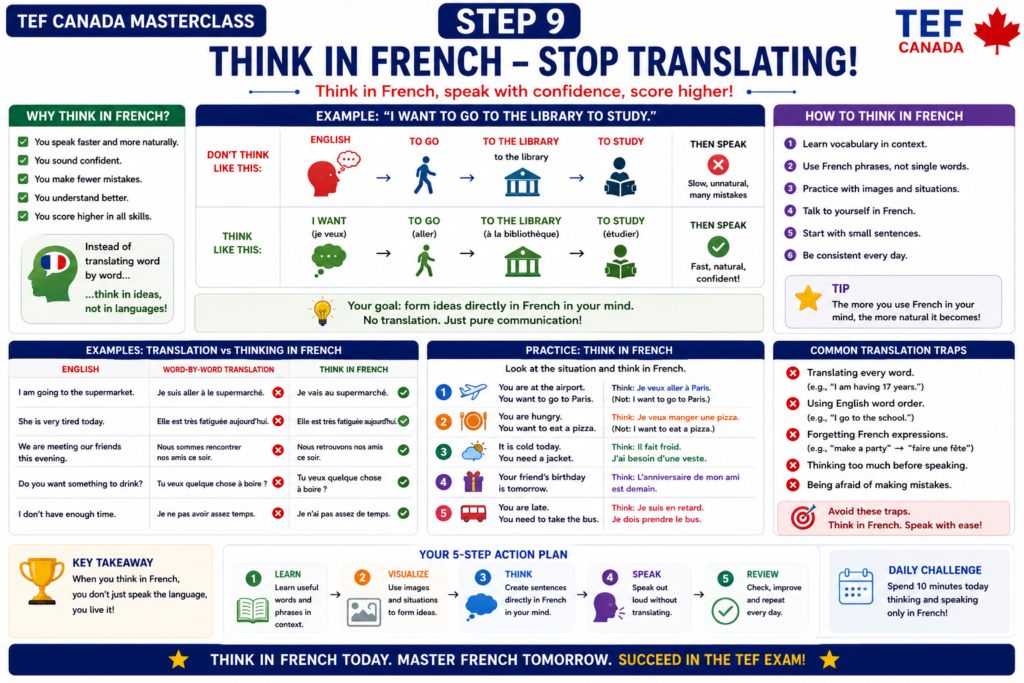
The Biggest habit that prevents Fluency
Hello everyone!
Welcome to Step 9.
You’ve already learned:
- How the TEF exam is organized.
- The 10 communication themes.
- Theme Folders.
- Mind Maps.
- Connectors.
- Speaking and Writing Frameworks.
- Language Chunks.
Now we’re going to talk about one habit that slows down almost every French learner.
That habit is translating everything from your native language into French.
If you want to become fluent, you must gradually train yourself to think directly in French.
This doesn’t happen overnight, but it is one of the biggest turning points in language learning.
Why translation Slows you down
Imagine you’re in Speaking Section B.
The examiner gives you an advertisement.
You immediately think in English:
“This gym is affordable, close to home, and has modern equipment.”
Now your brain has to:
English
↓
Translate into French
↓
Check grammar
↓
Choose vocabulary
↓
Correct pronunciation
↓
Finally speak.
This process takes time.
During the exam, those few seconds feel very long.
That’s why many students hesitate.
Not because they don’t know French…
But because they’re using two languages at the same time.
How Fluent speakers think
Now imagine an advanced learner.
They see the same advertisement.
Their brain immediately produces:
Cette salle de sport est près de chez moi.
Elle n’est pas chère.
Les équipements sont modernes.
No translation.
Just ideas directly in French.
This is much faster and much more natural.
Your Goal is Not perfect French
Many students believe:
“I need to know every word before I can speak.”
That’s impossible.
Even native speakers don’t know every word.
Your goal is much simpler.
Your goal is to communicate your ideas using the French you already know.
Simple French is always better than silent French.
Think in images, Not in English
Let’s try an experiment.
Imagine an apple.
Did you think:
“Apple.”
Probably not.
You simply saw the fruit.
Now connect that image directly to:
une pomme
No English.
Just the image.
This is how children learn languages.
Object
↓
French word
Instead of:
Object
↓
English
↓
French
Train yourself to make the shortest possible connection.
Replace translation with Association
Instead of translating vocabulary lists…
Create associations.
Example:
Theme: Restaurant
Instead of writing:
restaurant = restaurant
Connect it with other French words.
restaurant
↓
menu
↓
serveur
↓
plat
↓
addition
↓
réserver
↓
délicieux
Now one word naturally leads to another.
This is exactly how your memory becomes stronger.
Use French definitions
As your level improves, avoid using bilingual dictionaries all the time.
Instead of asking:
“What does logement mean in English?”
Ask:
“How would I explain logement in French?”
For example:
Un logement est un endroit où une personne habite.
Simple.
Clear.
Entirely in French.
This habit develops real fluency.
Describe instead of translating
Sometimes you don’t know a word.
Don’t panic.
Describe it.
Imagine you forget the word:
parapluie
Instead of stopping…
Say:
C’est un objet qu’on utilise quand il pleut.
The examiner is not expecting perfection.
They are evaluating whether you can keep communicating.
This technique is called circumlocution, and it is a very valuable communication skill.
Learn to simplify
Many students try to sound advanced.
They search for complicated vocabulary.
As a result, they become nervous.
Remember this:
Simple French spoken confidently is much more effective than complicated French spoken with hesitation.
Compare these two answers.
Student A
Uses difficult vocabulary.
Stops many times.
Makes grammar mistakes.
Student B
Uses simple vocabulary.
Speaks smoothly.
Explains ideas clearly.
Who sounds more confident?
Usually Student B.
Fluency is not about complexity.
It’s about communication.
Build French habits Every Day
Here are some simple exercises.
Exercise 1: Name everything around you
Look around your room.
Say:
une chaise
une table
une fenêtre
un ordinateur
Don’t translate.
Just identify the object in French.
Exercise 2: Describe your day
Instead of thinking in English, ask yourself:
Qu’est-ce que je fais maintenant ?
Answer in simple French.
Je bois un café.
Je travaille.
Je prépare mon cours.
Je regarde une vidéo.
This trains your brain to produce French automatically.
Exercise 3: Ask yourself questions
Throughout the day, ask simple questions.
Où suis-je ?
Qu’est-ce que je mange ?
Quel temps fait-il ?
Que vais-je faire après ?
Then answer them in French.
Exercise 4: Create mini conversations
Imagine you’re in a shop.
Create both parts of the conversation.
Bonjour.
Bonjour Madame.
Je peux vous aider ?
Oui, je cherche un ordinateur portable.
Just two or three minutes every day can make a huge difference.
Don’t translate whole sentences
Instead of thinking:
“Tomorrow I will go to work because I have an important meeting.”
Break it into simple French ideas.
Demain…
↓
Je vais travailler.
↓
J’ai une réunion importante.
Same meaning.
Much easier.
Native speakers often communicate in short, clear sentences.
You can too.
Accept imperfection
One of the biggest obstacles to fluency is fear of making mistakes.
Remember:
Communication comes before perfection.
If you hesitate for thirty seconds trying to remember one word, you’ve stopped communicating.
If you explain the idea using different words, the conversation continues.
That’s exactly what good communicators do.
Think about ideas, Not grammar
During the TEF exam, your first objective is:
“What do I want to say?”
Not:
“What tense should I use?”
Grammar is important.
But ideas come first.
Once you know your message, you can express it using the grammar you already know.
A daily Five-Minute routine
Every day, spend just five minutes thinking only in French.
For example:
Morning.
Aujourd’hui, je vais travailler.
Breakfast.
Je bois du café.
Walking.
Il fait beau aujourd’hui.
Shopping.
J’ai besoin de lait.
Dinner.
Ce repas est délicieux.
These small moments train your brain far more effectively than translating long paragraphs.
The long-term Goal
At first, you’ll still translate sometimes.
That’s completely normal.
Then you’ll notice something interesting.
Simple ideas will start coming directly in French.
Later, longer sentences will come automatically.
Eventually, you’ll realize you haven’t translated for several minutes.
That’s a sign that you’re beginning to think in French.
Final advice
Don’t wait until you’re “advanced” to stop translating.
Start today.
Use the French you already know.
Think in short sentences.
Use language chunks.
Describe instead of translating.
Accept simple language.
Every day, your brain will build stronger French connections.
Key takeaway
Translation is a useful learning tool, but it should not become a permanent habit.
The goal of the TEF exam is not to prove that you can translate English into French.
The goal is to show that you can communicate naturally in French.
The sooner you begin thinking directly in French, the faster you’ll speak, the more confidently you’ll write, and the more naturally you’ll interact during the exam.
Remember:
Don’t translate your thoughts. Train your thoughts to happen in French.