
Speak in Phrases, Not word by word
Hello everyone!
Welcome to Step 8.
By now, you’ve learned how to:
- Understand the 10 TEF themes.
- Build Theme Folders.
- Study one theme across all four skills.
- Create mind maps.
- Use connectors.
- Follow Speaking and Writing frameworks.
Now it’s time to discover one of the biggest differences between students who translate and students who speak fluently.
The difference is not grammar.
It is not vocabulary.
It is not pronunciation.
The difference is language chunks.
What is a Language Chunk?
A language chunk is a group of words that native speakers use together naturally.
Instead of building every sentence word by word…
You learn complete expressions.
For example, imagine someone asks you in English:
“How are you?”
You don’t stop to think:
“How… are… you…”
You answer automatically:
“I’m fine, thank you.”
That’s a language chunk.
Your brain remembers the whole expression as one unit.
French works exactly the same way.
Why Students speak slowly
Let’s compare two students.
Student A
Wants to say:
“I think this hotel is beautiful.”
Their brain works like this:
I…
think…
how do I say “think”?
Je…
pense…
this…
hotel…
is…
beautiful…
Every word requires a decision.
Speaking becomes slow.
Student B
Has already learned this chunk:
Je pense que…
Their brain immediately says:
Je pense que cet hôtel est magnifique.
Only the last few words change.
Speaking becomes much faster.
Think in Blocks, not Words
Instead of memorizing:
- je
- pense
- que
Learn:
Je pense que…
Instead of memorizing:
- à
- mon
- avis
Learn:
À mon avis…
Instead of memorizing:
- il
- faut
Learn:
Il faut…
Each chunk becomes one piece of French stored in your memory.
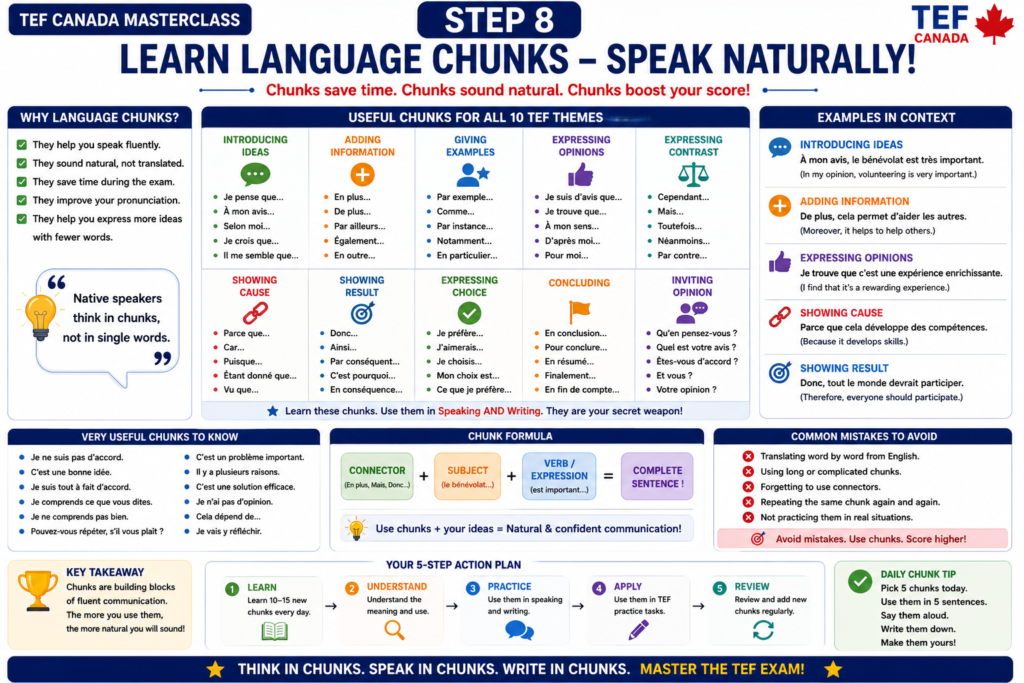
The Most useful Chunks for the Exam
Let’s organize them by purpose.
1. Giving your opinion
These are among the most frequently used expressions in Speaking and Writing.
Learn them until they become automatic.
- Je pense que…
- À mon avis…
- Selon moi…
- Personnellement…
- Je trouve que…
- Je crois que…
Instead of translating your opinion every time…
Simply choose one chunk and continue.
Example:
À mon avis, cette solution est la meilleure.
2. Agreeing
The examiner may challenge your opinion.
Be ready.
Useful chunks:
- Je suis d’accord.
- Tout à fait.
- Exactement.
- C’est vrai.
- Vous avez raison.
Example:
Je suis d’accord avec toi.
3. Disagreeing politely
Never say only:
Non.
Instead, soften your response.
Learn these chunks:
- Je ne suis pas tout à fait d’accord.
- Je comprends ton point de vue, mais…
- C’est possible, cependant…
- Je vois ce que tu veux dire, mais…
These sound much more natural.
4. Giving reasons
These chunks explain your ideas.
Examples:
- Parce que…
- En effet…
- La raison principale est que…
- C’est pourquoi…
Example:
Je préfère cette école parce qu’elle est près de chez moi.
5. Giving examples
Useful chunks:
- Par exemple…
- Prenons un exemple…
- Comme…
- C’est le cas de…
Examples make your arguments stronger.
6. Comparing
Useful chunks:
- Plus… que…
- Moins… que…
- Aussi… que…
- En comparaison…
- Contrairement à…
Example:
Cette ville est plus calme que Paris.
7. Making suggestions
Speaking Section B is all about convincing.
These chunks are essential.
- Tu devrais…
- Pourquoi ne pas…
- Je te conseille de…
- Je te recommande de…
- Si j’étais toi…
Example:
Si j’étais toi, je choisirais cette formation.
8. Expressing possibility
Sometimes you’re not completely certain.
Useful chunks:
- Il est possible que…
- Peut-être que…
- Je suppose que…
- Il me semble que…
Example:
Peut-être que cette solution te conviendra.
9. Expressing preference
Common TEF questions ask what you prefer.
Learn these chunks.
- Je préfère…
- J’aime mieux…
- Je choisirais…
- Mon choix serait…
Example:
Je préfère vivre en ville.
10. Concluding
Finish your ideas clearly.
Examples:
- Pour conclure…
- En résumé…
- Finalement…
- En conclusion…
These make your Speaking and Writing sound organized.
Chunks for Writing
Writing also uses ready-made expressions.
Beginning:
- Je vous écris pour…
- Je souhaiterais…
- Je me permets de vous contacter…
Making a request:
- Pourriez-vous…
- Serait-il possible de…
- Je vous serais reconnaissant de…
Closing:
- Je vous remercie par avance.
- Dans l’attente de votre réponse.
- Veuillez agréer, Madame, Monsieur…
Notice that these expressions appear in almost every formal email.
Learn them once.
Use them forever.
Chunks for Speaking Section B
Imagine the advertisement is about joining a gym.
Instead of thinking about every sentence…
Use chunks.
Salut !
J’ai trouvé quelque chose qui pourrait t’intéresser.
À mon avis, cette salle de sport est une excellente option.
Premièrement…
De plus…
Je comprends ton hésitation, mais…
Si j’étais toi…
Alors, qu’en penses-tu ?
Almost the entire conversation is built with chunks.
Only the details change.
How to Learn Chunks
Don’t study them randomly.
Create a dedicated notebook.
Write the chunk.
↓
Write one example.
↓
Use it in Speaking.
↓
Use it in Writing.
↓
Review it every week.
Soon, the chunk becomes automatic.
The 80/20 Rule
Did you know that a relatively small number of expressions appear again and again in French conversations?
If you master around 100 to 150 high-frequency language chunks, you’ll be able to handle most everyday situations in the TEF exam.
This doesn’t mean you know all of French.
It means you know the expressions that are used most often.
That’s much more valuable than memorizing hundreds of rare words you’ll never use.
Daily challenge
Every day, learn:
- 5 new language chunks.
- Use each one in three different sentences.
- Say each sentence aloud.
- Use at least one chunk in your writing practice.
After one month, you’ll have learned around 150 powerful expressions.
Imagine how much easier Speaking and Writing will become.
Final advice
Don’t try to build every sentence from individual words.
That’s how beginners speak.
Instead, collect useful phrases that native speakers use every day.
The more chunks you know, the less you need to translate.
Eventually, you’ll stop thinking:
“How do I say this?”
Instead, the expression will come to you naturally.
That’s when fluency begins.
Key takeaway
Fluent speakers don’t speak one word at a time.
They speak one phrase at a time.
Language chunks help you:
- speak faster,
- sound more natural,
- reduce hesitation,
- improve fluency,
- organize your ideas,
- and perform better in both Speaking and Writing.
Master your language chunks, and you’ll discover that French becomes easier, not because you’ve learned every word, but because you’ve learned how French is naturally spoken.