Now that you understand the basic structure of a French sentence, I want you to take the next step.
You already know:
Subject + Verb
and:
Subject + Verb + Object
In this lesson, you are going to learn how to build more complete sentences by adding a direct object and an indirect object.
The key idea is simple:
The order of the words matters.
In a simple French sentence, the basic order is usually similar to English, but French becomes more specific when you start adding objects, pronouns, adjectives and adverbs.
1. The basic structure
Let’s begin with the structure you already know.
Subject + Verb + Object
For example:
Marie aime Paul.
Let’s identify each part:
| French | Function |
|---|---|
| Marie | Subject |
| aime | Verb |
| Paul | Direct object |
The subject is the person doing the action.
The verb is the action.
The direct object is the person or thing receiving the action.
The source uses examples such as Tu appelles Jean and Elle lave la vaisselle to demonstrate this relationship.
2. What is a Direct Object?
A direct object receives the action of the verb directly, without a preposition such as à.
A useful question to ask is:
Verb + qui ?
or:
Verb + quoi ?
For example:
Je lis un livre.
Ask:
Je lis quoi ?
Answer:
un livre
Therefore:
un livre = complément d’objet direct (COD)
Another example:
Elle regarde la télévision.
Ask:
Elle regarde quoi ?
Answer:
la télévision
So:
la télévision = direct object
Another:
Nous invitons nos amis.
Ask:
Nous invitons qui ?
Answer:
nos amis
Therefore:
nos amis = direct object
3. A simple method for Finding the Direct Object
Whenever you are unsure, follow these three steps.
Step 1 — Find the verb
Paul mange une pomme.
Verb:
mange
Step 2 — Ask “who?” or “what?”
Paul mange quoi ?
Step 3 — Find the answer
une pomme
Therefore:
Paul = subject
mange = verb
une pomme = direct object
This is exactly the type of identification practice used in the source material.
4. Direct Object vs. No Direct Object
Not every sentence has a direct object.
Compare:
Je mange une pomme.
There is a direct object:
une pomme
But:
Je dors.
There is no direct object.
You cannot naturally ask:
Je dors quoi ?
So there is no direct object.
Another example:
Nous arrivons à huit heures.
There is no direct object.
à huit heures tells you when the action happens.
It is not the direct object.
5. Don’t confuse an Object with Additional information
Look at this sentence:
Les invités vont arriver à dix-neuf heures.
The verb is:
vont arriver
Then:
à dix-neuf heures
tells you when they will arrive.
It is not a direct object.
Now compare:
Ils vont féliciter Viviane.
Ask:
Ils vont féliciter qui ?
Answer:
Viviane
Therefore:
Viviane = direct object
These distinctions are specifically practised in the source exercises.
6. Now let’s add an Indirect Object
You can make your sentence more complete by adding another person who is involved in the action.
For example:
Rémy achète un livre à son père.
Let’s break it down:
Rémy → subject
achète → verb
un livre → direct object
à son père → indirect object
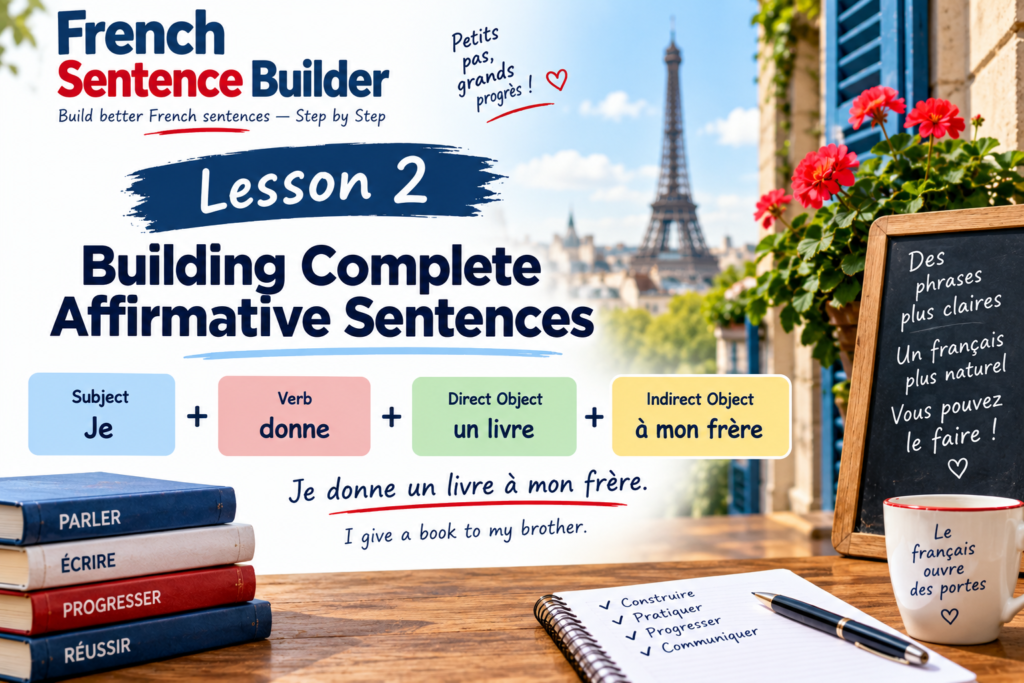
The structure is:
Subject + Verb + Direct Object + Indirect Object
This is one of the key sentence-building patterns in this section of the source.
7. Why is “un livre” Direct but “à son père” Indirect?
Let’s ask the questions.
Direct object
Rémy achète quoi ?
un livre
There is no preposition.
Therefore:
un livre = direct object
Indirect object
Now ask:
Rémy achète un livre à qui ?
à son père
The noun is introduced by:
à
Therefore:
à son père = indirect object
So remember:
Direct object → directly after the verb
Indirect object → often introduced by a preposition such as à
8. The sentence-building Formula
You now have a more powerful formula:
Level 1
Subject + Verb
Je travaille.
Level 2
Subject + Verb + Direct Object
Je lis un livre.
Level 3
Subject + Verb + Direct Object + Indirect Object
Je donne un livre à mon frère.
Break it down:
Je → subject
donne → verb
un livre → direct object
à mon frère → indirect object
9. More examples
Example 1
Le professeur montre un film aux élèves.
Subject:
Le professeur
Verb:
montre
Direct object:
un film
Indirect object:
aux élèves
Example 2
Ma mère donne un cadeau à mon frère.
Subject:
Ma mère
Verb:
donne
Direct object:
un cadeau
Indirect object:
à mon frère
Example 3
J’envoie une lettre à mon ami.
Subject:
Je
Verb:
envoie
Direct object:
une lettre
Indirect object:
à mon ami
Example 4
Nous expliquons le problème au professeur.
Subject:
Nous
Verb:
expliquons
Direct object:
le problème
Indirect object:
au professeur
10. Notice the contractions
You will often see:
à + le = au
So:
à le professeur ❌
becomes:
au professeur ✓
For example:
Je parle au professeur.
Similarly:
à + les = aux
So:
Je parle aux étudiants.
The sentence structure remains the same; only the form of the preposition changes.
11. The important word order Rule
Here is something I really want you to remember.
When you have a direct object noun and an indirect object noun, use:
Subject + Verb + Direct Object + Indirect Object
For example:
Je donne un livre à Paul.
Not:
Je donne à Paul un livre.
The second version can occur in some contexts with particular emphasis, but for the sentence-building foundation I want you to master the standard pattern first.
The source specifically emphasizes that French does not allow the same flexibility as English when the direct and indirect object nouns are reversed.
12. Build the sentence Step by Step
Let’s build one together.
I give you:
Marie / donner / cadeau / sa mère
First:
Subject
Marie
Verb
donne
Direct object
What does Marie give?
un cadeau
Indirect object
To whom?
à sa mère
Complete sentence:
Marie donne un cadeau à sa mère.
Now make it longer.
Add a time:
Marie donne un cadeau à sa mère demain.
Add a reason:
Marie donne un cadeau à sa mère demain parce que c’est son anniversaire.
You have now built a much more complete sentence without changing the fundamental structure.
Practice 1 — Find the Direct Object
For each sentence, ask qui ? or quoi ?
1.
Je prépare le dîner.
Direct object:
2.
Nous regardons un film.
Direct object:
3.
Elle achète une nouvelle voiture.
Direct object:
4.
Les enfants jouent dans le jardin.
Direct object:
5.
Mon frère lit le journal.
Direct object:
6.
Ils arrivent à huit heures.
Direct object:
Remember: some sentences do not have a direct object.
Practice 2 — Identify the Four Parts
Identify:
S = Subject
V = Verb
DO = Direct Object
IO = Indirect Object
Example
Je donne un livre à mon ami.
| Element | Answer |
|---|---|
| S | Je |
| V | donne |
| DO | un livre |
| IO | à mon ami |
Now you:
1.
Le professeur donne une note aux élèves.
2.
Ma sœur offre un cadeau à son amie.
3.
Nous envoyons une lettre à nos parents.
4.
Paul achète une voiture à son frère.
5.
Les enfants montrent leur dessin à leur mère.
Practice 3 — Complete the Sentence
Use the words to build complete French sentences.
1.
le professeur / montre / un film / aux élèves
2.
ma mère / donne / un cadeau / à mon frère
3.
nous / envoyons / une lettre / à nos parents
4.
Paul / achète / un livre / à sa sœur
5.
les enfants / apportent / leur travail / à leurs parents
The source uses this same type of controlled sentence construction, moving from identifying objects to supplying direct and indirect objects in complete sentences.
Practice 4 — Sentence builder
Now I want you to build the sentences yourself.
Use this formula:
SUBJECT + VERB + DIRECT OBJECT + INDIRECT OBJECT + EXTRA INFORMATION
Example
Subject: Je
Verb: donner
Direct object: un cadeau
Indirect object: à ma sœur
Time: demain
Your sentence:
Je donne un cadeau à ma sœur demain.
Now try:
A
Subject: Mon père
Verb: acheter
Direct object: une voiture
Indirect object: pour ma mère
B
Subject: Le professeur
Verb: expliquer
Direct object: le problème
Indirect object: aux étudiants
C
Subject: Nous
Verb: envoyer
Direct object: une photo
Indirect object: à nos amis
Time: ce soir
Practice 5 — Correct the word Order
Put the words in the correct order.
1.
un livre / à sa sœur / donne / Marie
2.
aux élèves / le professeur / un exercice / explique
3.
à mon ami / j’envoie / une photo
4.
leur mère / les enfants / un cadeau / donnent / à
5.
à son père / Rémy / un livre / achète
Mini writing Challenge
Now I want you to write five sentences about your daily life.
Each sentence should contain at least:
Subject + Verb + Object
For example:
Je regarde la télévision le soir.
Then, for at least two sentences, add an indirect object.
For example:
J’envoie des messages à mes amis.
Try to make your sentences personal.
You could write about:
- your work;
- your family;
- your studies;
- your hobbies;
- your daily routine;
- your friends.
What you should Remember
At this point, you should be comfortable with these structures:
Basic
Sujet + Verbe
Je travaille.
With a direct object
Sujet + Verbe + Objet direct
Je lis un livre.
With direct + indirect object
Sujet + Verbe + Objet direct + Objet indirect
Je donne un livre à mon frère.
And when you are unsure whether something is a direct object, ask:
Qui ?
or
Quoi ?
If there is a preposition such as à, pay attention: you may be dealing with an indirect object.
Your sentence builder Rule
I want you to remember this:
Don’t translate word by word from English.
Instead, build the French sentence according to its structure.
Think:
WHO? → DOES WHAT? → WHAT/WHO? → TO WHOM? → WHEN? → WHERE? → WHY?
For example:
Je donne un cadeau à ma sœur demain à la maison parce que c’est son anniversaire.
You can see the sentence growing one block at a time.
That is exactly what sentence building is about.
Next Lesson — Lesson 3: Negative Sentences
Next, we will take the sentences you can already build and learn how to turn them into negative sentences.
You will learn:
ne … pas
and then move toward:
ne … plus
ne … jamais
ne … rien
ne … personne
We will also look carefully at where the negative words go when the sentence contains objects and different verb structures. The source develops negative and interrogative sentence structures before moving into more precise question formation.