
Welcome
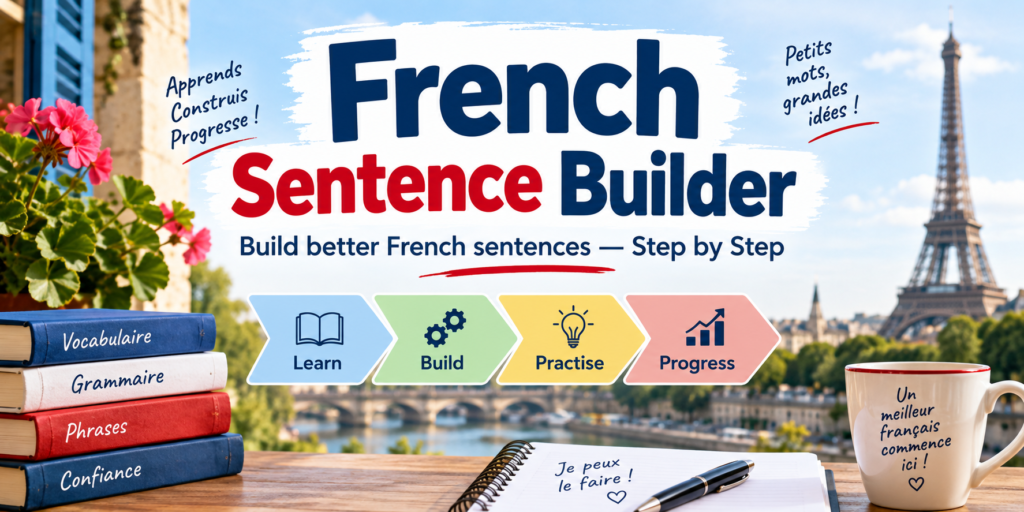
Welcome to French Sentence Builder.
In this course, you are going to learn how to build French sentences correctly, one step at a time.
You may already know many French words and grammar rules. However, knowing individual words is not enough. You need to know how to put those words together to create clear, correct and natural sentences.
That is our goal here.
You will begin with simple sentences and gradually learn how to make your French more detailed and sophisticated.
You will learn how to:
- build affirmative sentences;
- make sentences negative;
- ask questions;
- ask precise questions;
- use adjectives correctly;
- connect ideas;
- use direct and indirect objects;
- use pronouns;
- use adverbs and adverbial expressions;
- use prepositions;
- combine ideas into longer sentences;
- write messages, emails and letters;
- develop paragraphs;
- express more complex ideas.
The progression follows the central idea of the source: start with the building blocks of a sentence and gradually move toward independent sentence and paragraph writing.
How I want you to use this Course
I don’t want you to simply memorize sentences.
I want you to understand how a French sentence is constructed.
Think of every sentence as something you build.
For example:
Je travaille.
This is a complete sentence.
Now we can add information:
Je travaille à Paris.
We can add another detail:
Je travaille à Paris le lundi.
We can add a reason:
Je travaille à Paris le lundi parce que mon bureau est là-bas.
You are not memorizing four different sentences.
You are building one sentence step by step.
That is the skill I want you to develop.
Part 1 — The Foundations of a French sentence
Lesson 1 — What is a Sentence?
Before you start building longer sentences, you need to understand the basic structure of a French sentence.
1. A sentence needs a subject and a verb
The most important structure to remember is:
SUBJECT + VERB
For example:
Marie travaille.
Marie works.
Paul dort.
Paul sleeps.
Nous voyageons.
We travel.
Ils étudient.
They study.
The subject tells you who or what performs the action.
The verb tells you what the subject does or what happens.
The source introduces this fundamental relationship as subject + predicate, with the verb forming the central part of the predicate.
2. Find the Subject
When you read a French sentence, ask yourself:
Qui ?
Who?
or
Qu’est-ce qui ?
What?
Look at this sentence:
Lucas travaille.
Ask:
Qui travaille ?
Answer:
Lucas.
So:
| Part | Function |
|---|---|
| Lucas | Subject |
| travaille | Verb |
Now try:
Nous étudions le français.
Who studies French?
Nous
So:
Nous = sujet
étudions = verbe
3. The basic sentence Pattern
Once you know the subject and verb, you can add an object.
The basic pattern is:
SUBJECT + VERB + OBJECT
For example:
Marie aime Paul.
Break it down:
Marie → subject
aime → verb
Paul → object
Another example:
Je lis un livre.
Je → subject
lis → verb
un livre → object
Another:
Mon frère regarde la télévision.
Mon frère → subject
regarde → verb
la télévision → object
This subject + verb + object order is one of the fundamental sentence patterns presented in the source material.
4. Build the Sentence
Now I want you to think like a sentence builder.
Start with:
Je travaille.
Add where:
Je travaille à Paris.
Add when:
Je travaille à Paris le lundi.
Add with whom:
Je travaille à Paris le lundi avec mon frère.
Add a reason:
Je travaille à Paris le lundi avec mon frère parce que nous avons le même bureau.
Notice what happened.
You started with:
Je travaille.
and gradually built:
Je + travaille + à Paris + le lundi + avec mon frère + parce que…
This is how I want you to approach French.
Don’t try to create a complicated sentence immediately. Build it piece by piece.
5. Sentence or Phrase?
You also need to understand the difference between a phrase and a sentence.
A group of words does not necessarily contain a complete subject + verb structure.
For example:
À demain !
This communicates a message, but it does not contain a complete subject + verb structure.
Similarly:
Pas maintenant.
This is meaningful, but it is not a complete subject + verb sentence.
Now look at:
On se voit demain.
This is a complete sentence because you have:
On → subject
se voit → verb
demain → additional information
The source makes this same distinction between phrases that may function as expressions and grammatical sentences containing a subject and predicate.
6. Your First sentence-building Formula
For now, remember this:
Level 1
Subject + Verb
Je travaille.
Level 2
Subject + Verb + Object
Je regarde un film.
Level 3
Subject + Verb + Object + Information
Je regarde un film le soir.
Level 4
Subject + Verb + Object + Information + Reason
Je regarde un film le soir parce que je suis fatigué.
This is the foundation for everything we will do later.
Practice 1 — Identify the Parts
I want you to identify the subject, verb and object.
Example
Le garçon mange une pomme.
Subject: le garçon
Verb: mange
Object: une pomme
Now try:
1.
Marie prépare le dîner.
2.
Je lis un livre.
3.
Nous regardons un film.
4.
Mon frère achète une voiture.
5.
Les enfants jouent au football.
Practice 2 — Build the Sentence
Put the words in the correct order.
1.
travaille / Marie / à Paris
2.
un café / boit / Paul
3.
français / nous / étudions
4.
regarde / la télévision / elle
5.
un livre / je / lis
Practice 3 — Build a longer Sentence
Start with the basic sentence:
Je travaille.
Now add the information provided.
A
Where?
à Montréal
Build:
Je travaille à Montréal.
B
When?
tous les jours
Build:
Je travaille à Montréal tous les jours.
C
Reason?
parce que j’habite à Montréal
Build the complete sentence:
Je travaille à Montréal tous les jours parce que j’habite à Montréal.
Your sentence-building Challenge
Now I want you to build your own sentence.
Start with:
Je…
Add:
- a verb;
- an object;
- a place;
- a time;
- a reason.
For example:
Je regarde un film à la maison le soir parce que j’aime le cinéma.
Don’t worry about making the sentence complicated.
Your goal is to make every part of the sentence correct.
What you should Remember
Before moving to the next lesson, make sure you understand these five ideas:
1. A sentence normally contains a subject and a verb.
Je travaille.
2. The basic word order is often:
Subject + Verb + Object
Je lis un livre.
3. The subject tells you who performs the action.
Je travaille.
4. The object tells you who or what receives the action.
Je lis un livre.
5. You can build longer sentences by adding information step by step.
Je travaille.
Je travaille à Paris.
Je travaille à Paris le lundi.
Je travaille à Paris le lundi parce que mon bureau est là-bas.
Next Lesson
Lesson 2 — Building Affirmative Sentences
Next, I will teach you how to move from the basic Subject + Verb + Object structure to more complete affirmative sentences, including direct and indirect objects, sentence expansion, and word order.
The source places direct and indirect objects immediately after the foundational subject–verb–object work, including the pattern subject + verb + direct object + indirect object.