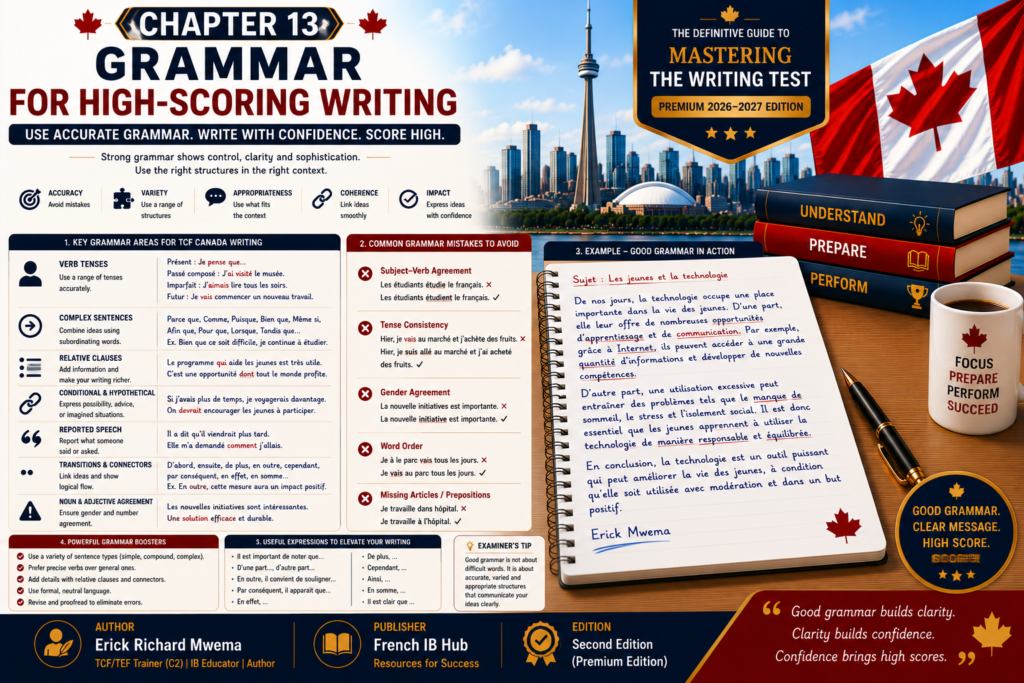
The Complete TCF Canada Grammar Reference for Expression Écrite
“Vocabulary helps you express ideas. Grammar helps others understand them.”
One of the biggest misconceptions among TCF Canada candidates is that grammar alone determines their writing score.
This is not true.
You can make a few grammatical mistakes and still receive an excellent score if your communication is clear, your ideas are organized, and your message fulfills the task.
However, candidates who consistently produce accurate grammar enjoy an important advantage.
Good grammar:
- increases clarity;
- improves coherence;
- demonstrates language control;
- allows you to write more naturally;
- gives the examiner confidence in your language ability.
This chapter is not a traditional French grammar book.
Instead, it is a practical grammar reference specifically designed for TCF Canada Expression Écrite.
Every grammar point you study here is directly connected to the writing tasks you will encounter during the examination.
Learning objectives
By the end of this chapter, you will:
- understand the essential grammar needed for Tasks 1, 2, and 3;
- know when and why each tense is used;
- avoid the most frequent grammatical mistakes;
- improve sentence variety;
- write more naturally and accurately.
The grammar pyramid
Not all grammar points carry the same importance.
Some appear in almost every response, while others are used only occasionally.
              Advanced Structures
                     ▲
            Complex Sentences
                     ▲
               Verb Tenses
                     ▲
      Articles • Agreements • Pronouns
                     ▲
           Basic Sentence Structure
Master the base before worrying about advanced grammar.
1. Sentence structure
Every French sentence requires a logical structure.
The most common pattern is:
Subject

↓

Verb

↓

Complement
Examples
Je cherche un appartement.
Nous visitons le musée.
Ils travaillent à Montréal.
Simple sentences are perfectly acceptable when they are clear and correct.
Expanding a sentence
Instead of:
Je travaille.
Write:
Je travaille dans une entreprise internationale depuis trois ans.
More information creates richer writing.
2. Articles
French articles are among the most common sources of errors.
Definite articles
| Singular | Plural |
|---|---|
| le | les |
| la | les |
| l’ | les |
Examples
le livre
la voiture
l’hôtel
les étudiants
Indefinite articles
| Singular | Plural |
|---|---|
| un | des |
| une | des |
Examples
un professeur
une école
des amis
Partitive articles
| Masculine | Feminine |
|---|---|
| du | de la |
| de l’ | des |
Examples
Je mange du pain.
Elle boit de l’eau.
Common mistakes
❌
Je cherche appartement.
✔
Je cherche un appartement.
3. Gender and Number Agreement
French nouns have gender.
Adjectives must agree.
Examples
un petit appartement
une petite maison
des étudiants motivés
des étudiantes motivées
Frequent Errors
❌
une petit maison
✔
une petite maison
4. Subject Pronouns
| French | English |
|---|---|
| je | I |
| tu | you |
| il | he |
| elle | she |
| nous | we |
| vous | you |
| ils | they |
| elles | they |
Always match the correct verb ending.
5. Present tense
The present tense appears in every writing task.
Use it for:
- opinions;
- habits;
- facts;
- descriptions.
Examples
Je pense que…
J’habite à Hyderabad.
Nous travaillons ensemble.
Common endings
-ER verbs
| Subject | parler |
|---|---|
| je | parle |
| tu | parles |
| il | parle |
| nous | parlons |
| vous | parlez |
| ils | parlent |
Useful High-Frequency Verbs
- être
- avoir
- faire
- aller
- venir
- pouvoir
- vouloir
- devoir
- savoir
- connaître
These verbs appear constantly in TCF writing.
6. Passé Composé
Essential for Task 2.
Use it for:
- completed actions;
- finished events;
- experiences.
Examples
J’ai visité Montréal.
Nous avons rencontré plusieurs étudiants.
Elle est arrivée hier.
Formation
Avoir + Past Participle
J’ai travaillé.
Être + Past Participle
Elle est partie.
Remember agreement with être.
Common Error
❌
Elle est parti.
✔
Elle est partie.
7. Imparfait
The imparfait describes:
- background;
- habits;
- repeated actions;
- descriptions.
Examples
Quand j’étais enfant…
Il faisait beau.
Nous habitions à Paris.
Passé Composé vs Imparfait
Compare:
Il pleuvait quand je suis sorti.
The rain was already happening (imparfait).
Leaving happened once (passé composé).
8. Futur Proche
Useful for plans.
Formation:
aller + infinitive
Examples
Je vais partir demain.
Nous allons commencer le cours.
9. Futur Simple
Used for predictions and formal writing.
Examples
Cette solution améliorera la situation.
Nous visiterons Québec.
10. Conditional
Very important for polite communication.
Instead of:
Je veux des informations.
Write:
Je voudrais obtenir des renseignements.
Better:
Pourriez-vous me renseigner ?
The conditional sounds more polite and professional.
Common Conditional Verbs
- je voudrais…
- je pourrais…
- j’aimerais…
- nous souhaiterions…
These expressions are especially valuable in Task 1.
11. Imperative
Used to:
- give instructions;
- make suggestions.
Examples
Écoutez attentivement.
Prenez votre temps.
Although less common in your own writing, you may refer to instructions or recommendations.
12. Negation
Structure:
ne

↓

Verb

↓

pas
Examples
Je ne comprends pas.
Nous ne pouvons pas participer.
Other forms:
- ne… jamais
- ne… plus
- ne… rien
- ne… personne
13. Question formation
Useful for Task 1.
Examples
Quels sont les horaires ?
Combien coûte le cours ?
Où se trouve l’hôtel ?
Comment puis-je m’inscrire ?
14. Direct and Indirect Object Pronouns
These make writing more natural.
| Direct | Indirect |
|---|---|
| le | lui |
| la | leur |
| les |
Example
Je connais ce professeur.
↓
Je le connais.
15. Relative Pronouns
Useful for connecting ideas.
- qui
- que
- dont
- où
Example
Le livre que j’ai acheté est intéressant.
These structures improve sentence variety.
16. Connectors
One of the easiest ways to improve your writing.
Addition
- de plus
- également
- en outre
- par ailleurs
Contrast
- cependant
- toutefois
- néanmoins
- en revanche
Cause
- parce que
- puisque
- grâce à
- en raison de
Consequence
- donc
- ainsi
- c’est pourquoi
- par conséquent
Conclusion
- enfin
- en conclusion
- pour terminer
- finalement
17. Common grammar mistakes
Mistake 1
Subject–verb disagreement
❌
Les étudiants travaille.
✔
Les étudiants travaillent.
Mistake 2
Wrong article
❌
Je bois du eau.
✔
Je bois de l’eau.
Mistake 3
Gender agreement
❌
une grand maison
✔
une grande maison
Mistake 4
Wrong auxiliary
❌
J’ai allé.
✔
Je suis allé.
Mistake 5
Using only present tense
A good narrative combines several tenses when appropriate.
Grammar According to Each Task
| Grammar | Task 1 | Task 2 | Task 3 |
|---|---|---|---|
| Present | ⭐⭐⭐ | ⭐⭐ | ⭐⭐⭐ |
| Passé composé | ⭐ | ⭐⭐⭐ | ⭐ |
| Imparfait | ⭐ | ⭐⭐⭐ | ⭐ |
| Future | ⭐⭐ | ⭐⭐ | ⭐⭐ |
| Conditional | ⭐⭐⭐ | ⭐ | ⭐⭐ |
| Connectors | ⭐⭐⭐ | ⭐⭐⭐ | ⭐⭐⭐ |
| Pronouns | ⭐⭐ | ⭐⭐ | ⭐⭐⭐ |
| Relative clauses | ⭐ | ⭐⭐ | ⭐⭐⭐ |
Grammar Self-Check before submitting
Ask yourself:
- Did every verb agree with its subject?
- Did I use the correct article?
- Did my adjectives agree?
- Did I choose the correct tense?
- Did I use connectors?
- Did I avoid repeating simple sentence structures?
Mini Grammar Quiz
1.
Correct the sentence:
Je suis allé au cinéma et j’ai voir un film.
✔
Je suis allé au cinéma et j’ai vu un film.
2.
Correct:
Les maison est grande.
✔
La maison est grande.
3.
Correct:
Nous va visiter Paris.
✔
Nous allons visiter Paris.
4.
Correct:
Elle est arrivé hier.
✔
Elle est arrivée hier.
5.
Correct:
Je veux savoir les horaires.
Better:
J’aimerais connaître les horaires.
Grammar practice challenge
Rewrite the following paragraph by:
- correcting all grammar mistakes;
- improving sentence variety;
- adding connectors.
L’année dernier je visite Montréal. Il fait très froid. Je rencontre beaucoup personne. Je suis très content. Je veux revenir.
Possible Improved Version
L’année dernière, j’ai visité Montréal. Il faisait très froid, mais l’ambiance était chaleureuse. J’y ai rencontré de nombreuses personnes très accueillantes et j’ai beaucoup pratiqué mon français. Cette expérience m’a rendu très heureux et j’aimerais y retourner un jour.
Grammar survival sheet
Present → Facts & Opinions

Passé composé → Completed Actions

Imparfait → Background & Descriptions

Future → Plans

Conditional → Polite Requests

Connectors → Better Organization

Agreement → Better Accuracy
Memorize this chart—it covers the majority of grammatical situations encountered in the TCF Canada writing examination.
Chapter summary
In this chapter, you explored the core grammar needed for high-scoring TCF Canada writing. Rather than studying grammar in isolation, you learned how each structure supports effective communication in Tasks 1, 2, and 3. From verb tenses and agreements to connectors and sentence variety, these tools will help you write with greater accuracy, confidence, and fluency.
Key takeaways
- Master the grammar you use most often before focusing on advanced structures.
- Choose verb tenses based on the communicative purpose.
- Pay close attention to agreements and articles.
- Use the conditional to make polite requests.
- Strengthen your writing with connectors and varied sentence structures.
Coming Up Next: Chapter 14 – Vocabulary for Every TCF Canada Writing Topic: 2,000+ Essential Words, Expressions, and Collocations
In the next chapter, you’ll build a comprehensive vocabulary bank organized by themes such as education, work, technology, travel, health, environment, society, and daily life. Rather than memorizing isolated words, you’ll learn natural collocations, useful expressions, synonyms, antonyms, and high-frequency phrases that can be immediately applied to Tasks 1, 2, and 3, helping you write with greater precision and sophistication.