
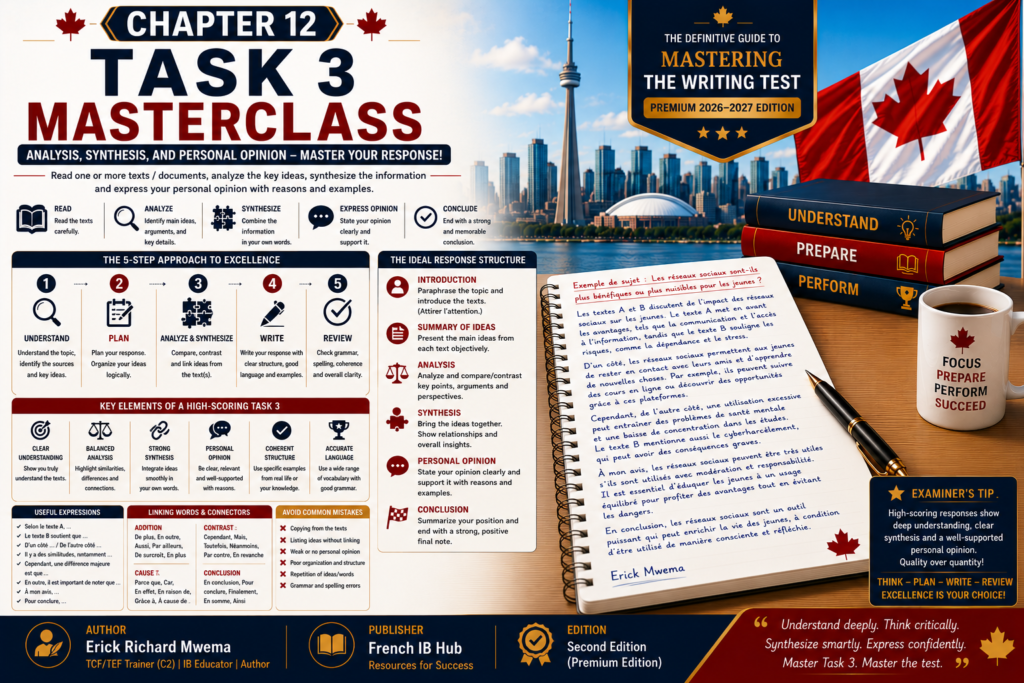
50 Real Exam Topics, Advanced Argumentation, Model Answers, and Examiner Corrections
“The strongest candidates are not those with the biggest vocabulary. They are the ones who think clearly, organize their ideas effectively, and communicate persuasively.”
You now understand the structure of Task 3.
You know how to:
- analyze source documents;
- identify the main ideas;
- write an objective synthesis;
- express your opinion;
- support your arguments;
- conclude effectively.
Now it is time to move from understanding to mastery.
This chapter is your practical workshop.
Instead of memorizing essays, you will learn how experienced candidates approach unfamiliar topics with confidence.
You will analyze realistic exam situations, identify hidden traps, strengthen arguments, expand vocabulary, and discover how examiners distinguish an average response from an excellent one.
Learning objectives
After completing this chapter, you will be able to:
- analyze any Task 3 topic confidently;
- identify arguments quickly;
- write balanced syntheses;
- construct convincing opinions;
- support ideas with relevant examples;
- avoid common logical mistakes;
- improve your writing through examiner-style corrections.
The Eight Families of Task 3 Topics
Most Task 3 prompts belong to one of eight broad themes.
                   TASK 3

      ┌────────────┼────────────┐
      │            │            │
 Technology   Environment  Education
      │            │            │
 Society      Health      Culture
      │            │
 Work        Lifestyle
Recognizing the topic family helps you activate relevant vocabulary and ideas before you start writing.
Family 1 – Technology
Typical themes:
- Artificial Intelligence
- Smartphones
- Online learning
- Remote work
- Social media
- Digital privacy
- Automation
Example topic
Should artificial intelligence become part of classroom teaching?
Candidate planning
Advantages

↓

Disadvantages

↓

Personal Position

↓

Examples

↓

Conclusion
Strong arguments
Advantages
- personalized learning;
- instant feedback;
- accessibility;
- language practice;
- flexible education.
Disadvantages
- dependence on technology;
- reduced human interaction;
- misinformation;
- privacy concerns.
Excellent opinion
Pour ma part, je considère que l’intelligence artificielle représente un excellent outil pédagogique lorsqu’elle complète le travail de l’enseignant plutôt que de le remplacer.
Notice the balanced position.
Family 2 – Environment
Typical Topics
- climate change;
- recycling;
- renewable energy;
- public transport;
- plastic pollution;
- sustainable cities.
Sample prompt
Should private cars be limited in city centres?
Weak argument
Cars pollute.
Better argument
Limiting private vehicles in city centres can improve air quality, reduce traffic congestion, and encourage citizens to use more sustainable forms of transport.
Family 3 – Education
Topics include:
- homework;
- online classes;
- school uniforms;
- examinations;
- multilingual education;
- lifelong learning.
Sample topic
Should homework be reduced?
Balanced Thinking
Advantages
- more family time;
- lower stress;
- extracurricular activities.
Disadvantages
- less independent practice;
- weaker revision habits;
- possible learning gaps.
Family 4 – Health
Typical Topics
- healthy eating;
- exercise;
- mental health;
- work-life balance;
- screen time.
Example prompt
Should companies offer flexible working hours?
Arguments
Advantages
- lower stress;
- improved productivity;
- healthier lifestyles.
Disadvantages
- coordination difficulties;
- unequal schedules;
- communication challenges.
Family 5 – Society
Examples
- volunteering;
- immigration;
- community life;
- public safety;
- equality.
Example topic
Should volunteering become compulsory for students?
Strong candidates consider both personal development and practical challenges before presenting their opinion.
Family 6 – Culture
Topics
- preserving traditions;
- museums;
- festivals;
- languages;
- cultural heritage.
Sample prompt
Should governments invest more money in cultural festivals?
Develop arguments around:
- tourism;
- identity;
- education;
- economic benefits;
- public spending priorities.
Family 7 – Work
Topics
- remote work;
- entrepreneurship;
- four-day workweek;
- career changes;
- automation.
Sample prompt
Would a four-day working week improve productivity?
Remember to discuss:
- employers;
- employees;
- customers;
- economy.
Family 8 – Lifestyle
Topics
- travel;
- sports;
- hobbies;
- digital detox;
- urban living.
Sample prompt
Should people spend less time on social media?
Avoid extreme positions.
Balanced reasoning always sounds more convincing.
The Art of Argumentation
Strong opinions follow a logical sequence.
Opinion

↓

Reason

↓

Explanation

↓

Example

↓

Mini Conclusion
Weak example
Social media is bad.
Strong example
À mon avis, les réseaux sociaux peuvent être utiles lorsqu’ils sont utilisés avec modération. Ils permettent de maintenir le contact avec la famille et les amis, mais une utilisation excessive peut entraîner une dépendance et réduire les interactions en face à face.
The second answer demonstrates nuance.
Building powerful examples
Your examples do not need statistics.
Simple real-life situations are enough.
Examples may come from:
- school;
- work;
- travel;
- family;
- technology;
- daily life;
- personal experience.
Example
Par exemple, de nombreuses entreprises utilisent désormais des plateformes numériques pour faciliter la collaboration entre collègues travaillant à distance.
Specific examples strengthen credibility.
Avoiding logical Fallacies
Some responses sound persuasive but contain weak reasoning.
Overgeneralization
❌
Everybody uses social media too much.
Better
Beaucoup de personnes passent plusieurs heures par jour sur les réseaux sociaux.
False Cause
❌
Smartphones make students lazy.
Better
Une utilisation excessive du smartphone peut réduire le temps consacré aux études.
One-Sided Thinking
Weak
Only advantages.
Better
Advantages
↓
Limitations
↓
Balanced opinion.
Vocabulary upgrade
Instead of:
bon
Use
- bénéfique
- avantageux
- efficace
- pertinent
- constructif
mauvais
Use
- nuisible
- problématique
- inefficace
- préoccupant
- défavorable
important
Use
- essentiel
- fondamental
- indispensable
- primordial
- significatif
intéressant
Use
- pertinent
- enrichissant
- captivant
- instructif
difficile
Use
- complexe
- exigeant
- délicat
- contraignant
Transition expressions
Introducing an Opinion
- Pour ma part…
- À mon avis…
- Il me semble que…
- Je considère que…
- Je suis convaincu que…
Adding arguments
- De plus…
- En outre…
- Par ailleurs…
- Il convient également de souligner que…
Giving examples
- Par exemple…
- Prenons le cas de…
- En effet…
- C’est notamment le cas de…
Contrasting
- Cependant…
- Toutefois…
- En revanche…
- Néanmoins…
Concluding
- En conclusion…
- Pour conclure…
- Finalement…
- Tout bien considéré…
Examiner correction workshop
Candidate version
Les voitures polluent.
Je pense qu’il faut les interdire.
C’est mauvais pour la planète.
Examiner comments
Problems
❌ too short
❌ no comparison
❌ no development
❌ weak vocabulary
❌ no example
Improved version
Les documents abordent la question de la circulation automobile dans les centres-villes. Le premier souligne les bénéfices environnementaux d’une réduction du trafic, tandis que le second insiste sur les difficultés que cette mesure pourrait créer pour certains habitants et commerçants.
Pour ma part, je pense qu’une limitation progressive des voitures est une solution équilibrée. Elle permettrait d’améliorer la qualité de l’air tout en encourageant l’utilisation des transports publics et des mobilités douces. Toutefois, il serait essentiel de prévoir des alternatives efficaces afin de ne pas pénaliser les personnes qui dépendent de leur véhicule.
En conclusion, cette politique pourrait avoir des effets très positifs si elle est accompagnée de mesures adaptées.
Why it scores Higher
| Weak Response | Improved Response |
|---|---|
| No synthesis | Objective synthesis |
| One argument | Multiple arguments |
| No examples | Practical examples |
| Basic vocabulary | Advanced vocabulary |
| Abrupt ending | Strong conclusion |
50 practice topics
Technology
- Artificial Intelligence in schools
- Smartphones for children
- Online education
- Remote work
- Data privacy
- Robots in healthcare
Environment
- Recycling laws
- Plastic bans
- Public transport
- Electric vehicles
- Renewable energy
- Urban green spaces
Education
- Homework
- School uniforms
- University fees
- Language learning
- Digital textbooks
- Gap years
Society
- Volunteering
- Community service
- Immigration
- Public safety
- Equality
- Civic responsibility
Health
- Mental health awareness
- Healthy school meals
- Sports at work
- Screen addiction
- Flexible schedules
- Preventive healthcare
Work
- Four-day workweek
- Freelancing
- Hybrid work
- Entrepreneurship
- Automation
- Lifelong learning
Culture
- Museums
- Cultural festivals
- Local traditions
- Minority languages
- Historical monuments
- Public art
Lifestyle
- Tourism
- Social media
- Fast fashion
- Public libraries
- City life
- Rural life
- Hobbies
- Digital detox
Timed practice method
To prepare effectively:
Step 1 (5 minutes)
Read the documents and underline:
- main ideas;
- supporting arguments;
- contrasting viewpoints.
Step 2 (3 minutes)
Prepare a simple outline.
Synthesis

↓

Comparison

↓

Opinion

↓

Arguments

↓

Examples

↓

Conclusion
Step 3
Write your response without stopping to correct every sentence.
Step 4
Reserve the final minutes to:
- check grammar;
- verify connectors;
- improve vocabulary;
- correct spelling;
- ensure both documents have been addressed.
Self-Evaluation checklist
| Question | ✓ |
|---|---|
| Did I identify the main ideas of both documents? | ☐ |
| Did I compare viewpoints rather than summarize separately? | ☐ |
| Did I keep the synthesis objective? | ☐ |
| Did I clearly introduce my opinion? | ☐ |
| Did I support every opinion with reasons and examples? | ☐ |
| Did I use varied connectors? | ☐ |
| Did I finish with a relevant conclusion? | ☐ |
Expert strategy
The highest-scoring candidates follow a simple habit:
Read → Think → Plan → Write → Revise
They never rush directly into writing.
Even two or three minutes of careful planning can make the difference between a disorganized response and a coherent, persuasive composition.
Chapter summary
This chapter transformed Task 3 from a complex writing exercise into a structured process.
You learned to:
- recognize the most common Task 3 themes;
- build balanced arguments;
- avoid weak reasoning;
- support opinions with realistic examples;
- improve vocabulary and transitions;
- analyze examiner corrections;
- evaluate your own work critically.
With consistent practice across these topic families, you will be prepared for a wide range of Task 3 prompts.
Key takeaways
- Identify the topic family before writing.
- Build arguments using the pattern: Opinion → Reason → Explanation → Example.
- Balance different viewpoints before expressing your own.
- Support claims with concrete, realistic examples.
- Revise your response to improve clarity, vocabulary, and accuracy.
Coming Up Next: Chapter 13 – Grammar for High-Scoring Writing: The Complete TCF Canada Grammar Reference
The next chapter moves away from individual tasks and focuses on the grammar that underpins all successful writing. We’ll cover the essential verb tenses, articles, pronouns, agreement rules, sentence structures, connectors, and common grammatical errors that frequently affect candidates’ scores. Rather than presenting grammar as isolated rules, each point will be linked directly to the types of writing required in the TCF Canada Expression Écrite examination.