
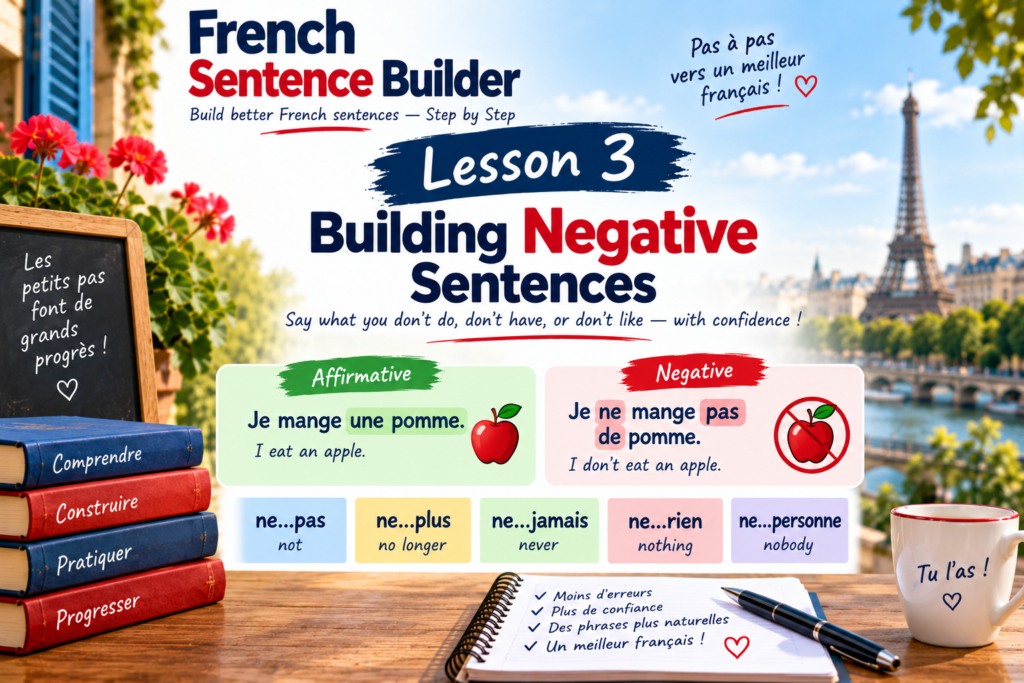
Introduction
Now that you know how to build a complete affirmative sentence, I want you to learn how to change that sentence into a negative sentence.
You already know how to say:
Je travaille.
I work.
Now you need to be able to say:
Je ne travaille pas.
I do not work.
This may look simple, but French negation has several important rules.
You will learn how to:
- use
ne...pas; - place the negative words correctly;
- use
n’before a vowel; - make negative sentences with objects;
- understand when
un, une, des, du, de labecomede; - make negative sentences in the past;
- make negative sentences in the near future;
- use
ne...plus; - use
ne...jamais; - use
ne...rien; - use
ne...personne; - build negative questions;
- avoid common mistakes.
The goal is not simply to memorize ne...pas.
The goal is for you to understand where the negative structure goes inside the sentence.
1. Start with an Affirmative sentence
Let’s begin with something you already know.
Je travaille.
I work.
This is an affirmative sentence.
If I want to say that I do not work, I put the sentence into the negative:
Je ne travaille pas.
I do not work.
Look carefully:
Je ne travaille pas.
The verb travaille is between ne and pas.
This gives you the most important rule of this lesson.
The basic structure
Sujet + ne/n’ + verbe + pas + reste de la phrase
For example:
Je ne travaille pas.
Tu ne regardes pas la télévision.
Il ne parle pas français.
Nous ne voyageons pas souvent.
Elles ne viennent pas aujourd’hui.
2. Where Do ne and pas Go?
In a simple present-tense sentence, ne comes before the conjugated verb, and pas comes after the conjugated verb.
Affirmative
Je travaille.
Negative
Je ne travaille pas.
Another example:
Elle regarde la télévision.
becomes:
Elle ne regarde pas la télévision.
Another:
Nous habitons à Paris.
becomes:
Nous n’habitons pas à Paris.
So remember:
NE + VERB + PAS
Not:
Je pas travaille. ❌
Not:
Je travaille ne pas. ❌
Correct:
Je ne travaille pas. ✓
3. Ne becomes N’
You have already learned that French words sometimes change before a vowel.
The same thing happens with ne.
When the verb begins with a vowel sound, ne becomes n’.
Compare:
Je ne travaille pas.
But:
Je n’habite pas à Paris.
Je n’aime pas le café.
Il n’écoute pas la radio.
Elle n’étudie pas aujourd’hui.
Nous n’arrivons pas à huit heures.
The rule is:
ne + consonant → ne
ne + vowel → n’
For example:
Je ne parle pas.
but:
Je n’écoute pas.
4. Negative sentences with Objects
Now let’s connect this lesson to the sentence structure you learned in Lesson 2.
You learned:
Sujet + Verbe + Objet
For example:
Je regarde un film.
Now make it negative:
Je ne regarde pas un film.
However, there is an important article rule you need to understand.
In many negative sentences, an indefinite or partitive article changes to de or d’.
So you will very often see:
un → de
une → de
des → de
du → de
de la → de
de l’ → d’
For example:
J’ai une voiture.
becomes:
Je n’ai pas de voiture.
Another example:
Je regarde des films.
becomes:
Je ne regarde pas de films.
Another:
Je bois du café.
becomes:
Je ne bois pas de café.
Another:
Je mange de la viande.
becomes:
Je ne mange pas de viande.
Before a vowel:
Je bois de l’eau.
becomes:
Je ne bois pas d’eau.
This is an important French pattern. (Progress with Lawless French)
5. But be careful with le, la, l’, and les
The previous rule does not mean that every article becomes de.
Definite articles normally stay the same:
le
la
l’
les
For example:
J’aime le chocolat.
becomes:
Je n’aime pas le chocolat.
Not:
Je n’aime pas de chocolat. ❌
Another example:
Elle aime les films français.
becomes:
Elle n’aime pas les films français.
So compare:
Indefinite / partitive
J’ai une voiture.
Je n’ai pas de voiture.
Definite
J’aime la musique.
Je n’aime pas la musique.
This distinction is very important.
6. A special case: The verb Être
When you use être, do not automatically change the article to de.
For example:
Je suis étudiant.
becomes:
Je ne suis pas étudiant.
You can also say:
Je ne suis pas un étudiant.
Similarly:
C’est une voiture.
becomes:
Ce n’est pas une voiture.
Not:
Ce n’est pas de voiture. ❌
So for now, remember this simple rule:
With many action verbs,
un/une/des/du/de lacan becomede/d’after negation.
But with être, the article normally stays.
7. Negative sentences with Avoir
Avoir is especially important because you will use it constantly.
Affirmative:
J’ai une voiture.
Negative:
Je n’ai pas de voiture.
Affirmative:
J’ai des amis à Paris.
Negative:
Je n’ai pas d’amis à Paris.
Affirmative:
J’ai du temps.
Negative:
Je n’ai pas de temps.
Notice the structure:
Je n’ai pas de voiture.
The negative words surround the conjugated verb ai.
8. Negation with the Passé Composé
Now let’s make the sentence more advanced.
You already know that the passé composé uses:
auxiliary + past participle
For example:
J’ai travaillé.
To make this negative, put ne...pas around the auxiliary verb.
Je n’ai pas travaillé.
Not:
Je n’ai travaillé pas. ❌
The structure is:
Sujet + ne/n’ + auxiliaire + pas + participe passé
Examples
J’ai mangé.
Je n’ai pas mangé.
Elle a travaillé.
Elle n’a pas travaillé.
Nous avons voyagé.
Nous n’avons pas voyagé.
Ils sont partis.
Ils ne sont pas partis.
Notice:
Elle n’a pas travaillé.
and:
Ils ne sont pas partis.
The ne...pas surrounds the auxiliary.
9. Negation with the Futur Proche
You also know the futur proche:
aller + infinitif
For example:
Je vais travailler.
To make it negative:
Je ne vais pas travailler.
The negative structure surrounds the conjugated form of aller.
Structure
Sujet + ne/n’ + aller + pas + infinitif
Examples:
Je vais sortir.
Je ne vais pas sortir.
Elle va voyager.
Elle ne va pas voyager.
Nous allons travailler.
Nous n’allons pas travailler.
Ils vont venir.
Ils ne vont pas venir.
Be careful.
Do not say:
Je ne vais travailler pas. ❌
Say:
Je ne vais pas travailler. ✓
10. Negative sentences with the Passé Récent
You learned the passé récent:
venir de + infinitif
For example:
Je viens de manger.
To make this negative:
Je ne viens pas de manger.
The negative words surround the conjugated verb viens.
Je ne viens pas de manger.
Another example:
Elle vient de partir.
becomes:
Elle ne vient pas de partir.
This means:
She has not just left.
11. Ne...plus — No Longer / Not Anymore
Now we can move beyond ne...pas.
Ne...plus means:
no longer
not anymore
Compare:
Je travaille ici.
I work here.
Je ne travaille pas ici.
I don’t work here.
Je ne travaille plus ici.
I no longer work here.
The idea is different.
ne...pas
Something is not happening.
ne...plus
Something happened before, but it does not happen anymore.
Examples:
Je ne fume plus.
I don’t smoke anymore.
Elle n’habite plus à Paris.
She no longer lives in Paris.
Nous ne travaillons plus le dimanche.
We don’t work on Sundays anymore.
Il ne joue plus au football.
He doesn’t play football anymore.
12. Ne...jamais — Never
Ne...jamais means:
never
Examples:
Je ne voyage jamais en hiver.
I never travel in winter.
Elle ne mange jamais de viande.
She never eats meat.
Nous ne sortons jamais le lundi.
We never go out on Monday.
Il ne regarde jamais la télévision.
He never watches television.
Notice:
ne + verb + jamais
For example:
Je ne travaille jamais le dimanche.
Not:
Je jamais travaille le dimanche. ❌
ne...jamais works like the basic negative structure, with jamais taking the place of pas. (Progress with Lawless French)
13. Ne...rien — Nothing
Rien means:
nothing
The structure is:
ne + verb + rien
Examples:
Je ne comprends rien.
I understand nothing.
Je ne vois rien.
I see nothing.
Elle ne mange rien.
She eats nothing.
Nous n’avons rien compris.
We understood nothing.
With the passé composé:
Je n’ai rien compris.
Notice that rien comes after the auxiliary and before the past participle.
Je n’ai rien compris.
14. Ne...personne — Nobody / No One
Personne means:
nobody / no one
When it is the object of the verb:
ne + verb + personne
Examples:
Je ne connais personne.
I don’t know anyone.
Elle ne voit personne.
She doesn’t see anyone.
Nous n’invitons personne.
We are not inviting anyone.
With the passé composé:
Je n’ai vu personne.
I didn’t see anyone.
Elle n’a rencontré personne.
She didn’t meet anyone.
15. Personne can also be the Subject
This is an important difference.
Look at:
Je ne vois personne.
Here, I am the subject.
Personne is the object.
But we can also say:
Personne ne vient.
Nobody is coming.
Now personne is the subject.
The structure is:
Personne + ne + verbe
Examples:
Personne ne comprend.
Nobody understands.
Personne ne travaille aujourd’hui.
Nobody is working today.
Personne n’est disponible.
Nobody is available.
So remember:
Object
Je ne vois personne.
Subject
Personne ne vient.
16. Comparing the main Negative structures
| French | Meaning |
|---|---|
ne...pas | not |
ne...plus | no longer / not anymore |
ne...jamais | never |
ne...rien | nothing |
ne...personne | nobody / no one |
ne...aucun(e) | no / not any |
Examples:
Je ne travaille pas.
I don’t work.
Je ne travaille plus.
I don’t work anymore.
Je ne travaille jamais le dimanche.
I never work on Sundays.
Je ne comprends rien.
I understand nothing.
Je ne connais personne ici.
I don’t know anyone here.
Je n’ai aucune idée.
I have no idea.
17. Ne...aucun(e) — Not Any / None
You can use aucun with a noun.
Because it describes a noun, it agrees in gender:
aucun
aucune
Examples:
Je n’ai aucune idée.
I have no idea.
Il n’a aucun problème.
He has no problem.
Nous n’avons aucune information.
We have no information.
Elle n’a aucun ami dans cette ville.
She doesn’t have any friends in this city.
For your basic sentence building, think:
ne + verb + aucun(e) + noun
18. Negative questions
You can also ask a negative question.
For example:
Tu travailles demain ?
Are you working tomorrow?
Negative:
Tu ne travailles pas demain ?
Aren’t you working tomorrow?
You can also use est-ce que:
Est-ce que tu ne travailles pas demain ?
You will study question formation in much more detail in the next lessons, but start becoming comfortable with negative questions now.
19. Building a Negative sentence Step by Step
Let’s take:
Je regarde un film le soir.
Step 1 — Find the subject
Je
Step 2 — Find the conjugated verb
regarde
Step 3 — Put ne before the verb
Je ne regarde…
Step 4 — Put pas after the verb
Je ne regarde pas…
Step 5 — Keep the rest of the sentence
Je ne regarde pas un film le soir.
But if we mean I don’t watch any film, the article changes:
Je ne regarde pas de film le soir.
The important point is that you should first build the negative structure correctly. Then check whether the article needs to change.
20. Sentence transformation practice
Now transform each affirmative sentence into a negative sentence.
Example 1
Je travaille le samedi.
→
Je ne travaille pas le samedi.
Example 2
Elle aime le café.
→
Elle n’aime pas le café.
Example 3
Nous avons une voiture.
→
Nous n’avons pas de voiture.
Example 4
Ils regardent des films.
→
Ils ne regardent pas de films.
Example 5
Je vais sortir ce soir.
→
Je ne vais pas sortir ce soir.
Example 6
Elle a travaillé hier.
→
Elle n’a pas travaillé hier.
Example 7
Je voyage souvent.
→
Je ne voyage jamais.
Notice that this is not simply a mechanical replacement of pas.
The meaning changes depending on the negative expression you choose.
21. Build the sentence yourself
Use the blocks to create complete negative sentences.
Block 1
Je / travailler / dimanche
Build:
Je ne travaille pas le dimanche.
Block 2
Elle / aimer / café
Build:
Elle n’aime pas le café.
Block 3
Nous / avoir / voiture
Build:
Nous n’avons pas de voiture.
Block 4
Ils / voyager / hiver
Build:
Ils ne voyagent jamais en hiver.
Block 5
Je / comprendre / rien
Build:
Je ne comprends rien.
Block 6
Elle / connaître / personne
Build:
Elle ne connaît personne.
22. Common mistakes
Mistake 1
Je pas travaille. ❌
Correct:
Je ne travaille pas. ✓
Remember:
NE + VERB + PAS
Mistake 2
Je ne ai pas. ❌
Correct:
Je n’ai pas. ✓
Because ne becomes n' before the vowel sound in ai.
Mistake 3
Je n’aime pas de café. ❌
If you mean that you don’t like coffee generally:
Je n’aime pas le café. ✓
Mistake 4
Je ne regarde des films pas. ❌
Correct:
Je ne regarde pas de films. ✓
pas comes immediately after the conjugated verb.
Mistake 5
Je n’ai pas une voiture. ❌
For the general meaning “I don’t have a car”:
Je n’ai pas de voiture. ✓
Mistake 6
Je ne vais travailler pas. ❌
Correct:
Je ne vais pas travailler. ✓
With the futur proche, ne...pas surrounds vais.
Mistake 7
Je ne jamais voyage. ❌
Correct:
Je ne voyage jamais. ✓
23. Your sentence builder Formula
You now have several ways to build a negative sentence.
Simple present
Sujet + ne/n’ + verbe + pas + reste
Je ne travaille pas aujourd’hui.
Passé composé
Sujet + ne/n’ + auxiliaire + pas + participe passé
Je n’ai pas travaillé hier.
Futur proche
Sujet + ne/n’ + aller + pas + infinitif
Je ne vais pas travailler demain.
No longer
Sujet + ne/n’ + verbe + plus
Je ne travaille plus ici.
Never
Sujet + ne/n’ + verbe + jamais
Je ne travaille jamais le dimanche.
Nothing
Sujet + ne/n’ + verbe + rien
Je ne comprends rien.
Nobody
Sujet + ne/n’ + verbe + personne
Je ne connais personne.
24. Your mini Challenge
Now I want you to write eight negative sentences about yourself.
Use these instructions:
Sentence 1
Something you don’t do.
Je ne…
Sentence 2
Something you don’t like.
Je n’aime pas…
Sentence 3
Something you don’t have.
Je n’ai pas de…
Sentence 4
Something you don’t do anymore.
Je ne… plus.
Sentence 5
Something you never do.
Je ne… jamais.
Sentence 6
Something you don’t understand.
Je ne comprends pas…
or:
Je ne comprends rien.
Sentence 7
Someone you don’t know or see.
Je ne connais personne…
Sentence 8
Something you are not going to do.
Je ne vais pas…
Try to make your sentences personal rather than copying the examples from the lesson.
25. Communication challenge
Now imagine that I ask you:
Qu’est-ce que tu ne fais jamais le week-end ?
You could answer:
Je ne travaille jamais le dimanche. Je ne me lève pas très tôt et je ne vais pas au bureau. Je ne regarde pas beaucoup la télévision non plus. En général, je préfère sortir avec mes amis.
Notice what you are doing here.
You are no longer producing isolated grammar sentences.
You are using negative structures to communicate real information.
That is exactly what I want you to develop throughout this course.
26. Final review
Before moving on, make sure you can answer these questions:
Where does ne go?
Before the conjugated verb.
Je ne travaille pas.
Where does pas go?
After the conjugated verb.
Je ne travaille pas.
When does ne become n'?
Before a vowel sound.
Je n’aime pas.
What happens in many negative sentences with un, une, des, du, de la?
They often become de or d'.
J’ai une voiture.
Je n’ai pas de voiture.
What does ne...plus mean?
No longer / not anymore.
What does ne...jamais mean?
Never.
What does ne...rien mean?
Nothing.
What does ne...personne mean?
Nobody / no one.
Where does negation go in the passé composé?
Around the auxiliary:
Je n’ai pas travaillé.
Where does negation go in the futur proche?
Around aller:
Je ne vais pas travailler.
Sentence Builder Rule
When you want to make a sentence negative, don’t move the whole sentence around.
Find the conjugated verb first.
Then build:
SUBJECT → NE/N’ → CONJUGATED VERB → PAS/PLUS/JAMAIS/RIEN → REST OF SENTENCE
For example:
Je → ne → regarde → pas → la télévision.
Je ne regarde pas la télévision.
Once you understand this pattern, French negation becomes much easier.
What you can do Now
After this lesson, you should be able to:
- build basic negative sentences;
- correctly position
neandpas; - use
n'before vowels; - form negative sentences in the present;
- form negative sentences in the passé composé;
- form negative sentences in the futur proche;
- use
ne...plus; - use
ne...jamais; - use
ne...rien; - use
ne...personne; - understand the basic
derule after negation; - transform affirmative sentences into negative sentences.
Next Lesson
Lesson 4 — Asking Questions
In the next lesson, you will learn how to turn your sentences into questions using the three major French question structures:
Tu travailles ici ?
Est-ce que tu travailles ici ?
Travailles-tu ici ?
You will learn when to use each one, how to form them, and which structure sounds most natural in everyday French.