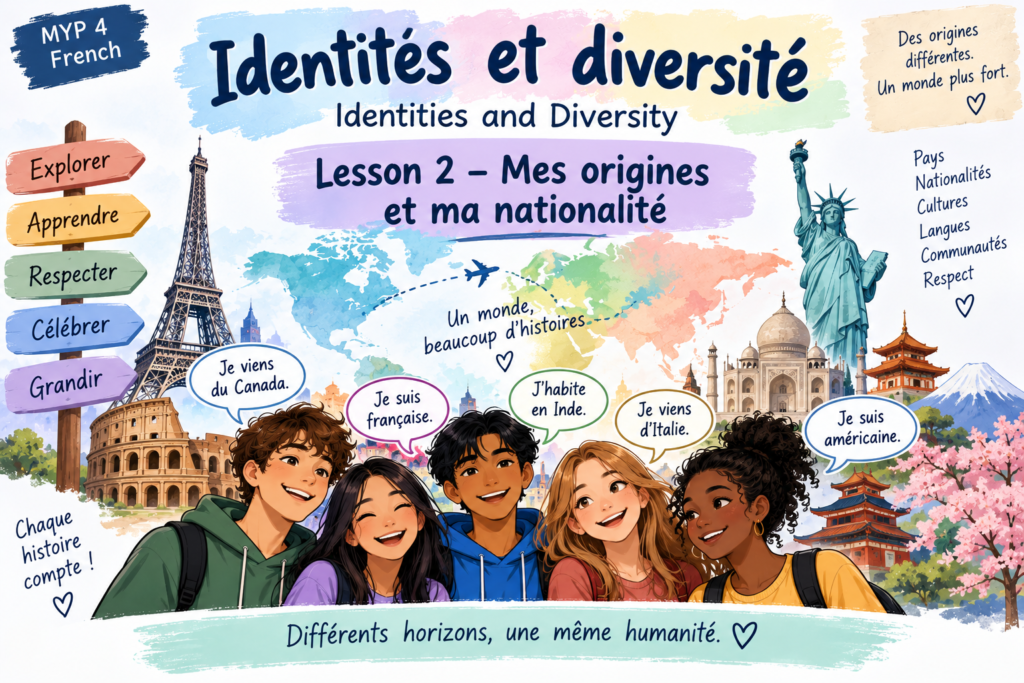
In this lesson, you will go beyond simply saying where you live. You will learn how to talk about your country, origin and nationality and describe people from different countries.
You will also develop your understanding of gender and adjective agreement in French. By the end of the lesson, you will be able to describe yourself and others more accurately and respectfully.
1. Learning objectives
By the end of this lesson, you should be able to:
- name different countries in French;
- say where you are from;
- say where you live;
- state your nationality;
- distinguish between a country and a nationality;
- form common masculine and feminine nationality adjectives;
- use être, venir de and habiter correctly;
- ask and answer questions about origin and nationality;
- describe another person’s origin and nationality;
- recognise similarities and differences between people from different backgrounds.
Emergent Level
You will focus on:
- identifying countries and nationalities;
- saying where you are from;
- saying your nationality;
- using simple sentences with être, venir de and habiter;
- using common masculine and feminine forms.
Capable Level
You will:
- describe your own and another person’s origins;
- use nationality adjectives accurately;
- explain differences between origin, nationality and place of residence;
- connect ideas using et, mais, aussi, cependant and parce que;
- give more detailed descriptions of cultural identity.
2. Key vocabulary – Les pays
| French | English |
|---|---|
| la France | France |
| l’Inde | India |
| le Canada | Canada |
| les États-Unis | the United States |
| l’Angleterre | England |
| l’Espagne | Spain |
| l’Italie | Italy |
| l’Australie | Australia |
| le Japon | Japan |
| la Chine | China |
| l’Allemagne | Germany |
| le Brésil | Brazil |
| le Mexique | Mexico |
| la Russie | Russia |
| la Corée du Sud | South Korea |
| l’Afrique du Sud | South Africa |
3. Key vocabulary – Les nationalités
| Masculine | Feminine | English |
|---|---|---|
| indien | indienne | Indian |
| français | française | French |
| anglais | anglaise | English |
| canadien | canadienne | Canadian |
| américain | américaine | American |
| australien | australienne | Australian |
| espagnol | espagnole | Spanish |
| italien | italienne | Italian |
| japonais | japonaise | Japanese |
| chinois | chinoise | Chinese |
| allemand | allemande | German |
| brésilien | brésilienne | Brazilian |
| mexicain | mexicaine | Mexican |
| russe | russe | Russian |
| sud-coréen | sud-coréenne | South Korean |
| sud-africain | sud-africaine | South African |
4. Starter activity – Pays ou nationalité ?
Look at the words below.
Inde – indien – France – française – Canada – canadien – Italie – italienne
Can you separate them into two groups?
Pays
Nationalités
Think
What is the difference between a country and a nationality?
5. Country vs Nationality
A country is a place.
l’Inde
la France
le Canada
A nationality describes a person.
indien / indienne
français / française
canadien / canadienne
Compare
L’Inde est un pays.
Je suis indien.
La France est un pays.
Je suis française.
6. Saying where you are From – Venir de
Usage
Use venir de to say where you come from or to talk about your origin.
Structure
Subject + venir + de/d’/du/des + place
Formation
| Subject | Venir | Example |
|---|---|---|
| je | viens | Je viens d’Inde. |
| tu | viens | Tu viens de France. |
| il | vient | Il vient du Canada. |
| elle | vient | Elle vient d’Italie. |
| nous | venons | Nous venons d’Inde. |
| vous | venez | Vous venez de France. |
| ils | viennent | Ils viennent du Canada. |
| elles | viennent | Elles viennent d’Italie. |
Examples
Je viens d’Inde.
Je viens de France.
Elle vient d’Italie.
Ils viennent du Canada.
7. De, d’, du, des
The form of de changes depending on the country.
de + country
Je viens de France.
d’ + vowel
Je viens d’Inde.
Je viens d’Italie.
Je viens d’Australie.
du + masculine country
Je viens du Canada.
Je viens du Japon.
des + plural country
Je viens des États-Unis.
Quick Reference
| Country | Form | Example |
|---|---|---|
| France | de | Je viens de France. |
| Inde | d’ | Je viens d’Inde. |
| Italie | d’ | Je viens d’Italie. |
| Canada | du | Je viens du Canada. |
| Japon | du | Je viens du Japon. |
| États-Unis | des | Je viens des États-Unis. |
8. Saying where you Live – Habiter
Usage
Use habiter to say where you live.
Structure
For a city:
Subject + habiter + à + city
For a country:
Subject + habiter + en/au/aux + country
Examples
J’habite à Delhi.
J’habite en Inde.
J’habite à Paris.
J’habite en France.
J’habite au Canada.
J’habite aux États-Unis.
9. Origin vs Place of residence
These two ideas are not always the same.
Origin
Je viens d’Inde.
I come from India.
Current residence
J’habite à Paris.
I live in Paris.
You can combine them:
Je viens d’Inde, mais j’habite à Paris.
Capable Challenge
Explain that a person’s origin and current place of residence can be different.
Je viens d’Inde, mais j’habite en France depuis quelques années.
10. Saying your Nationality – Être + Nationality
Usage
Use être + nationality adjective to state nationality.
Structure
Subject + être + nationality adjective
Examples
Je suis indien.
Je suis indienne.
Il est français.
Elle est française.
Nous sommes canadiens.
Elles sont italiennes.
11. Nationality agreement
Nationality adjectives agree with the person they describe.
Masculine → Feminine
indien → indienne
français → française
anglais → anglaise
italien → italienne
canadien → canadienne
Examples
Rahul est indien.
Sara est indienne.
Lucas est français.
Emma est française.
12. Formation of nationality adjectives
There are several common patterns.
Pattern 1 – Add -e
canadien → canadienne
américain → américaine
organisé → organisée
Pattern 2 – -ien → -ienne
indien → indienne
italien → italienne
canadien → canadienne
Pattern 3 – -ais → -aise
français → française
anglais → anglaise
japonais → japonaise
Pattern 4 – Different feminine form
espagnol → espagnole
chinois → chinoise
brésilien → brésilienne
allemand → allemande
Important
Not every nationality follows one simple rule.
Learn the masculine and feminine forms together.
13. Nationality adjectives – pronunciation
Pay attention to the endings.
français → française
anglais → anglaise
indien → indienne
italien → italienne
Some written endings change pronunciation.
Listen carefully and repeat each pair.
Practice
Il est français.
Elle est française.
Il est indien.
Elle est indienne.
14. Asking about Origin
You can ask someone where they come from.
Question
D’où viens-tu ?
Where are you from?
Answer
Je viens d’Inde.
Je viens de France.
Je viens du Canada.
Je viens des États-Unis.
15. Asking about Nationality
Question
Quelle est ta nationalité ?
Answer
Je suis indien.
or
Je suis indienne.
Formal version
Quelle est votre nationalité ?
Je suis français.
16. Asking about where someone Lives
Question
Où habites-tu ?
Answer
J’habite à Delhi.
J’habite en Inde.
Formal version
Où habitez-vous ?
17. Question and answer practice
| Question | Answer |
|---|---|
| D’où viens-tu ? | Je viens d’Inde. |
| Quelle est ta nationalité ? | Je suis indien/indienne. |
| Où habites-tu ? | J’habite à Delhi. |
| Dans quel pays habites-tu ? | J’habite en Inde. |
18. Guided practice – Complète les phrases
Complete each sentence with the correct word.
1.
Je viens ______ Inde.
2.
J’habite ______ Delhi.
3.
Je suis ______.
(India – masculine)
4.
Elle est ______.
(France)
5.
Il vient ______ Canada.
6.
Nous habitons ______ France.
7.
Elle vient ______ Italie.
8.
Ils viennent ______ États-Unis.
19. Grammar challenge – Choose the correct Form
1.
Sara est :
a. indien
b. indienne
2.
Lucas est :
a. française
b. français
3.
Emma vient :
a. de France
b. du France
4.
Rahul vient :
a. d’Inde
b. de Inde
5.
Nous habitons :
a. en Canada
b. au Canada
6.
Ils viennent :
a. des États-Unis
b. de États-Unis
20. EMERGENT LEVEL
Task – Mon pays, mon identité
Write 6–8 sentences about your origin and nationality.
Include:
- your name;
- your country;
- where you live;
- your nationality;
- one language you speak;
- one thing you like about your country or culture.
Sentence Starters
Je m’appelle…
Je viens de…
J’habite à…
Je suis…
Je parle…
J’aime…
Example
Je m’appelle Arjun. J’ai 14 ans. Je viens d’Inde. J’habite à Delhi. Je suis indien. Je parle anglais et hindi. J’aime la cuisine indienne.
21. CAPABLE LEVEL
Task – Mes origines, mon identité
Write 100–120 words about your origins and identity.
Include:
- where you come from;
- where you currently live;
- your nationality;
- the languages you speak;
- your family or cultural background;
- one tradition, food, celebration or activity that is important to you;
- your opinion about your cultural identity;
- at least one reason.
Useful Structures
Je viens de…
J’habite à…
Je suis…
Ma famille vient de…
Je parle…
Une chose importante dans ma culture est…
J’aime… parce que…
À mon avis…
Example
Je m’appelle Sara et je viens d’Inde, mais j’habite à Paris avec ma famille. Je suis indienne et je parle hindi, anglais et français. Ma famille est très importante pour moi et nous célébrons plusieurs fêtes ensemble. J’aime particulièrement la cuisine indienne parce qu’elle me rappelle ma famille et mon enfance. À mon avis, connaître ses origines est important parce que cela nous aide à comprendre notre identité.
22. Speaking practice – Devine la nationalité
Work with a partner.
Student A chooses a country secretly.
Give three clues.
Example
Je viens de ce pays.
J’habite dans ce pays.
Je suis…
Your partner guesses:
Tu es indien ?
Tu es française ?
Tu es canadien ?
Then switch roles.
23. Speaking extension – Présente ton partenaire
Interview your partner.
Ask:
Comment t’appelles-tu ?
D’où viens-tu ?
Où habites-tu ?
Quelle est ta nationalité ?
Quelles langues parles-tu ?
Qu’est-ce que tu aimes ?
Then introduce your partner to the class.
Emergent
Use 5 simple sentences.
Voici Sara. Elle vient d’Inde. Elle habite à Delhi. Elle est indienne. Elle parle anglais et hindi.
Capable
Use 8–10 connected sentences.
Voici Sara. Elle vient d’Inde, mais elle habite maintenant à Paris. Elle est indienne et elle parle hindi, anglais et français. Elle aime beaucoup la musique parce que…
24. Comparing people – Différent ou similaire ?
Identity can be both different and similar.
Useful expressions
| French | English |
|---|---|
| différent(e) | different |
| similaire | similar |
| le même / la même | the same |
| comme | like/as |
| aussi | also |
| mais | but |
| cependant | however |
| tous les deux | both |
| toutes les deux | both |
Examples
Nous sommes tous les deux indiens.
Nous parlons la même langue.
Nous avons des origines différentes.
Nous sommes différents, mais nous avons beaucoup de choses en commun.
25. Capable challenge – Compare two people
Look at the two profiles.
Personne A
Amélie vient de France. Elle habite à Lyon. Elle est française. Elle parle français et anglais. Elle aime la musique.
Personne B
Arjun vient d’Inde. Il habite à Delhi. Il est indien. Il parle hindi, anglais et français. Il aime aussi la musique.
Write 4–5 sentences comparing them.
Example
Amélie et Arjun viennent de pays différents. Amélie est française et Arjun est indien. Ils parlent tous les deux anglais. Ils aiment aussi la musique. Ils ont donc des différences, mais ils ont également des points communs.
26. Team task – La carte de la diversité
Work in groups of 3–4 students.
Create a chart-paper poster showing the diversity of your group.
Your poster should include:
Nos pays
Where do people in your group come from?
Nos nationalités
What are your nationalities?
Nos langues
Which languages do you speak?
Nos villes
Where do you live?
Nos points communs
What do you have in common?
Nos différences
What makes you different?
Emergent team Output
Create simple sentences using:
Nous venons de…
Nous habitons à…
Nous sommes…
Nous parlons…
Nous aimons…
Each person should present 2–3 sentences.
Capable team Output
Explain both similarities and differences.
Use:
Dans notre groupe, nous avons des origines différentes, mais…
Nous parlons plusieurs langues, cependant…
Certains d’entre nous viennent de…, tandis que…
Nous avons plusieurs points communs, notamment…
Finish with:
Notre diversité est importante parce que…
Each person should speak for approximately 30–45 seconds.
27. Reflection – Mon identité et mes origines
Think about:
Est-ce que nos origines définissent notre identité ?
Emergent
Complete:
Je viens de ____________________.
Je suis ____________________.
Mes origines sont importantes parce que ____________________.
Capable
Write 3–4 connected sentences.
Try to explain why your origins, culture, languages or family background may be important to your identity.
À mon avis, nos origines font partie de notre identité, mais elles ne définissent pas toute notre personnalité. Nos langues, nos expériences et nos intérêts sont également importants.
28. Formative assessment – Origine et nationalité
Emergent
Write 6 sentences.
You must correctly use:
☐ Je viens de…
☐ J’habite à…
☐ Je suis…
☐ Je parle…
☐ One country preposition
☐ One nationality adjective
Capable
Write 8–10 connected sentences.
You must include:
- origin;
- current residence;
- nationality;
- languages;
- cultural identity;
- one similarity or difference;
- one reason;
- at least two connectors.
29. Exit ticket
Emergent
Answer:
- D’où viens-tu ?
- Où habites-tu ?
- Quelle est ta nationalité ?
- Quelles langues parles-tu ?
Capable
Write 5 connected sentences explaining your origin, nationality and current place of residence.
Try to use:
mais – aussi – parce que – cependant
30. MYP Criteria connection
This lesson develops skills connected to all four MYP Language Acquisition criteria.
Criterion A – Listening
You will practise:
- identifying countries and nationalities;
- understanding questions about origin;
- identifying specific information about people’s identities.
Criterion B – Reading
You will practise:
- identifying countries and nationalities in texts;
- understanding descriptions of people’s origins;
- identifying similarities and differences.
Criterion C – Speaking
You will practise:
- asking and answering questions;
- describing your origin and nationality;
- introducing another person;
- comparing people.
Criterion D – Writing
You will practise:
- writing about your identity;
- using nationality adjectives accurately;
- organising information;
- connecting ideas and giving reasons.
31. ATL Skills
Social
You will:
- listen respectfully when classmates discuss their backgrounds;
- recognise different cultural perspectives;
- work collaboratively;
- discuss differences without making assumptions or stereotypes.
Communication
You will:
- ask and answer questions about identity;
- communicate information clearly;
- use appropriate vocabulary and grammatical structures;
- adapt your language when speaking with different people.
32. Learner profile
Open-minded
You will recognise that people can have different countries of origin, nationalities, languages and cultural experiences.
Communicator
You will express information about your identity and learn to communicate respectfully with people from different backgrounds.
33. Lesson 2 – Success criteria
Emergent
By the end of the lesson, I can:
☐ Identify common countries in French.
☐ Identify common nationalities in French.
☐ Say where I come from.
☐ Say where I live.
☐ State my nationality.
☐ Use être correctly with nationality.
☐ Use venir de correctly.
☐ Use basic country prepositions.
☐ Ask and answer questions about origin and nationality.
☐ Describe another person using simple sentences.
Capable
By the end of the lesson, I can:
☐ Explain the difference between country, origin, nationality and residence.
☐ Use être, venir de and habiter accurately.
☐ Form common masculine and feminine nationality adjectives.
☐ Use country prepositions accurately.
☐ Describe another person’s origins and nationality.
☐ Compare similarities and differences.
☐ Give reasons using parce que.
☐ Connect ideas using mais, aussi and cependant.
☐ Discuss identity and diversity respectfully.
34. Homework / Independent practice
Emergent
Create a country and nationality table with 10 countries.
For each country, write:
- the country in French;
- the masculine nationality;
- the feminine nationality.
Then write 8 sentences about your own origin and nationality.
Capable
Write 100–120 words titled:
Mes origines et mon identité
Include:
- where you come from;
- where you live;
- your nationality;
- languages;
- your cultural background;
- one tradition, food, celebration or activity;
- why your background is important to you;
- one similarity or difference between you and another person.
Use at least four:
et – mais – aussi – parce que – cependant – donc
35. Grammar summary – What you can now do
| What you want to say | Structure |
|---|---|
| Say where you come from | Je viens de/d’/du/des + lieu |
| Say where you live | J’habite à + ville |
| Say your country | J’habite en/au/aux + pays |
| Say your nationality | Je suis + nationality |
| Ask where someone comes from | D’où viens-tu ? |
| Ask where someone lives | Où habites-tu ? |
| Ask nationality | Quelle est ta nationalité ? |
| Describe a person | Il/Elle est + nationality |
| Compare people | … mais… / … aussi… |
| Give a reason | … parce que… |
| Show contrast | … cependant… |
36. My Origin and Nationality sentence builder
Use the framework below to build your own response.
Je m’appelle ____________________.
Je viens de ____________________.
J’habite à ____________________.
Je suis ____________________.
Je parle ____________________.
Ma famille vient de ____________________.
J’aime ____________________ parce que ____________________.
Mes origines sont importantes pour moi parce que ____________________.
Capable Challenge
Connect your ideas into a paragraph.
Je m’appelle… et je viens de… mais j’habite maintenant à… Je suis… et je parle… Mes origines sont importantes pour moi parce que…
Next Lesson
Lesson 3 – Ma famille et mon identité
In the next lesson, you will explore how family relationships and personal connections contribute to identity. You will learn family vocabulary, possessive adjectives and structures for describing the people who are important to you.