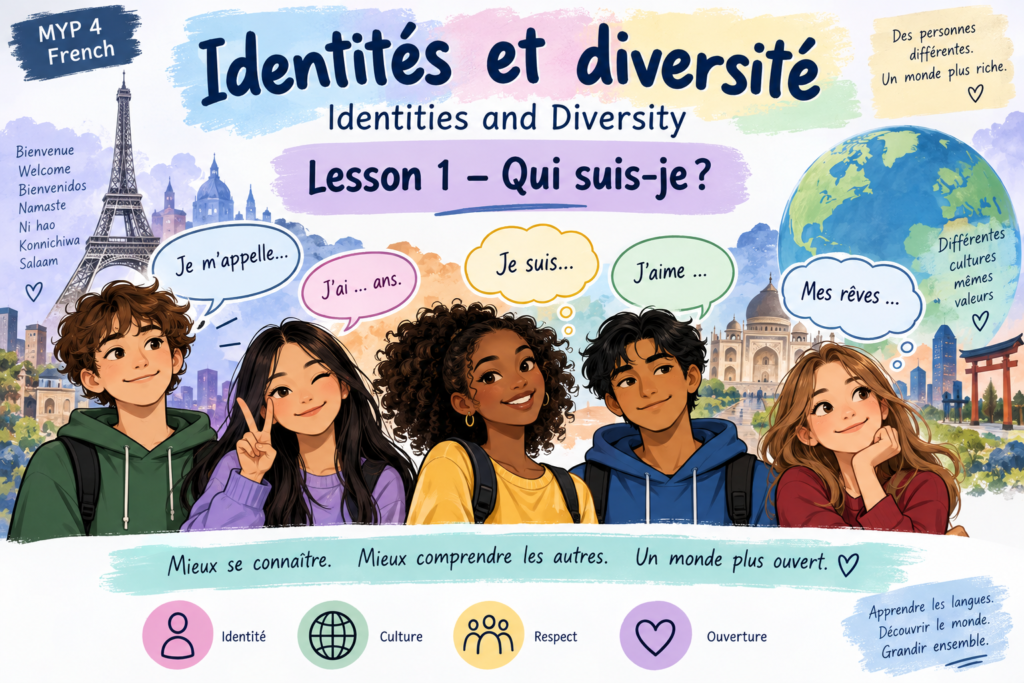
Lesson 1 – Qui suis-je ?
Welcome to Unit 1! In this lesson, you will begin exploring identity. You will learn how to introduce yourself, talk about where you come from, describe your nationality and use être and avoir to give basic information about yourself.
The goal is not simply to memorise vocabulary. You will learn how to use French to communicate information about your identity clearly and confidently.
1. Learning objectives
By the end of this lesson, you should be able to:
- introduce yourself in French;
- say your name and age;
- say where you live;
- say where you are from;
- talk about your nationality;
- describe your personality;
- talk about your interests and preferences;
- use être, avoir, s’appeler, habiter, venir de, parler and aimer correctly;
- ask another person simple questions about their identity;
- give information about yourself in connected sentences.
Emergent Level
You will focus on recognising and producing simple sentences about yourself.
Capable Level
You will develop your answers by adding reasons, details and connected ideas about your identity.
2. Key vocabulary – L’identité
| French | English |
|---|---|
| l’identité | identity |
| le nom | surname/name |
| le prénom | first name |
| l’âge | age |
| le pays | country |
| la nationalité | nationality |
| l’origine | origin |
| la ville | city |
| le lieu de naissance | place of birth |
| habiter | to live |
| être | to be |
| avoir | to have |
| venir de | to come from |
| vivre à | to live in |
| parler | to speak |
| aimer | to like/love |
| s’appeler | to be called |
3. Starter activity – Qui suis-je ?
Look at the information below.
Bonjour ! Je m’appelle Emma. J’ai 14 ans. J’habite à Delhi. Je suis indienne. Je parle anglais et français. J’aime la musique et le sport.
Now identify the information:
- Prénom : ____________________
- Âge : ____________________
- Ville : ____________________
- Nationalité : ____________________
- Langues : ____________________
- Loisirs : ____________________
Think
Which information tells us about a person’s identity?
4. Saying your Name – S’appeler
Usage
Use s’appeler to say your name.
Structure
Subject + reflexive pronoun + appeler
For yourself:
Je m’appelle + name.
Formation
S’appeler is a reflexive verb.
| Subject | Formation | Example |
|---|---|---|
| je | m’appelle | Je m’appelle Sara. |
| tu | t’appelles | Tu t’appelles Sara. |
| il | s’appelle | Il s’appelle Lucas. |
| elle | s’appelle | Elle s’appelle Emma. |
| nous | nous appelons | Nous nous appelons… |
| vous | vous appelez | Vous vous appelez… |
| ils | s’appellent | Ils s’appellent Paul et Marc. |
| elles | s’appellent | Elles s’appellent Emma et Sara. |
Examples
Je m’appelle Rahul.
Comment t’appelles-tu ?
Elle s’appelle Emma.
Remember
Je m’appelle…
Not:
Incorrect: Je appelle…
5. Saying your Age – Avoir
Usage
Use avoir to say your age.
In French, you literally say that you have a certain number of years.
Structure
Subject + avoir + number + ans
Formation
| Subject | Avoir | Example |
|---|---|---|
| je | j’ai | J’ai 14 ans. |
| tu | tu as | Tu as 15 ans. |
| il | il a | Il a 14 ans. |
| elle | elle a | Elle a 15 ans. |
| nous | nous avons | Nous avons 14 ans. |
| vous | vous avez | Vous avez 15 ans. |
| ils | ils ont | Ils ont 14 ans. |
| elles | elles ont | Elles ont 15 ans. |
Examples
J’ai quatorze ans.
Quel âge as-tu ?
Elle a quinze ans.
Common Error
Incorrect: Je suis 14 ans.
Correct: J’ai 14 ans.
6. Describing yourself – Être
Usage
Use être to give information about yourself, including:
- nationality;
- personality;
- characteristics;
- occupation or status.
Structure
Subject + être + information/adjective
Formation
| Subject | Être | Example |
|---|---|---|
| je | suis | Je suis français. |
| tu | es | Tu es français. |
| il | est | Il est français. |
| elle | est | Elle est française. |
| nous | sommes | Nous sommes français. |
| vous | êtes | Vous êtes français. |
| ils | sont | Ils sont français. |
| elles | sont | Elles sont françaises. |
Examples
Je suis indien.
Je suis sociable.
Je suis étudiant.
Je suis élève.
Elle est française.
7. Talking about Nationality
Usage
Use être + nationality adjective to say your nationality.
Structure
Subject + être + nationality
Formation
Nationality adjectives change according to gender and number.
Masculine → Feminine
| Masculine | Feminine |
|---|---|
| indien | indienne |
| français | française |
| anglais | anglaise |
| américain | américaine |
| canadien | canadienne |
| australien | australienne |
| espagnol | espagnole |
| italien | italienne |
Examples
Je suis indien.
Je suis indienne.
Je suis français.
Je suis française.
Important reminder
Pay attention to who is speaking or who you are describing.
Je suis indien.
Je suis indienne.
The adjective must agree with the person.
8. Saying where you Live – Habiter
Usage
Use habiter to say where you live.
Structure
For a city:
Subject + habiter + à + city
Formation
| Subject | Formation | Example |
|---|---|---|
| je | j’habite | J’habite à Delhi. |
| tu | tu habites | Tu habites à Paris. |
| il/elle | il/elle habite | Elle habite à Mumbai. |
| nous | nous habitons | Nous habitons à Delhi. |
| vous | vous habitez | Vous habitez à Paris. |
| ils/elles | ils/elles habitent | Ils habitent à Lyon. |
Examples
J’habite à Delhi.
J’habite à Mumbai.
J’habite à Paris.
Remember
Use à before a city:
J’habite à Delhi.
9. Talking about Countries
Usage
Use en, au, aux when saying where you live or where you are going to a country.
Structure
habiter + en/au/aux + country
Examples
J’habite en Inde.
J’habite en France.
J’habite au Canada.
J’habite aux États-Unis.
For this lesson, focus especially on:
J’habite en Inde.
J’habite en France.
10. Saying where you come From – Venir de
Usage
Use venir de to talk about your origin or where you come from.
Structure
Subject + venir + de/d’/du/des + place
Formation
| Subject | Venir | Example |
|---|---|---|
| je | viens | Je viens d’Inde. |
| tu | viens | Tu viens de France. |
| il/elle | vient | Elle vient du Canada. |
| nous | venons | Nous venons d’Inde. |
| vous | venez | Vous venez de France. |
| ils/elles | viennent | Ils viennent du Canada. |
Examples
Je viens d’Inde.
Je viens de France.
Je viens de Delhi.
Important
de + vowel → d’
de + Inde → d’Inde
de + Angleterre → d’Angleterre
Combine Your Ideas
J’habite à Delhi et je viens d’Inde.
11. Talking about Languages – Parler
Usage
Use parler to say which languages you speak.
Structure
Subject + parler + language
Formation
| Subject | Formation | Example |
|---|---|---|
| je | je parle | Je parle français. |
| tu | tu parles | Tu parles anglais. |
| il/elle | il/elle parle | Elle parle hindi. |
| nous | nous parlons | Nous parlons français. |
| vous | vous parlez | Vous parlez anglais. |
| ils/elles | ils/elles parlent | Ils parlent espagnol. |
Examples
Je parle anglais.
Je parle français.
Je parle anglais et français.
Question
Quelles langues parles-tu ?
Answer
Je parle anglais et français.
12. Talking about Likes – Aimer
Usage
Use aimer to talk about your interests, preferences and things you enjoy.
Structure
Subject + aimer + noun
or
Subject + aimer + infinitive
Formation
| Subject | Formation | Example |
|---|---|---|
| je | j’aime | J’aime la musique. |
| tu | tu aimes | Tu aimes le sport. |
| il/elle | il/elle aime | Elle aime lire. |
| nous | nous aimons | Nous aimons voyager. |
| vous | vous aimez | Vous aimez le cinéma. |
| ils/elles | ils/elles aiment | Ils aiment jouer. |
Examples
J’aime la musique.
J’aime le sport.
J’aime lire.
J’aime jouer aux jeux vidéo.
13. Saying what you don’t Like – Ne… pas
Usage
Use ne… pas to make a sentence negative.
Structure
Subject + ne/n’ + conjugated verb + pas + rest of sentence
Examples
Je n’aime pas le football.
Je n’aime pas danser.
Je n’aime pas les jeux vidéo.
Remember
The negative goes around the conjugated verb.
Je n’aime pas…
Not:
Incorrect: Je ne pas aime…
14. Using articles with Interests
When talking about general likes and dislikes, you often use le, la, l’ or les.
Structure
J’aime + definite article + noun
Examples
J’aime le sport.
J’aime la musique.
J’aime le cinéma.
J’aime les jeux vidéo.
J’aime l’art.
With an activity:
J’aime lire.
J’aime danser.
J’aime jouer au football.
Negative
Je n’aime pas le sport.
Je n’aime pas la musique.
15. Describing your Personality – Être + Adjective
Usage
Use être + adjective to describe your personality and characteristics.
Structure
Subject + être + adjective
Examples
Je suis gentil.
Je suis intelligente.
Je suis sportif.
Je suis créative.
16. Personality vocabulary
| French | English |
|---|---|
| gentil / gentille | kind |
| sympathique | friendly |
| sociable | sociable |
| timide | shy |
| amusant / amusante | fun |
| sportif / sportive | sporty |
| créatif / créative | creative |
| curieux / curieuse | curious |
| intelligent / intelligente | intelligent |
| calme | calm |
| travailleur / travailleuse | hardworking |
| organisé / organisée | organised |
Examples
Je suis sociable et curieux.
Je suis calme et organisée.
17. Adjective agreement – Formation
Usage
Adjectives must agree with the person or people they describe.
General formation
For many adjectives:
Masculine → Feminine: + e
Examples
sportif → sportive
français → française
organisé → organisée
américain → américaine
However, some adjectives have different feminine forms.
indien → indienne
curieux → curieuse
travailleur → travailleuse
gentil → gentille
Remember
Do not simply add -e to every adjective. Learn common masculine and feminine forms together.
18. Asking questions about Identity
You also need to know how to ask for personal information.
Name
Comment t’appelles-tu ?
Answer:
Je m’appelle Sara.
Age
Quel âge as-tu ?
Answer:
J’ai quatorze ans.
City
Où habites-tu ?
Answer:
J’habite à Delhi.
Origin
D’où viens-tu ?
Answer:
Je viens d’Inde.
Nationality
Quelle est ta nationalité ?
Answer:
Je suis indienne.
Languages
Quelles langues parles-tu ?
Answer:
Je parle anglais et français.
Likes
Qu’est-ce que tu aimes ?
Answer:
J’aime la musique et le sport.
Dislikes
Qu’est-ce que tu n’aimes pas ?
Answer:
Je n’aime pas le football.
19. Question formation – Quick reference
| Information | Question | Answer |
|---|---|---|
| Name | Comment t’appelles-tu ? | Je m’appelle… |
| Age | Quel âge as-tu ? | J’ai… ans. |
| City | Où habites-tu ? | J’habite à… |
| Origin | D’où viens-tu ? | Je viens de… |
| Nationality | Quelle est ta nationalité ? | Je suis… |
| Languages | Quelles langues parles-tu ? | Je parle… |
| Likes | Qu’est-ce que tu aimes ? | J’aime… |
| Dislikes | Qu’est-ce que tu n’aimes pas ? | Je n’aime pas… |
20. Build Your Identity Profile
Now bring the structures together.
Mon profil
Complete the sentences:
Je m’appelle ____________________.
J’ai ____________________ ans.
J’habite à ____________________.
Je viens de ____________________.
Je suis ____________________.
Je parle ____________________.
J’aime ____________________.
Je n’aime pas ____________________.
21. Sentence-building Progression
Build your French step by step.
Step 1 – Basic information
Je m’appelle Sara.
Step 2 – Add age
Je m’appelle Sara et j’ai 14 ans.
Step 3 – Add location
Je m’appelle Sara, j’ai 14 ans et j’habite à Delhi.
Step 4 – Add nationality
Je m’appelle Sara, j’ai 14 ans, j’habite à Delhi et je suis indienne.
Step 5 – Add languages
Je parle anglais, hindi et français.
Step 6 – Add interests
J’aime la musique et le sport.
Step 7 – Add a reason
J’aime la musique parce que c’est relaxant.
Step 8 – Connect ideas
Je m’appelle Sara et j’ai 14 ans. J’habite à Delhi, en Inde, et je suis indienne. Je parle anglais, hindi et français. J’aime la musique parce que c’est relaxant, mais j’aime aussi le sport.
This progression helps you move from isolated sentences to connected communication.
22. EMERGENT LEVEL
Task – Ma carte d’identité
Create a simple identity profile.
Write:
- Your name
- Your age
- Your city
- Your country
- Your nationality
- The languages you speak
- One thing you like
- One thing you don’t like
Example
Je m’appelle Sara.
J’ai 14 ans.
J’habite à Delhi.
Je viens d’Inde.
Je suis indienne.
Je parle anglais et français.
J’aime la musique.
Je n’aime pas le cricket.
Your Challenge
Try to add one personality adjective:
Je suis sociable.
23. CAPABLE LEVEL
Task – Mon identité
At the Capable level, you should give more than basic facts.
Write 8–10 connected sentences about yourself.
Include:
- your name and age;
- where you live;
- where you are from;
- your nationality;
- languages;
- interests;
- one aspect of your personality;
- something that is important to you;
- a reason for one of your interests.
Example
Je m’appelle Sara et j’ai quatorze ans. J’habite à Delhi, en Inde, et je suis indienne. Je parle anglais, hindi et un peu français. J’aime beaucoup la musique parce qu’elle me permet de me détendre. J’aime aussi le sport, surtout le badminton. Je suis une personne sociable et curieuse. Ma famille est très importante pour moi parce qu’elle me soutient toujours.
Notice how the Capable response connects ideas rather than simply listing information.
24. Giving reasons – Parce que
Usage
Use parce que to explain why you like something or why something is important to you.
Structure
Idea + parce que + reason
Examples
J’aime la musique parce que c’est relaxant.
J’aime le sport parce que c’est amusant.
Ma famille est importante pour moi parce qu’elle me soutient.
Extend Your Answer
Instead of:
J’aime le sport.
Try:
J’aime le sport parce que c’est amusant.
25. Connecting ideas
At the Capable level, avoid writing only short, separate sentences.
Use connectors to make your communication more developed.
| French | English |
|---|---|
| et | and |
| mais | but |
| aussi | also |
| parce que | because |
| cependant | however |
| donc | therefore/so |
Structure
Idea + connector + idea
Examples
Je parle anglais et français.
J’aime le sport, mais je n’aime pas le football.
J’aime la musique parce que c’est relaxant.
Je suis sociable et je suis aussi curieux.
J’aime le sport. Cependant, je préfère la musique.
26. Speaking practice – Interview ton partenaire
Work with a partner.
Student A asks the questions.
Student B answers.
Then switch roles.
Questions
Comment t’appelles-tu ?
Quel âge as-tu ?
Où habites-tu ?
D’où viens-tu ?
Quelle est ta nationalité ?
Quelles langues parles-tu ?
Qu’est-ce que tu aimes ?
Qu’est-ce que tu n’aimes pas ?
EMERGENT SPEAKING
Answer using short, complete sentences.
Example
A: Comment t’appelles-tu ?
B: Je m’appelle Arjun.
A: Quel âge as-tu ?
B: J’ai quatorze ans.
A: Où habites-tu ?
B: J’habite à Delhi.
CAPABLE SPEAKING
At the Capable level, extend your answers.
Instead of:
J’aime le sport.
Try:
J’aime le sport, surtout le football, parce que c’est amusant et je joue avec mes amis.
Instead of:
Je parle anglais.
Try:
Je parle anglais et hindi à la maison, et j’apprends le français à l’école.
Capable Challenge
Ask one follow-up question.
Pourquoi aimes-tu le sport ?
Avec qui joues-tu au football ?
Depuis quand apprends-tu le français ?
27. Pronunciation focus
French spelling and pronunciation are not always the same.
Pay attention to verb endings.
Je parle
Tu parles
Il parle
Nous parlons
Vous parlez
Ils parlent
Notice that several written endings are not pronounced.
Practise:
Je parle français.
Tu parles français.
Ils parlent français.
28. Team task – Notre classe, notre diversité
Work in groups of 3–4 students.
Your team will create a chart-paper poster titled:
Notre classe, notre diversité
Your poster should show how people in your group are different and similar.
On your chart paper, include:
Names
Countries/origins
Languages
Interests
Personality
Then identify:
Nos points communs
What do you have in common?
Nos différences
What makes you different?
Emergent team Output
Write simple sentences:
Nous sommes différents.
Nous parlons différentes langues.
Nous aimons le sport.
Nous habitons dans la même ville.
Nous sommes sympathiques.
Each person should contribute information and present 2–3 sentences.
Capable team Output
Your group should explain both similarities and differences.
Use:
Nous avons des intérêts différents, mais nous aimons tous…
Nous parlons différentes langues, cependant…
Nous sommes différents parce que…
Nous avons plusieurs points communs, notamment…
Presentation
Each person should speak for approximately 30–45 seconds.
The group should finish with:
Notre diversité est importante parce que…
29. Reflection – Identity and Diversity
Think about this question:
Est-ce que deux personnes peuvent être différentes mais avoir des choses en commun ?
Emergent
Complete:
Nous sommes différents parce que ____________________.
Nous avons quelque chose en commun : ____________________.
Capable
Explain your idea in 3–4 connected sentences.
À mon avis, deux personnes peuvent être très différentes mais avoir beaucoup de choses en commun. Par exemple, elles peuvent parler différentes langues mais aimer les mêmes activités. La diversité est importante parce qu’elle nous permet de découvrir de nouvelles perspectives.
30. Cultural connection – Identité et diversité
Identity is not only about your name, age or nationality.
People can have many different aspects of identity, including:
- languages;
- family;
- traditions;
- interests;
- places they have lived;
- cultures;
- communities;
- personal values.
Think
Est-ce que la nationalité définit toute notre identité ?
Emergent
Complete:
Mon identité est importante parce que ____________________.
Capable
Explain:
À mon avis, l’identité ne dépend pas seulement de la nationalité. Elle comprend aussi ____________________.
31. Formative assessment – Mon mini-profil
Complete this short formative checkpoint before the exit ticket.
Emergent
Write 5–6 sentences.
Include:
- your name;
- age;
- city;
- nationality;
- one language;
- one interest.
Checklist
☐ I used je m’appelle correctly.
☐ I used j’ai to give my age.
☐ I used j’habite à correctly.
☐ I used je suis correctly.
☐ I used je parle correctly.
☐ I used j’aime correctly.
Capable
Write 8–10 connected sentences.
Include:
- identity;
- age;
- location;
- origin;
- nationality;
- languages;
- personality;
- interests;
- a reason;
- at least two connectors.
Challenge
Use:
et – mais – aussi – parce que – cependant
32. Exit ticket
Before leaving the lesson, answer:
Emergent
- Comment t’appelles-tu ?
- Quel âge as-tu ?
- Où habites-tu ?
- Quelle est ta nationalité ?
- Qu’est-ce que tu aimes ?
Capable
Write 5 connected sentences introducing yourself and explaining one aspect of your identity.
Try to use:
et – mais – parce que – aussi
33. MYP Criteria connection
This lesson prepares you for the assessment skills you will develop throughout the unit.
Criterion A – Listening
You will practise:
- recognising familiar identity vocabulary;
- identifying personal information;
- understanding simple questions and answers.
Criterion B – Reading
You will practise:
- identifying specific information;
- recognising identity vocabulary;
- understanding simple descriptions of people.
Criterion C – Speaking
You will practise:
- asking and answering questions;
- giving information about yourself;
- interacting with a partner;
- extending your answers.
Criterion D – Writing
You will practise:
- writing simple sentences;
- organising information;
- using identity vocabulary;
- applying grammatical structures;
- connecting ideas.
34. ATL Skills
Social
You will:
- listen respectfully to different perspectives;
- work cooperatively with your classmates;
- recognise that people can have different identities, languages and interests;
- identify similarities and differences respectfully.
Communication
You will:
- introduce yourself clearly;
- ask and answer questions;
- communicate information about your identity;
- adapt your language when speaking to a partner or group.
35. Learner profile
Open-minded
You will recognise and appreciate that your classmates may have different backgrounds, languages, interests and perspectives.
Communicator
You will practise expressing information about yourself clearly in French and listening to others.
36. Lesson 1 – Success criteria
Emergent
By the end of the lesson, I can:
☐ Introduce myself in French.
☐ Say my age using avoir.
☐ Say where I live.
☐ Say where I am from.
☐ State my nationality.
☐ Say which languages I speak.
☐ Talk about things I like and dislike.
☐ Use être and avoir in simple sentences.
☐ Ask and answer basic questions about identity.
Capable
By the end of the lesson, I can:
☐ Give detailed information about my identity.
☐ Use être and avoir accurately.
☐ Use nationality and personality adjectives with appropriate agreement.
☐ Explain my interests and preferences.
☐ Give reasons using parce que.
☐ Connect ideas using et, mais, cependant and aussi.
☐ Ask and answer follow-up questions.
☐ Compare similarities and differences between people.
☐ Present information confidently to a group.
37. Homework / Independent Practice
Emergent
Write 8 sentences introducing yourself in French.
Include:
- your name;
- age;
- city;
- country/origin;
- nationality;
- languages;
- one thing you like;
- one thing you don’t like.
Capable
Write 100–120 words titled:
Qui suis-je ?
Include your:
- identity;
- origins;
- languages;
- interests;
- personality;
- something important to you;
- reasons for your interests.
Try to use:
Je suis…
J’ai…
J’habite…
Je viens de…
J’aime… parce que…
Je suis… mais…
À mon avis…
38. Grammar summary – What you can now do
| What you want to say | Structure |
|---|---|
| Say your name | Je m’appelle + nom |
| Say your age | J’ai + âge + ans |
| Say where you live | J’habite à + ville |
| Say your country | J’habite en/au/aux + pays |
| Say where you come from | Je viens de/d’/du/des + lieu |
| Say your nationality | Je suis + nationalité |
| Say languages | Je parle + langue |
| Say what you like | J’aime + nom/infinitif |
| Say what you don’t like | Je n’aime pas + nom/infinitif |
| Describe yourself | Je suis + adjectif |
| Give a reason | … parce que + raison |
| Add another idea | … et/aussi… |
| Contrast ideas | … mais/cependant… |
39. My Identity sentence builder
Use this framework to build your own introduction:
Je m’appelle ____________________ et j’ai ____________________ ans.
J’habite à ____________________ et je viens de ____________________.
Je suis ____________________.
Je parle ____________________ et ____________________.
J’aime ____________________ parce que ____________________.
Je n’aime pas ____________________.
Je suis ____________________ et ____________________.
Capable Challenge
Now connect your ideas into a short paragraph rather than writing each sentence separately.
Target: 8–10 connected sentences.
Challenge yourself to use at least four:
et – mais – aussi – parce que – cependant – donc
40. Next Lesson
Lesson 2 – Mes origines et ma nationalité
In the next lesson, you will go deeper into countries, nationalities and origins, and you will practise adjective agreement so that you can describe people and cultures accurately.