Global context
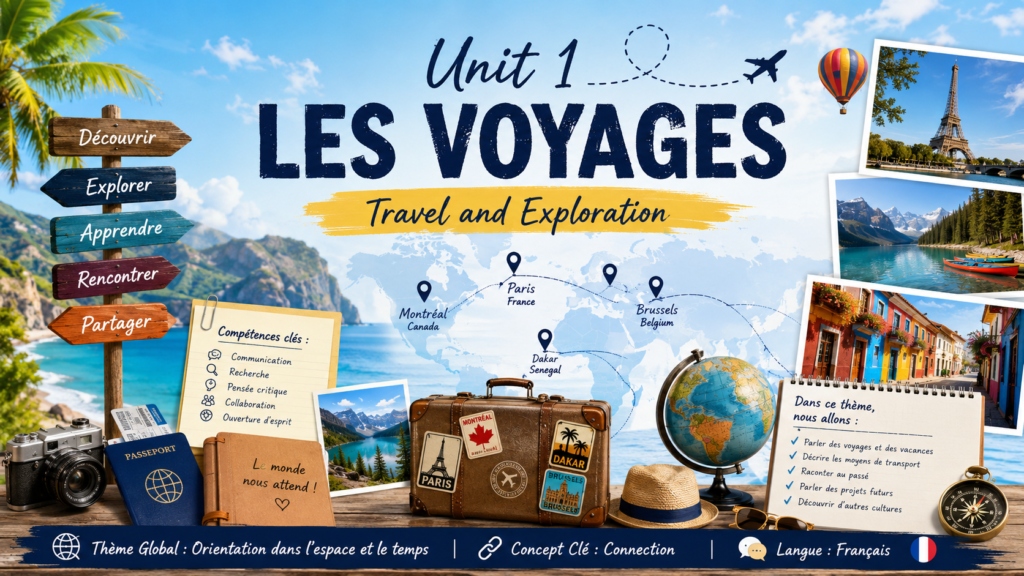
Orientation in Space and Time
Statement of Inquiry
Travel broadens perspectives and helps people understand different cultures, places, and experiences.
Key concept
Connection
Related concepts
Culture, Perspective
Inquiry questions
Factual
- Quels moyens de transport existe-t-il ?
- Quels documents sont nécessaires pour voyager ?
Conceptual
- Comment les voyages influencent-ils notre vision du monde ?
Debatable
- Voyager est-il la meilleure façon d’apprendre une culture ?
Learning objective
By the end of this unit, you will be able to:
- Discuss travel experiences and future travel plans.
- Describe different means of transportation.
- Talk about holidays and vacations.
- Narrate past events using the passé composé.
- Express future intentions using the futur proche.
- Compare travel experiences in different countries.
- Develop intercultural understanding through travel-related topics.
Week 1: Introduction to Travel
Lesson 1: Why do People travel?
Learning objective
Today, you will explore different reasons why people travel and how travel can broaden your understanding of the world.
Starter (5 min)
Look carefully at the images below.


Think about these questions:
- Où sont-ils ?
- Pourquoi voyagent-ils ?
Starter vocabulary support
Places
| Français | English |
|---|---|
| un aéroport | airport |
| une plage | beach |
| une montagne | mountain |
| un musée | museum |
| une ville | city |
| un pays | country |
Travel Verbs
| Français | English |
|---|---|
| voyager | to travel |
| visiter | to visit |
| découvrir | to discover |
| apprendre | to learn |
| explorer | to explore |
| rencontrer | to meet |
Starter sentences
Use these models to create your own answers:
- Ils sont à l’aéroport.
- Ils sont à la plage.
- Ils visitent un musée.
- Ils voyagent pour découvrir une nouvelle culture.
- Ils voyagent pour se détendre.
- Ils voyagent avec leur famille.
Inquiry Discussion
Think → Pair → Share
Discuss with a partner:
Pourquoi les gens voyagent-ils ?
Possible ideas:
- Découvrir de nouvelles cultures
- Étudier
- Travailler
- Se détendre
- Visiter la famille
Vocabulary Introduction
Let’s learn some essential travel vocabulary:
| Français | Anglais |
|---|---|
| un voyage | trip |
| une destination | destination |
| un passeport | passport |
| une valise | suitcase |
| un billet | ticket |
| un hôtel | hotel |
| une réservation | booking |
Create your own visual vocabulary cards using images and definitions.
Sentence builders
Je voyage pour…
- Je voyage pour découvrir de nouveaux endroits.
- Je voyage pour apprendre une nouvelle langue.
- Je voyage pour visiter ma famille.
- Je voyage pour me détendre.
- Je voyage pour explorer le monde.
Connectors
- parce que
- et
- mais
- aussi
Examples
- Je voyage pour découvrir de nouvelles cultures parce que j’aime apprendre.
- Je voyage pour visiter ma famille et passer du temps avec elle.
Individual task (Notebook)
Pourquoi voyageons-nous ?
Write 5 reasons why people travel.
Output
French paragraph (50–70 words).
Writing support
Starter:
Les gens voyagent pour plusieurs raisons. Ils voyagent pour…
Pair task
Interview your partner:
- Où aimerais-tu voyager ?
- Pourquoi ?
Record answers in a table.
Speaking support
Questions:
- Où aimerais-tu voyager ?
- Pourquoi ?
- Avec qui voudrais-tu voyager ?
- Quand voudrais-tu voyager ?
Answers:
- J’aimerais voyager en France.
- J’aimerais visiter le Canada.
- Je voudrais voyager avec ma famille.
- Je voudrais voyager pendant les vacances.
Output
Completed interview sheet.
Group task
Travel motivation poster
Create a chart paper poster showing:
- 5 reasons people travel
- Pictures
- French vocabulary
- One slogan
Example:
Voyager ouvre l’esprit !
Useful words
- découvrir
- apprendre
- explorer
- rencontrer
- partager
Output
Group poster presentation.
ATL skill
Communication
Exit ticket
Complete:
Je voyage pour __________.
Lesson 2: Travel Destinations
Learning objective
Today, you will learn how to describe destinations and explain why you would like to visit them.
Starter
Map activity
Locate:
- Paris
- Montréal
- Dakar
- Brussels
Destination vocabulary
| Français | Anglais |
|---|---|
| un pays | country |
| une capitale | capital city |
| un monument | landmark |
| une attraction | attraction |
| un musée | museum |
| une plage | beach |
| une montagne | mountain |
| célèbre | famous |
Sentence starters
Talking about places
- Paris est en France.
- Montréal est au Canada.
- Dakar est au Sénégal.
- Bruxelles est en Belgique.
Describing a destination
- C’est une ville célèbre.
- Il y a beaucoup de monuments.
- Il y a de belles plages.
- La culture est intéressante.
Reading activity
Read the tourism texts and identify:
- The country
- Tourist attractions
- Activities
Speaking
Work with a partner:
Je voudrais visiter ______ parce que ______.
Speaking support
- Je voudrais visiter Paris parce que la ville est magnifique.
- Je voudrais visiter Montréal parce que les gens parlent français.
- Je voudrais visiter Dakar parce que la culture est intéressante.
Individual task
Dream destination fact file
Choose one destination.
Include:
- Country
- Capital
- Language
- 3 attractions
Output
Notebook research page.
Writing template
Nom du pays :
Capitale :
Langue :
Attraction 1 :
Attraction 2 :
Attraction 3 :
Je voudrais visiter ce pays parce que…
Pair task
Compare destinations.
| Destination | Similarities | Differences |
|---|
Comparison Language
- Les deux villes sont…
- Cependant…
- Mais…
- Contrairement à…
Output
Comparison chart.
Group task
World travel map
On chart paper:
- Draw a world map
- Mark destinations
- Add French labels
Useful labels
- France
- Canada
- Sénégal
- Belgique
- capitale
- ville
- monument
Output
Classroom display.
Homework
Research your dream destination and be ready to share it with the class.
Week 2: Planning a Trip
Lesson 3: Organising a Vacation
Learning objective
Today, you will learn how to plan a trip using travel vocabulary and practical travel information.
Starter
Packing challenge
Choose the items you think are essential for a trip:
- Passeport
- Billets
- Vêtements
- Carte
Discuss your choices with a partner.
Travel vocabulary
| Français | Anglais |
|---|---|
| un passeport | passport |
| un billet | ticket |
| des vêtements | clothes |
| une carte | map |
| de l’argent | money |
| un appareil photo | camera |
| un téléphone | phone |
| une réservation | reservation |
Sentence starters
- Pour voyager, il faut…
- Je vais prendre…
- Je vais mettre…
- J’ai besoin de…
Examples
- Pour voyager, il faut un passeport.
- J’ai besoin d’un billet.
- Je vais prendre mon téléphone.
- Je vais mettre mes vêtements dans ma valise.
Guided practice
Complete the travel itinerary:
| Jour | Activité |
|---|---|
| Jour 1 | Arrivée |
| Jour 2 | Visite |
| Jour 3 | Musée |
Individual task
My Travel checklist
Create a travel checklist.
- Passeport
- Billet
- Valise
- Argent
Add at least five more items.
Output
Notebook checklist.
Pair task
Plan a weekend trip together.
Decide:
- Destination
- Transport
- Hotel
Output
Mini itinerary.
Planning support
- Nous allons visiter…
- Nous allons voyager en…
- Nous allons rester à l’hôtel…
- Nous allons visiter…
Group task
Travel agency project
Create a 3-day travel package.
Include:
- Budget
- Activities
- Hotel
- Transport
Output
Travel brochure on chart paper.
Collaborative activity
In groups, create a complete 3-day travel plan and present it to the class.
Presentation support
- Notre destination est…
- Le budget est…
- Nous allons voyager en…
- Nous allons visiter…
ATL
Organization Skills
Exit ticket
Write one sentence:
Pour voyager, il faut __________.
Lesson 4: Travel Agency Role Play
Learning objective
Today, you will learn how to ask for travel information and make reservations.
Language structures
Practice using:
- Je voudrais réserver…
- Combien coûte… ?
- À quelle heure part le train ?
- Où est l’hôtel ?
Travel agency vocabulary
| Français | Anglais |
|---|---|
| une réservation | reservation |
| un client | customer |
| une agence de voyages | travel agency |
| un hôtel | hotel |
| un billet | ticket |
| un départ | departure |
| une arrivée | arrival |
| un prix | price |
Guided practice
Repeat and practise the expressions with your partner.
Create short dialogues using the expressions.
Model dialogue
A : Bonjour.
B : Bonjour. Comment puis-je vous aider ?
A : Je voudrais réserver une chambre d’hôtel.
B : Pour quelle date ?
A : Pour le 15 juillet.
B : Très bien.
Individual task
Write 5 travel questions.
Example:
- Combien coûte le billet ?
More examples
- Où est l’hôtel ?
- À quelle heure part l’avion ?
- Y a-t-il une piscine ?
- Quel est le prix ?
Output
Notebook activity.
Pair task
Role-Play
Student A = Client
Student B = Travel Agent
Use at least:
- 3 questions
- 3 answers
- 1 reservation request
Output
2-minute dialogue.
Group task
Travel agency booth
Each group creates:
- Agency name
- Poster
- Holiday offers
- Price list
- Travel destination
Output
Live role-play station.
Pair activity
One of you will be the travel agent and the other will be the customer.
Switch roles after the first dialogue.
Criterion D Preparation
Interactive speaking practice.
Exit ticket
Complete:
Je voudrais réserver __________.
Week 1–2 Portfolio check
By the end of Week 2, you should have:
- Vocabulary Cards
- Travel Motivation Poster
- Dream Destination Fact File
- World Travel Map Contribution
- Travel Checklist
- Weekend Trip Itinerary
- Travel Brochure
- Travel Agency Dialogue
These pieces will become part of your MYP Learning Portfolio and may be used as evidence for Criterion B, C, and D.
Next: https://frenchibhub.com/group-task-mon-voyage-de-reve/