Lesson 1
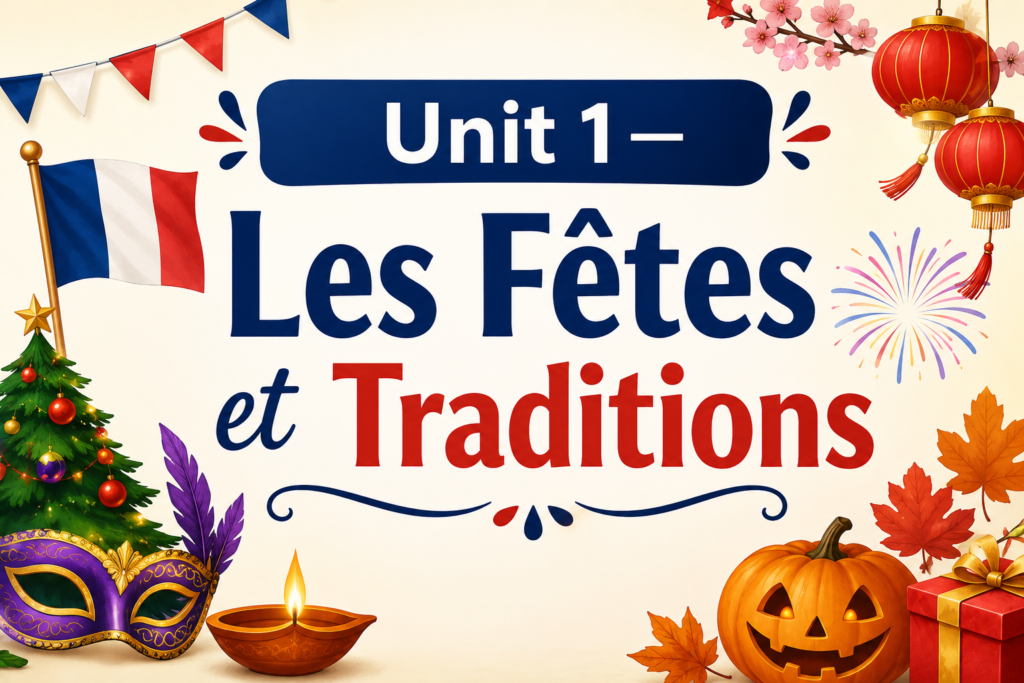
Introduction aux fêtes et aux traditions
(Introduction to Festivals and Traditions)
Bonjour tout le monde !
Welcome to Unit 1: Les Fêtes et Traditions.
Before we start learning French grammar or memorising new vocabulary, I want you to think about something.
Imagine this…
Your birthday arrives.
Your family decorates the house.
Everyone is smiling.
Your relatives visit.
There is delicious food on the table.
People sing.
You receive gifts.
Photos are taken.
Everyone is happy.
Now ask yourself:
Why do people celebrate?
Have you ever thought about it?
Celebrations are much more than parties.
They help us remember important events.
They bring families together.
They teach us about our culture.
They remind us of our history.
Every country has its own traditions.
France has many beautiful celebrations.
India has Diwali, Holi and Pongal.
Brazil celebrates Carnaval.
China celebrates the Chinese New Year.
Mexico celebrates Día de los Muertos.
Although these celebrations are different, they all have one thing in common:
They bring people together.
That is exactly what we are going to study in this unit.
Learning objectives
By the end of today’s lesson, you will be able to:
- understand the difference between a celebration and a tradition.
- recognise some important French festivals.
- learn useful vocabulary related to celebrations.
- describe simple celebrations.
- compare celebrations from different countries.
What is a Celebration?
A celebration is a special event where people come together to remember, honour or enjoy something important.
A celebration may be:
- religious
- cultural
- historical
- personal
Examples:
Christmas
Birthday
Wedding
National Day
Graduation
New Year
In French
Une célébration
or
Une fête
Examples
La Fête Nationale
Noël
Pâques
Le Nouvel An
Mon anniversaire
What is a Tradition?
A tradition is something people do regularly because it has been passed from one generation to another.
It becomes part of a family’s or country’s identity.
Examples:
Decorating a Christmas tree
Lighting diyas during Diwali
Eating special food
Watching fireworks
Giving presents
Visiting relatives
Traditional dances
Traditional clothing
French
Une tradition
Think about it
Can you name one tradition in your family?
Examples
Eating together every Sunday
Praying before meals
Celebrating birthdays
Visiting grandparents
French culture
France is famous for many celebrations.
Today we will discover a few of them.
1. La Fête Nationale Française
Date
14 juillet
Why?
It celebrates the Storming of the Bastille in 1789.
This event marked the beginning of the French Revolution.
People:
watch military parades
wave French flags
listen to music
watch fireworks
eat together
visit family
Useful sentence
La Fête Nationale est célébrée le 14 juillet.
2. Noël
Date
25 décembre
People:
decorate Christmas trees
exchange gifts
prepare delicious meals
visit relatives
attend church
Useful sentence
À Noël, les familles se réunissent.
3. Pâques
People celebrate Easter with family.
Children often search for chocolate eggs.
Useful sentence
Les enfants cherchent des œufs en chocolat.
4. Le Nouvel An
People celebrate the beginning of a new year.
They:
count down
watch fireworks
wish everyone happiness
Useful sentence
Bonne année !
Vocabulary
Festivals
| French | English |
|---|---|
| une fête | celebration |
| une tradition | tradition |
| une célébration | celebration |
| Noël | Christmas |
| Pâques | Easter |
| le Nouvel An | New Year |
| la Fête Nationale | National Day |
| un anniversaire | birthday |
People
| French | English |
|---|---|
| la famille | family |
| les amis | friends |
| les voisins | neighbours |
| les enfants | children |
| les invités | guests |
Activities
| French | English |
|---|---|
| célébrer | celebrate |
| manger | eat |
| chanter | sing |
| danser | dance |
| écouter de la musique | listen to music |
| regarder les feux d’artifice | watch fireworks |
| offrir des cadeaux | give gifts |
| recevoir des cadeaux | receive gifts |
| prendre des photos | take photos |
| se réunir | gather together |
Food
| French | English |
|---|---|
| un gâteau | cake |
| des bonbons | sweets |
| du chocolat | chocolate |
| un repas | meal |
| une boisson | drink |
Key verbs
Today we will learn some useful verbs.
| Infinitive | Meaning |
|---|---|
| célébrer | to celebrate |
| aimer | to like |
| manger | to eat |
| regarder | to watch |
| écouter | to listen |
| jouer | to play |
| chanter | to sing |
| danser | to dance |
Sentence starters
These expressions will help you speak and write.
Introducing a celebration
Ma fête préférée est…
Aujourd’hui, je vais parler de…
J’aime…
La fête est…
Talking about the date
Elle est célébrée…
Chaque année…
Le…
Pendant…
Talking about activities
Nous mangeons…
Nous dansons…
Nous chantons…
Nous regardons…
Nous jouons…
Nous décorons…
Giving an opinion
J’aime cette fête parce que…
À mon avis…
Je pense que…
Je trouve cette fête…
Grammar focus
Today we revise the Present Tense.
Why?
Because festivals happen every year.
Examples
Je célèbre Noël.
Nous mangeons ensemble.
Ils chantent.
Elle danse.
Nous regardons les feux d’artifice.
Notice that we describe habits and traditions using the present tense.
Reading practice
Read the text.
Bonjour !
Ma fête préférée est Noël.
Je célèbre cette fête avec ma famille.
Nous décorons la maison.
Nous mangeons un grand repas.
Nous chantons des chansons.
Le soir, nous ouvrons les cadeaux.
J’aime Noël parce que c’est une fête joyeuse.
Reading questions
- Quelle est la fête préférée ?
- Avec qui célèbre-t-on Noël ?
- Que fait la famille ?
- Pourquoi aime-t-elle Noël ?
- Trouve deux activités.
Speaking practice
Answer using complete sentences.
Quelle est ta fête préférée ?
Quand célèbres-tu cette fête ?
Avec qui célèbres-tu cette fête ?
Que fais-tu ?
Pourquoi aimes-tu cette fête ?
Writing practice
Write six complete French sentences about your favourite celebration.
Use these sentence starters.
Ma fête préférée est…
Je célèbre…
Je mange…
Je joue…
J’aime cette fête parce que…
À mon avis…
Classroom activity
Festival matching
Match the celebration with the activity.
| Celebration | Activity |
|---|---|
| Noël | Exchange gifts |
| La Fête Nationale | Watch fireworks |
| Pâques | Chocolate eggs |
| Le Nouvel An | Countdown |
Pair activity
Work with a partner.
Student A asks:
Quelle est ta fête préférée ?
Student B answers.
Then switch roles.
Mini challenge
Complete the sentences.
Ma fête préférée est __________.
Je célèbre cette fête avec __________.
Nous __________ de la musique.
Nous __________ des cadeaux.
Cette fête est __________.
IB Learner Profile Connection
This lesson helps you become:
- Open-minded – by learning about celebrations from different cultures.
- Communicators – by expressing ideas confidently in French.
- Knowledgeable – by exploring French history and traditions.
- Reflective – by comparing your own traditions with those of others.
Homework
Create a Festival Fact File about one celebration from your country.
Include:
- Name of the celebration
- Date
- Why it is celebrated
- Activities
- Food
- Family traditions
- One picture or drawing
- Write 5–6 simple French sentences using the vocabulary from today’s lesson.
Lesson summary
Today you have learned:
- The difference between a fête and a tradition.
- Four major French celebrations: La Fête Nationale, Noël, Pâques, and Le Nouvel An.
- More than 30 essential vocabulary words related to festivals.
- Useful sentence starters for speaking and writing.
- How to describe celebrations using the present tense.
- How festivals reflect culture, identity, and heritage.
In the next lesson, we will build on this foundation by learning how to describe celebrations in more detail, talk about traditions within our families, and use richer vocabulary to communicate confidently in French.