Train your Brain to think in French, Not in Vocabulary lists
Hello everyone!
So far, we’ve learned:
- Step 1: Understand the 10 themes.
- Step 2: Focus on communication skills instead of memorizing vocabulary.
- Step 3: Create a Theme Folder.
- Step 4: Study one theme across all four exam skills.
Now we’re moving to one of the most powerful learning techniques used by language learners and memory experts:
Mind Mapping
This single technique can dramatically improve your ability to remember vocabulary, generate ideas quickly, and speak more fluently during the TEF exam.
Why do Students forget Vocabulary?
Let me ask you a question.
Imagine you study these words:
- le train
- l’hôtel
- la valise
- le passeport
- le billet
- le taxi
- l’aéroport
You memorize them tonight.
Tomorrow, you remember most of them.
Next week…
You only remember two or three.
Why?
Because your brain doesn’t like isolated information.
Think about your phone.
If someone gives you ten random phone numbers, you’ll probably forget them.
But if those numbers belong to your family and close friends, you remember them easily.
Why?
Because your brain connects information.
French vocabulary works exactly the same way.
The more connections you create, the easier it becomes to remember.
That’s exactly what a mind map does.
What is a Mind Map?
A mind map is simply a way of organizing ideas around one central topic.
Instead of writing a long vocabulary list…
You place the theme in the middle.
Then you create branches.
Each branch represents a category.
For example:
                TRAVEL
                    │
────────────────────────────────
│        │        │        │
Transport Hotel Documents Activities
│        │        │        │
Train    Room     Passport Museum
Bus      Pool     Visa      Beach
Plane    Reception Ticket    Hiking
Taxi     Breakfast Luggage   Shopping
Instead of memorizing twenty separate words…
Your brain now sees one complete picture.
This is much easier to remember.
Why mind Maps work
Your brain doesn’t think alphabetically.
It thinks by association.
For example…
If I say:
Hospital
What immediately comes to your mind?
Doctor.
Nurse.
Medicine.
Patient.
Emergency.
Appointment.
You didn’t have to think.
Your brain made the connections automatically.
This is exactly how you should learn French.
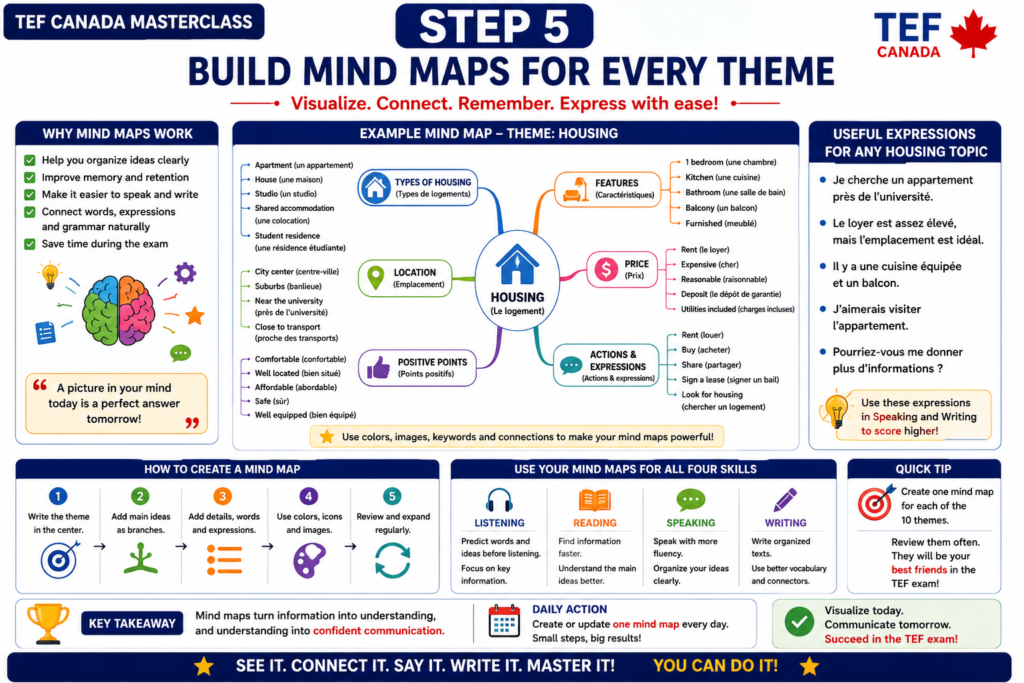
Example 1 – Housing theme
Let’s create a simple mind map together.
Our central idea is:
Housing
Now ask yourself:
“What words are connected to housing?”
Rooms
- chambre
- cuisine
- salon
- salle de bains
- balcon
- garage
- jardin
Furniture
- lit
- table
- chaise
- canapé
- armoire
- bureau
Verbs
- habiter
- louer
- acheter
- vendre
- déménager
- construire
Adjectives
- grand
- petit
- calme
- moderne
- confortable
- spacieux
- lumineux
Problems
- trop cher
- trop petit
- bruyant
- loin du centre-ville
- pas de parking
Advantages
- proche du métro
- quartier calme
- bien situé
- entièrement meublé
- transports en commun
Now look at your page.
Instead of seeing 30 random words…
You see one organized system.
Example 2 – Health theme
Central idea:
Health
Create branches.
People
- médecin
- infirmier
- pharmacien
- dentiste
Places
- hôpital
- clinique
- pharmacie
Health Problems
- fièvre
- mal de tête
- rhume
- grippe
- douleur
Verbs
- consulter
- prendre
- soigner
- guérir
- tousser
Advice
- boire de l’eau
- se reposer
- faire du sport
- manger sainement
- dormir suffisamment
Now your brain connects everything naturally.
Example 3 – Technology
Central idea:
Technology
Devices
- ordinateur
- téléphone
- tablette
- montre connectée
Internet
- Wi-Fi
- connexion
- navigateur
- site web
Social Media
- TikTok
Verbs
- télécharger
- envoyer
- partager
- cliquer
- publier
Advantages
- rapide
- pratique
- efficace
Disadvantages
- dépendance
- piratage
- perte de temps
- cyberharcèlement
Again…
Everything is connected.
Don’t stop at Vocabulary
This is where many students make another mistake.
They create a vocabulary mind map.
Then they stop.
You should go much further.
Every branch should include:
Vocabulary
ordinateur
↓
Verb
utiliser
↓
Adjective
rapide
↓
Expression
Je me sers de mon ordinateur tous les jours.
↓
Opinion
À mon avis, les ordinateurs sont indispensables.
↓
Question
Quel ordinateur utilises-tu ?
↓
Speaking idea
Convince your friend to buy a new laptop.
↓
Writing idea
Write an email asking for technical support.
Now one single word prepares you for every exam skill.
Mind Maps for speaking
Let’s imagine Speaking Section B.
Advertisement:
“A new gym is opening.”
Your mind should automatically create branches.
Price
Affordable
Location
Near home
Equipment
Modern machines
Benefits
Healthy
Meet new people
Lose weight
Reduce stress
Improve fitness
Objections
Too expensive
Too far
No time
Then immediately think of responses.
Now you already have enough ideas to speak for several minutes.
Mind Maps for writing
Imagine the writing task is:
“You need to complain about a noisy neighbour.”
Create a quick mind map.
Problem
↓
Noise
↓
Late at night
↓
Can’t sleep
↓
Need a solution
↓
Request action
Instead of staring at a blank page…
Your ideas are already organized.
Writing becomes much easier.
The Five-Minute mind map exercise
Whenever you study a new theme, spend just five minutes creating a mind map.
Start with the central topic.
Then ask yourself:
Who?
Who is involved?
Where?
Where does it happen?
What?
What objects are related?
Actions?
What verbs are commonly used?
Opinions?
What positive and negative opinions can I express?
Problems?
What problems might occur?
Solutions?
How can the problems be solved?
Answering these questions gives you a complete picture of the theme.
Why this Method is so Powerful
Imagine revising the day before the exam.
Would you rather read:
Ten pages of vocabulary…
Or one colorful page showing the entire theme?
Most students choose the second option.
That’s because your brain remembers images, categories, and connections much better than long lists.
A mind map allows you to see the whole theme at a glance.
Final advice
Don’t learn French like a dictionary.
A dictionary lists words one after another.
Your brain doesn’t work that way.
Your brain learns through connections.
Every time you create a mind map, you’re teaching your brain to connect vocabulary, grammar, ideas, opinions, questions, and communication strategies.
The result?
When you enter the TEF exam and see a topic like Travel, Housing, or Technology, your brain won’t search for isolated words.
Instead, it will immediately activate an entire network of related ideas, expressions, and arguments.
That’s exactly how confident French speakers think.
Key takeaway
A mind map is not just a revision tool.
It is a thinking tool.
It helps you:
- remember vocabulary more easily,
- organize your ideas quickly,
- generate arguments for Speaking,
- plan your Writing,
- understand Reading and Listening more effectively,
- and build confidence in every part of the TEF Canada exam.
From today onwards, don’t study with disconnected word lists.
Study with connections.
Because the stronger the connections in your mind, the stronger your French will become.