The Secret that makes Preparation Easier
Hello everyone!
Now that you understand what the 10 themes are, it’s time to learn the most important strategy in your TEF preparation.
Many students prepare like this:
- Today I’ll study Housing.
- Tomorrow I’ll study Travel.
- Next week I’ll study Health.
Then they memorize hundreds of vocabulary words.
After a few weeks, they realize something frustrating…
“I know many words, but I still can’t speak or write confidently.”
Why does this happen?
Because vocabulary alone does not help you communicate.
Communication is a skill.
Just as knowing the names of football players doesn’t make you a footballer, knowing French words doesn’t automatically make you a French speaker.
The TEF examiner is evaluating your ability to use the language, not simply know the language.
That’s why, instead of studying one vocabulary list after another, you should study the communication skills that appear in every theme.
The Secret of the TEF Exam
Let’s imagine two students.
Student A
Memorizes 200 words about housing.
Apartment.
Kitchen.
Bedroom.
Rent.
Garage.
Balcony.
Neighbour.
Electricity.
Water bill.
Excellent.
Now the examiner asks:
“Which apartment would you recommend to your friend?”
The student knows the vocabulary…
But cannot explain their opinion.
Student B
Knows fewer words.
But can:
- describe
- compare
- recommend
- explain
- ask questions
- justify opinions
Who do you think will receive the higher score?
Student B.
Why?
Because TEF measures communication, not memorization.
The Six communication skills
Every TEF theme requires the same communication skills.
Whether you’re talking about:
- housing,
- work,
- health,
- travel,
- shopping,
- technology,
you’ll always need to do six things.
Let’s study them one by one.
Skill 1 – Describe
The first communication skill is description.
Imagine someone asks you:
“Tell me about your house.”
You don’t simply list vocabulary.
Instead, you organize your ideas.
For example:
J’habite dans un appartement moderne.
Il y a trois chambres.
Le quartier est très calme.
Notice what you’re doing.
You’re describing.
Now imagine another topic.
Describe your workplace.
Describe your city.
Describe your school.
Describe your family.
It’s exactly the same skill.
Only the topic changes.
Skill 2 – Express your Opinion
French speakers constantly express opinions.
The examiner expects you to do the same.
Instead of giving facts only…
Say what you think.
Examples:
Je pense que…
I think that…
À mon avis…
In my opinion…
Personnellement…
Personally…
Je trouve que…
I find that…
Let’s compare.
Without opinion:
Cet appartement est grand.
With opinion:
Je trouve que cet appartement est très spacieux.
The second answer sounds much more natural.
Skill 3 – Explain
An opinion without an explanation is weak.
Whenever you give your opinion…
Explain why.
For example:
Je préfère vivre en ville parce qu’il y a plus de transports en commun.
Notice the structure.
Opinion.
↓
Reason.
This works in every theme.
Health.
Travel.
Education.
Technology.
Shopping.
Always explain why.
Useful expressions:
- Parce que…
- Car…
- En effet…
- Puisque…
Skill 4 – Compare
The examiner loves comparisons.
Instead of saying:
Cette voiture est bien.
Compare it.
Cette voiture est plus économique que l’autre.
Now your language becomes richer.
Useful comparison expressions:
- plus… que
- moins… que
- aussi… que
- meilleur que
- pire que
You can compare:
Two apartments.
Two jobs.
Two cities.
Two schools.
Two holidays.
Two phones.
Comparisons are everywhere.
Skill 5 – Recommend
This is especially important for Speaking Section B, where your goal is to convince a friend.
Instead of only describing something…
Recommend it.
Examples:
Je te conseille de…
I advise you to…
Tu devrais…
You should…
Je te recommande…
I recommend…
Ce serait une bonne idée de…
It would be a good idea to…
Recommendations make your French sound persuasive.
Skill 6 – Ask questions
Good communication is never one-sided.
You must know how to ask questions.
For example:
Housing
Quel est le prix ?
Est-ce qu’il est meublé ?
Travel
À quelle heure part le train ?
Shopping
Est-ce qu’il y a une réduction ?
Health
Puis-je prendre rendez-vous ?
Learning to ask questions allows you to keep the conversation going naturally.
Notice the Pattern
Let’s use one theme.
Housing
Can you…
Describe an apartment?
Express your opinion?
Compare two apartments?
Recommend one?
Ask questions?
Explain your choice?
Yes.
Now change the topic.
Travel
Describe a destination.
Express your opinion.
Compare two hotels.
Recommend one.
Ask questions.
Explain your reasons.
Exactly the same communication skills.
Only the vocabulary changes.
This is why mastering the skills is much more important than memorizing long vocabulary lists.
The communication formula
Whenever you receive a topic in the exam, train yourself to think in this order:
Step 1
Describe.
What is it?
Step 2
Give your opinion.
What do I think?
Step 3
Explain.
Why do I think that?
Step 4
Compare.
Is there a better option?
Step 5
Recommend or suggest.
What should the other person do?
Step 6
Ask questions or respond.
How can I continue the conversation?
If you follow this sequence, you’ll never run out of ideas during Speaking or Writing.
Practical example
Imagine the theme is Technology.
Instead of panicking, apply the six skills.
Describe
Cette application est très pratique.
Opinion
À mon avis, c’est une excellente application.
Explain
Parce qu’elle permet de gagner du temps.
Compare
Elle est plus rapide que les autres applications.
Recommend
Je te conseille de la télécharger.
Ask
Est-ce que tu l’as déjà utilisée ?
One theme.
Six communication skills.
And you’ve already produced a complete conversation.
Why this Strategy works
Think about driving a car.
You don’t learn to drive one car…
…then learn again for another brand.
Once you’ve mastered the skill of driving, you can drive almost any car.
French works the same way.
Once you’ve mastered the skills of:
- describing,
- expressing opinions,
- explaining,
- comparing,
- recommending,
- and asking questions,
you can communicate confidently in every one of the 10 TEF themes.
Key takeaway
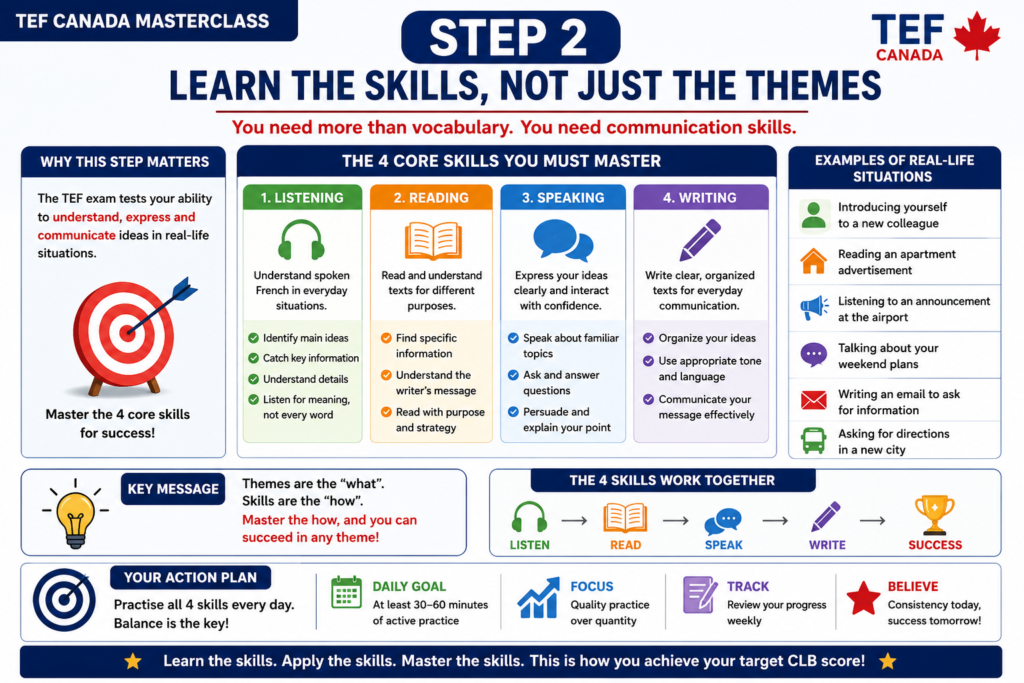
The themes tell you what you’ll talk about.
The communication skills tell you how to talk about it.
This is one of the biggest mindset shifts you can make in your TEF preparation.
From now on, don’t ask yourself:
“How many words do I need to memorize?”
Instead, ask yourself:
“Can I describe it? Can I explain it? Can I compare it? Can I recommend it? Can I ask questions about it?”
If the answer is yes, then you’re not just learning French, you are developing the exact communication skills that the TEF examiner is looking for in Listening, Reading, Speaking, and Writing.