Don’t Interrogate—Have a natural Conversation
Hello everyone!
Welcome to Step 15.
You’ve now reached one of the most important sections of the TEF Canada exam:
Expression Orale – Partie A
Many students are afraid of this section because they think:
“I have to ask perfect questions.”
Actually…
That’s not what the examiner is looking for.
The examiner wants to know whether you can hold a natural conversation, ask relevant questions, react appropriately, and collect the information you need.
This lesson will teach you exactly how to do that.
What is Speaking Section A?
In Part A, you and the examiner play different roles.
The examiner has information that you need.
Your job is to ask questions and obtain that information.
Imagine you’re speaking to someone in real life.
You don’t know everything.
So you ask questions.
That’s exactly what happens in this section.
The examiner is evaluating whether you can communicate effectively.
What does the Examiner evaluate?
The examiner is not counting how many difficult words you know.
Instead, they evaluate:
- Can you ask clear questions?
- Can you understand the answers?
- Can you ask follow-up questions?
- Can you react naturally?
- Can you keep the conversation going?
- Can you use polite language?
- Can you organize your conversation logically?
Communication is much more important than perfection.
The Biggest mistake
Let’s imagine the task is about renting an apartment.
Many students immediately ask random questions.
Quel est le prix ?
Où est-il ?
Est-il grand ?
Est-ce qu’il est libre ?
The questions are correct.
But they don’t sound like a conversation.
They sound like an interrogation.
Real conversations have a logical flow.
Think Like a Journalist
Imagine you’re a journalist conducting an interview.
You don’t ask random questions.
You organize your interview.
You move from general information to specific details.
Do exactly the same during the TEF exam.
The Five-Step Conversation Framework
Every Speaking Section A conversation can follow the same structure.
Step 1 – Greet the Examiner
Always begin politely.
Examples:
Bonjour.
Bonjour Madame.
Bonjour Monsieur.
Then introduce your purpose.
Examples:
J’aimerais obtenir quelques informations.
Je voudrais vous poser quelques questions.
This creates a natural beginning.
Step 2 – Start with General questions
Begin with broad questions.
Example:
Apartment advertisement.
Don’t immediately ask:
Les animaux sont-ils acceptés ?
Instead ask:
Pouvez-vous me parler de cet appartement ?
or
Pouvez-vous me donner quelques informations ?
Now the conversation begins naturally.
Step 3 – Ask specific questions
Once you know the general situation, ask for details.
Examples:
Price
Quel est le loyer ?
Location
Où se trouve l’appartement ?
Size
Quelle est la superficie ?
Transport
Est-il près des transports en commun ?
Availability
Quand est-il disponible ?
Notice how each question builds naturally on the previous one.
Step 4 – React to the Answers
This is where many students lose marks.
The examiner answers.
The student immediately asks another question.
No reaction.
No conversation.
Instead, react naturally.
Examples:
Ah, je vois.
D’accord.
C’est intéressant.
Très bien.
Je comprends.
C’est une bonne nouvelle.
Now your conversation sounds authentic.
Step 5 – Ask Follow-Up questions
Suppose the examiner says:
Le loyer est de 900 euros.
Don’t move to another topic immediately.
Ask another related question.
Examples:
Les charges sont-elles comprises ?
Y a-t-il un dépôt de garantie ?
Est-il possible de négocier le prix ?
One answer often creates another question.
That’s exactly how real conversations work.
The Five types of questions
Almost every Speaking Section A task uses these categories.
Information
Où… ?
Quand… ?
Comment… ?
Pourquoi… ?
Quantity
Combien coûte… ?
Combien de… ?
Choice
Préférez-vous… ?
Est-il possible de choisir… ?
Confirmation
Est-ce que… ?
Est-il possible de… ?
Clarification
Pouvez-vous répéter ?
Pourriez-vous expliquer ?
Qu’est-ce que vous voulez dire ?
These questions are extremely useful if you don’t understand something.
Keep the conversation alive
Imagine this dialogue.
Student:
Quel est le prix ?
Examiner:
500 euros.
Student:
Où est-il ?
This feels mechanical.
Now compare.
Student:
Quel est le prix ?
Examiner:
500 euros.
Student:
Ah, d’accord. Les charges sont-elles comprises dans ce prix ?
Much better.
Now the conversation flows naturally.
What if you don’t understand?
Don’t panic.
Never remain silent.
Use communication strategies.
Examples:
Pardon ?
Pourriez-vous répéter, s’il vous plaît ?
Je n’ai pas bien compris.
Pouvez-vous parler un peu plus lentement ?
The examiner prefers this to guessing incorrectly.
Use polite language
Remember that you’re speaking to someone you don’t know.
Use polite expressions.
Examples:
Pourriez-vous…
Serait-il possible de…
J’aimerais savoir…
Je voudrais obtenir des informations…
These expressions immediately make your French sound more professional.
Common topics
Speaking Section A often includes situations such as:
- Renting an apartment
- Booking a hotel
- Joining a sports club
- Registering for a course
- Buying a product
- Looking for a job
- Asking about public transport
- Organizing an event
- Visiting a museum
- Making an appointment
Notice something?
These are exactly the themes you’ve already studied.
That’s why the first twelve lessons were so important.
Practice exercise
Choose one advertisement.
Now ask yourself:
Can I ask at least:
- five general questions?
- five detailed questions?
- three follow-up questions?
If the answer is yes…
You’re ready for almost any Speaking Section A topic.
Common mistakes
Avoid these habits.
Incorrect: Asking random questions.
Incorrect: Reading directly from the advertisement.
Incorrect: Speaking without reacting.
Incorrect: Forgetting follow-up questions.
Incorrect: Using only yes/no questions.
Replace them with:
Correct: Organize your conversation.
Correct: Begin generally.
Correct: Ask for details.
Correct: React naturally.
Correct: Continue the discussion.
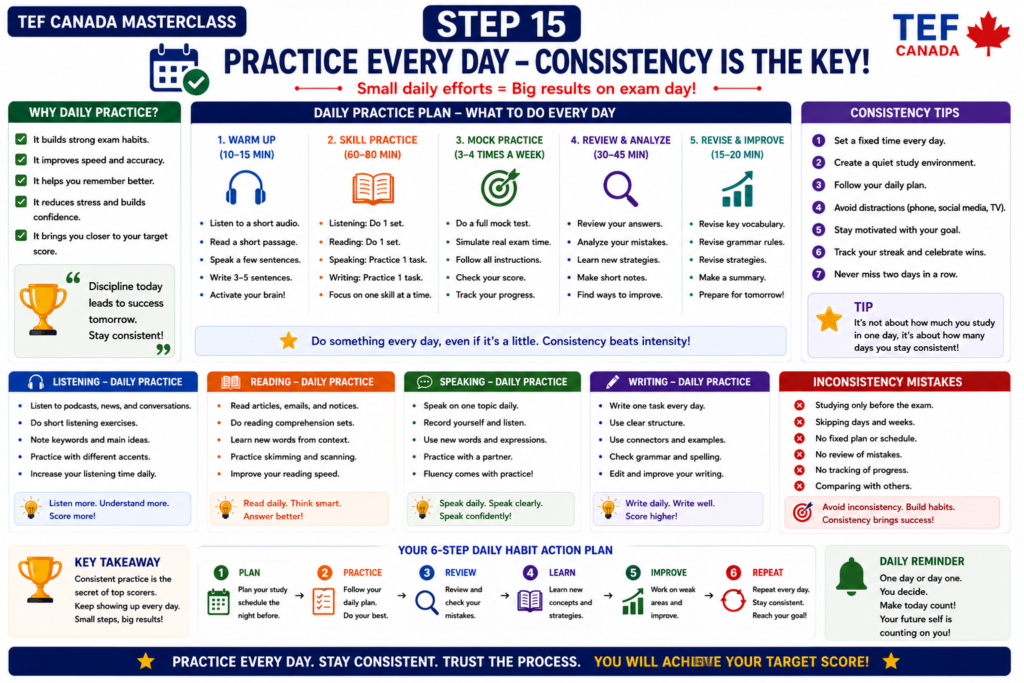
Daily practice
Choose one advertisement every day.
Set a timer for three minutes.
Pretend you’re speaking to the examiner.
Your goal is to:
- greet,
- introduce your purpose,
- ask questions,
- react,
- ask follow-up questions,
- finish politely.
Repeat with a different theme every day.
Within a few weeks, you’ll notice that asking questions becomes automatic.
What separates High-Scoring candidates?
High-scoring candidates don’t ask more difficult questions.
They ask better-organized questions.
They sound interested.
They react naturally.
They keep the conversation flowing.
That’s exactly what happens in real life.
And that’s exactly what the TEF examiner wants to hear.
Final advice
Don’t think of Speaking Section A as an exam.
Think of it as a conversation with someone who has information you need.
Be curious.
Listen carefully.
React naturally.
Ask intelligent follow-up questions.
If you do that, you’ll already be demonstrating strong communication skills.
Key takeaway
To succeed in Expression Orale – Partie A, remember this simple conversation formula:
Greeting → Purpose → General Questions → Specific Questions → Reactions → Follow-Up Questions → Polite Closing
When you stop treating Part A as a list of questions and start treating it as a real conversation, your confidence, fluency, and score will improve significantly.
Remember this golden rule:
The best candidates don’t ask the most questions. They create the most natural conversation.