
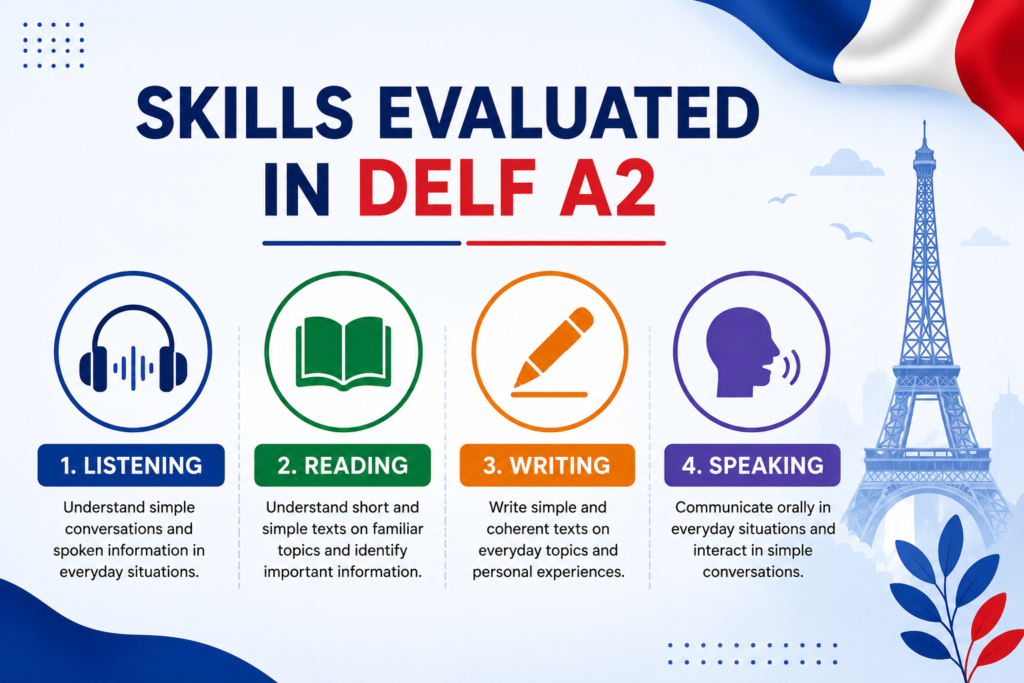
The DELF A2 exam evaluates a learner’s ability to communicate effectively in everyday French situations. The exam is based on practical communication rather than advanced academic language.
At this level, students are expected to:
- understand simple spoken and written French,
- express themselves clearly in familiar situations,
- interact with others using basic vocabulary and grammar,
- manage routine communication independently.
The DELF A2 exam evaluates four major language skills:
- Listening (Compréhension Orale)
- Reading (Compréhension Écrite)
- Writing (Production Écrite)
- Speaking (Production Orale)
Each skill is equally important and marked out of 25.
1. Listening Skills (Compréhension Orale)
What is Listening Comprehension?
Listening comprehension refers to the ability to understand spoken French.
Students must understand:
- conversations,
- announcements,
- instructions,
- interviews,
- public messages,
- daily interactions.
Objectives of the Listening Section
The listening section evaluates whether students can:
- identify important information,
- understand simple conversations,
- recognize key details,
- follow everyday spoken communication.
Skills Tested in Listening
A. Understanding Main Ideas
Students must understand the general meaning of a recording.
Example
A conversation may discuss:
- travel,
- shopping,
- school,
- hobbies,
- appointments.
Students should identify the topic quickly.
B. Identifying Specific Information
Students listen for:
- names,
- dates,
- times,
- places,
- prices,
- numbers.
Example
« Le train part à 16h45. »
Students identify:
- departure time.
C. Understanding Everyday Expressions
Students should understand common French expressions such as:
- Bonjour !
- Excusez-moi.
- Je voudrais…
- Combien ça coûte ?
- À quelle heure ?
D. Understanding Speaker Intentions
Students identify:
- requests,
- invitations,
- opinions,
- complaints,
- suggestions.
Types of Audio in DELF A2
Students may hear:
- phone conversations,
- radio announcements,
- interviews,
- conversations in shops,
- weather forecasts,
- transport announcements,
- public notices.
Example Listening Situation
Audio
« Bonjour Madame, je voudrais réserver une table pour deux personnes ce soir à 20 heures. »
Skills Tested
- understanding reservations,
- recognizing time,
- understanding purpose.
Common Difficulties in Listening
Students often struggle with:
- fast pronunciation,
- unfamiliar accents,
- missing keywords,
- panic during recordings.
Tips to Improve Listening
Listen Daily
Practice using:
- French podcasts,
- YouTube videos,
- songs,
- DELF listening exercises.
Focus on Keywords
Do not try to understand every word.
Focus on:
- verbs,
- times,
- places,
- numbers.
Practice Active Listening
Pause recordings and repeat:
- pronunciation,
- intonation,
- expressions.
2. Reading Skills (Compréhension Écrite)
What is Reading Comprehension?
Reading comprehension is the ability to understand written French texts.
Students must understand:
- notices,
- advertisements,
- emails,
- invitations,
- articles,
- schedules,
- instructions.
Objectives of the Reading Section
The reading section evaluates whether students can:
- understand written information,
- identify key ideas,
- locate details,
- interpret practical texts.
Skills Tested in Reading
A. Understanding Main Ideas
Students identify:
- the topic,
- purpose,
- general meaning.
B. Finding Specific Information
Students search for:
- dates,
- prices,
- addresses,
- schedules,
- names.
C. Understanding Instructions
Students interpret:
- public notices,
- directions,
- rules,
- procedures.
D. Understanding Opinions and Messages
Students recognize:
- feelings,
- preferences,
- requests,
- invitations.
Types of Reading Texts
Students may read:
- restaurant menus,
- train schedules,
- emails,
- hotel advertisements,
- announcements,
- posters,
- social messages.
Example Reading Task
Text
« Le musée est ouvert du mardi au dimanche de 10h à 18h. »
Possible Questions
- Which days is the museum open?
- What are the opening hours?
Tips to Improve Reading
Read Simple French Daily
Practice with:
- short articles,
- blogs,
- advertisements,
- dialogues.
Learn Vocabulary by Themes
Focus on:
- travel,
- food,
- shopping,
- health,
- family.
Practice Scanning
Train yourself to quickly identify:
- numbers,
- names,
- important words.
3. Writing Skills (Production Écrite)
What is Writing Production?
Writing production refers to the ability to express ideas in written French.
Students must write:
- clear,
- organized,
- understandable texts.
Objectives of the Writing Section
The writing section evaluates whether students can:
- communicate information,
- express opinions,
- describe experiences,
- write messages and emails.
Skills Tested in Writing
A. Sentence Formation
Students should write:
- grammatically correct sentences,
- clear structures,
- simple but effective language.
B. Organization of Ideas
Students must organize:
- introduction,
- body,
- conclusion.
C. Vocabulary Usage
Students should use appropriate vocabulary related to:
- daily life,
- family,
- studies,
- travel,
- hobbies.
D. Grammar Accuracy
Students are evaluated on:
- verb conjugation,
- agreement,
- articles,
- sentence structure.
Common Writing Tasks
Students may:
- invite a friend,
- describe an event,
- write an email,
- explain plans,
- narrate a simple experience.
Example Writing Task
Topic
Write an email inviting your friend to your birthday party.
Skills Evaluated
- greetings,
- invitation expressions,
- future tense,
- organization.
Tips to Improve Writing
Write Daily
Practice:
- short paragraphs,
- emails,
- diary entries.
Use Connectors
Examples:
- et,
- mais,
- parce que,
- ensuite,
- puis,
- finalement.
Review Grammar
Pay attention to:
- verb endings,
- gender agreement,
- punctuation.
4. Speaking Skills (Production Orale)
What is Speaking Production?
Speaking production refers to the ability to communicate orally in French.
Students should:
- express ideas clearly,
- interact naturally,
- answer questions confidently.
Objectives of the Speaking Section
The speaking section evaluates whether students can:
- participate in conversations,
- express opinions,
- describe situations,
- interact appropriately.
Skills Tested in Speaking
A. Pronunciation
Students should pronounce French words clearly.
B. Fluency
Students should speak naturally without excessive hesitation.
C. Interaction
Students must:
- answer questions,
- react appropriately,
- maintain conversation.
D. Vocabulary Usage
Students should use practical everyday vocabulary.
E. Communication Strategies
Students should:
- ask for clarification,
- reformulate ideas,
- continue speaking even with mistakes.
Example Speaking Topics
Students may speak about:
- family,
- hobbies,
- school,
- vacations,
- daily routine,
- favorite activities.
Example Questions
- Présentez-vous.
- Parlez de votre famille.
- Décrivez votre ville.
- Qu’aimez-vous faire pendant le week-end ?
Tips to Improve Speaking
Speak Regularly
Practice speaking every day.
Do Not Fear Mistakes
Communication is more important than perfection.
Learn Useful Expressions
Examples:
- À mon avis…
- Je pense que…
- J’aime…
- Je préfère…
Practice Role-Plays
Simulate:
- restaurant conversations,
- shopping situations,
- travel interactions.
Integrated Communication Skills
In real life, language skills work together.
For example:
- you listen during a conversation,
- read messages,
- reply in writing,
- speak during interactions.
The DELF A2 exam therefore evaluates practical communication as a whole.
Why These Skills Matter
Mastering these four skills helps students:
- communicate confidently,
- travel more easily,
- study French successfully,
- prepare for higher DELF levels,
- interact in French-speaking environments.
These skills form the foundation for future progress toward B1, B2, and advanced French proficiency.
Next: https://frenchibhub.com/lesson-1-se-presenter-et-parler-de-soi/