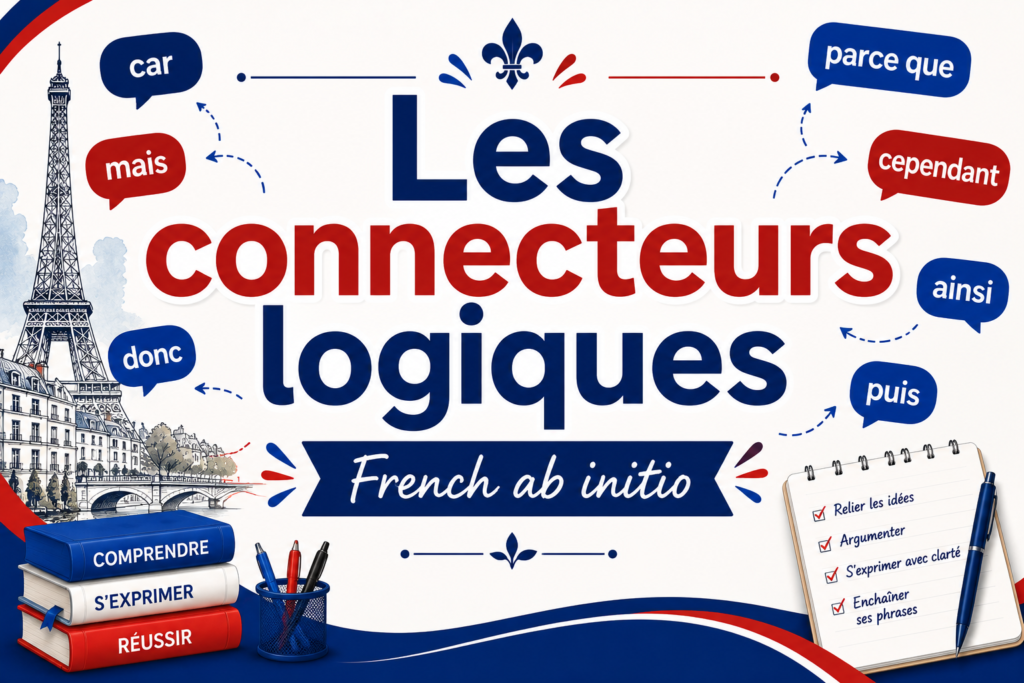
Learn how to use French logical connectors, organize ideas clearly, improve speaking and writing structure, and communicate more naturally in French.
What are “les connecteurs logiques”?
Logical connectors are words or expressions used to:
- connect ideas
- organize information
- show relationships between sentences
- make speaking and writing clearer
They are essential because they help you:
- structure opinions
- explain ideas logically
- improve fluency
- sound more natural in French
Main idea of Logical Connectors
Think of logical connectors as:
“bridges between ideas”
Without connectors:
- ideas sound disconnected
- sentences feel repetitive
- arguments are weak
With connectors:
- ideas flow naturally
- arguments become clearer
- communication becomes more organized
When do we use Logical Connectors?
We use connectors to:
- add information
- explain causes
- show consequences
- express opposition
- give examples
- conclude ideas
1. Addition
Use these connectors to add information.
Common connectors
- et = and
- aussi = also
- de plus = moreover
- en outre = furthermore
Examples
J’aime voyager et découvrir de nouvelles cultures.
(I like traveling and discovering new cultures.)
Nous avons visité Paris. De plus, nous avons vu la Tour Eiffel.
(We visited Paris. Moreover, we saw the Eiffel Tower.)
2. Cause
Use these connectors to explain WHY something happens.
Common connectors
- parce que = because
- car = because
- puisque = since
Examples
Nous sommes restés à l’hôtel parce qu’il pleuvait.
(We stayed at the hotel because it was raining.)
Je suis fatigué car j’ai beaucoup voyagé.
(I am tired because I traveled a lot.)
3. Consequence
Use these connectors to show a result or consequence.
Common connectors
- donc = therefore / so
- alors = so
- par conséquent = consequently
Examples
Il faisait très chaud, donc nous sommes allés à la plage.
(It was very hot, so we went to the beach.)
Le train était annulé. Par conséquent, nous avons pris le bus.
(The train was canceled. Consequently, we took the bus.)
4. Opposition
Use these connectors to show contrast or opposition.
Common connectors
- mais = but
- cependant = however
- pourtant = however / yet
- en revanche = on the other hand
Examples
Le voyage était long, mais très intéressant.
(The trip was long, but very interesting.)
Nous voulions sortir. Cependant, il pleuvait beaucoup.
(We wanted to go out. However, it was raining heavily.)
5. Example
Use these connectors to give examples.
Common connectors
- par exemple = for example
- notamment = notably / especially
J’aime les monuments historiques, par exemple la Tour Eiffel.
(I like historical monuments, for example the Eiffel Tower.)
6. Conclusion
Use these connectors to finish or summarize ideas.
Common connectors
- enfin = finally
- en conclusion = in conclusion
- pour conclure = to conclude
Examples
En conclusion, voyager permet de découvrir de nouvelles cultures.
(In conclusion, traveling allows people to discover new cultures.)
How to identify the correct connector
Ask yourself:
Do I want to:
- add information?
- explain?
- show a consequence?
- oppose an idea?
- give an example?
- conclude?
The answer helps you choose the correct connector.
Travel theme examples
Addition
Nous avons visité plusieurs monuments et nous avons pris beaucoup de photos.
(We visited several monuments and took many photos.)
Cause
Nous avons annulé le voyage parce qu’il faisait mauvais.
(We canceled the trip because the weather was bad.)
Consequence
L’hôtel était complet, donc nous avons cherché une autre chambre.
(The hotel was full, so we looked for another room.)
Opposition
Le voyage était fatigant. Cependant, il était magnifique.
(The trip was tiring. However, it was wonderful.)
Common mistakes
Mistake 1
Incorrect: Je suis resté à l’hôtel donc il pleuvait.
Why wrong?
Because “donc” expresses consequence, not cause.
Correct: Je suis resté à l’hôtel parce qu’il pleuvait.
Mistake 2
Incorrect: Cependant nous avons visité le musée parce qu’il était fermé.
Why wrong?
The ideas do not logically connect.
Correct: Nous voulions visiter le musée. Cependant, il était fermé.
Quick identification technique
Ask yourself:
What relationship exists between these ideas?
- addition?
- cause?
- consequence?
- opposition?
- example?
- conclusion?
Then choose the connector.
Mini practice
Choose the correct connector
- Il pleuvait, __________ nous sommes restés à l’hôtel.
- Nous avons visité Rome et __________ Florence.
- Le voyage était cher. __________, il était très intéressant.
- J’aime les voyages culturels, __________ les visites de musées.
Answers
- donc
- aussi
- cependant
- par exemple
Speaking practice
Answer the questions using logical connectors
- Pourquoi aimez-vous voyager ?
- Préférez-vous la ville ou la campagne ?
- Quels sont les avantages du tourisme ?
- Les réseaux sociaux influencent-ils les voyages ?
Try to use:
- parce que
- cependant
- donc
- de plus
Writing practice
Write a short paragraph about travel using:
- one addition connector
- one cause connector
- one consequence connector
- one opposition connector
Why are Logical Connectors important?
Logical connectors help you:
- organize ideas clearly
- improve speaking fluency
- write better paragraphs
- explain opinions naturally
- sound more advanced in French
They are essential for:
- IB French ab initio
- oral presentations
- discussions
- TEF / TCF preparation
- structured writing
Continue your learning
After studying les connecteurs logiques, continue with these important grammar lessons:
➜ Le passé composé — learn how to talk about completed past actions and specific events
➜ Le plus-que-parfait — learn how to describe an action that happened before another past action
➜ L’impératif — learn how to give advice, instructions, and recommendations
➜ Raconter un voyage au passé — learn how to narrate travel experiences naturally in French
These grammar lessons will help you:
- improve oral fluency
- organize ideas better
- write more structured paragraphs
- prepare for IB French ab initio assessments
The logical connectors lesson above is part of a complete travel and communication grammar sequence for beginner and intermediate French learners.