Description
Learn French invitations and responses with grammar rules, polite expressions, and TEF Canada examples. Invite, accept, and refuse naturally at A1–A2 level.
Introduction: From Describing to Acting in French
In this lesson on French invitations and responses, you will learn how to interact naturally in real-life situations.
Until now, you have learned how to:
- introduce yourself
- describe your life
- talk about your routine
Now, you must act and communicate.
At TEF 100% level, the goal is:
not just speaking → interacting in French
Mastering French invitations and responses will help you:
- invite someone confidently
- accept or refuse politely
- succeed in TEF Canada speaking tasks
What Are French Invitations and Responses?
French invitations and responses are structures used to:
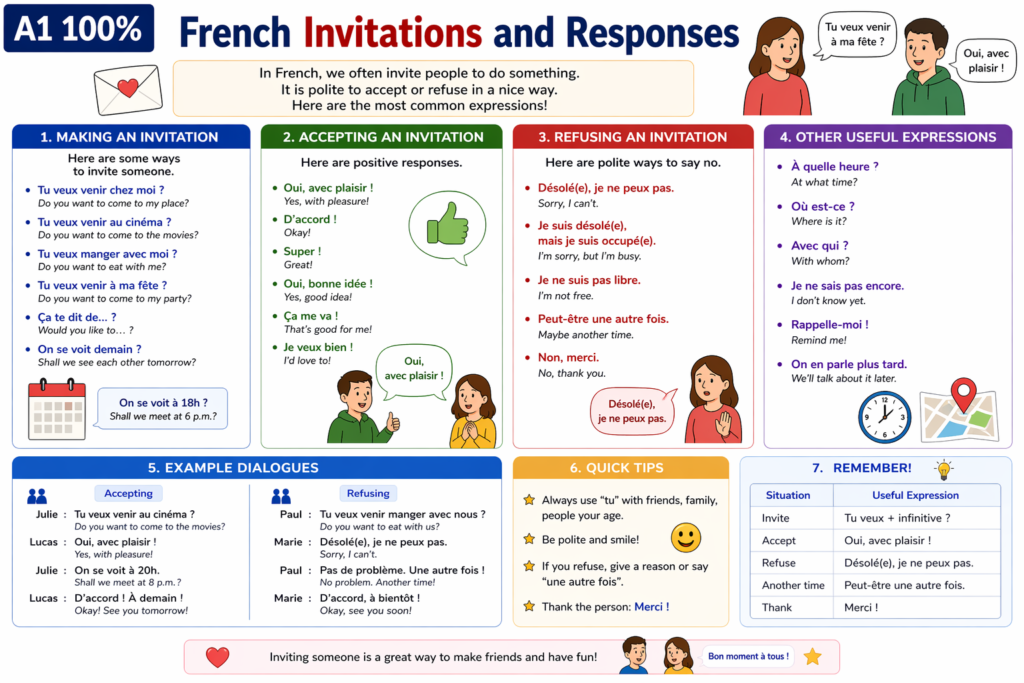
- invite someone → Tu veux…, Ça te dit…
- accept → Oui, avec plaisir
- refuse politely → Désolé(e), je ne peux pas
These are essential for real-life French conversation (A1–A2 level).
1. Grammar Logic of French Invitations and Responses
In French invitations and responses, grammar is not only about rules.
It is based on 3 key elements:
– Present tense
– Modal verbs (vouloir, pouvoir, devoir)
– Politeness structures
The grammar you use determines your level of politeness.
2. Structure 1 — Tu veux + infinitive
Grammar Breakdown
- Tu veux = present tense of vouloir
- + infinitive = action
Examples
- Tu veux sortir ?
- Tu veux venir au cinéma ?
- Tu veux manger ?
SEO + Learning Insight
This structure is very common in French invitations and responses for beginners because it is:
- simple
- direct
- easy to use in conversation
3. Structure 2 — Ça te dit + infinitive
Grammar Breakdown
- ça = neutral subject
- te = indirect object pronoun
- dit = verb dire
Examples
- Ça te dit de sortir ?
- Ça te dit d’aller au cinéma ?
Key Difference in French Invitations and Responses
| Structure | Tone |
|---|---|
| Tu veux… | direct |
| Ça te dit… | softer and more natural |
Both are correct in French invitations and responses, but tone changes meaning.
4. Accepting Invitations in French Invitations and Responses
Accepting is simple, but very important socially.
Expressions
- Oui, avec plaisir !
- Oui, pourquoi pas !
Why This Matters
In French invitations and responses, these expressions show:
- politeness
- natural communication
- social interaction skills
This is exactly what TEF examiners evaluate.
5. Refusing Invitations (Polite Grammar Strategy)
Refusing is a key part of French invitations and responses.
You must combine:
– Negation
– Modal verbs
– Politeness
Structure
Désolé(e) + je ne peux pas / je dois + infinitive
Examples
- Désolé(e), je ne peux pas
- Désolé(e), je dois travailler
- Désolé(e), je ne peux pas venir
Grammar Breakdown
- je ne peux pas → negation + pouvoir
- je dois → obligation
- infinitive → action
Important Communication Rule
Incorrect: Je ne peux pas → too direct
Correct: Désolé(e), je ne peux pas → polite
Politeness is essential in French invitations and responses.
6. Real Conversation Examples (A2 Level)
Example 1
A: Tu veux venir au cinéma ?
B: Oui, avec plaisir !
Example 2
A: Ça te dit de sortir ?
B: Désolé(e), je ne peux pas. Je dois travailler.
Example 3 (Higher Score)
A: Tu veux venir au restaurant ?
B: Désolé(e), je ne peux pas. Je dois travailler demain matin.
Adding details improves your level in French invitations and responses.
7. Common Mistakes in French Invitations and Responses
Grammar Errors
- Tu veux viens
- Je peux pas
- Je dois à travailler
Correct Forms
- Tu veux venir
- Je ne peux pas
- Je dois travailler
Communication Errors
- Non
- Silence
Always respond clearly in French invitations and responses.
8. TEF Canada Strategy (Exam Focus)
In TEF Canada, French invitations and responses test your ability to:
- interact
- respond naturally
- use correct grammar
High-Scoring Pattern
Invitation → Response → Reason
Example:
- Tu veux sortir ?
- Désolé(e), je ne peux pas. Je dois travailler.
9. Practice (A1 → A2 Progression)
Exercise 1
- Tu veux ___ (venir / viens)
- Je ne ___ pas (peux / peut)
- Je ___ travailler (dois / doit)
Exercise 2
- Je peux venir → negative
- Je veux sortir → question
Exercise 3
Respond:
Tu veux aller au cinéma ?
- acceptance
- refusal
10. Mini TEF Speaking Task
Situation: You invite a friend.
Model Answer
Tu veux venir au cinéma ?
- Accept:
Oui, avec plaisir !
- Refuse:
Désolé(e), je ne peux pas. Je dois travailler.
Continue Learning French
After mastering French invitations and responses, continue with:
- Learn French demonstrative adjectives (ce, cette, cet, ces)
- Practice ordering food in French with “je voudrais”
FAQ
How do you invite someone in French?
Use: Tu veux + infinitive or Ça te dit + infinitive.
How do you refuse politely in French?
Say: Désolé(e), je ne peux pas or Je dois + infinitive.
Why are French invitations important?
Because they are used in real-life communication.
Is this required for TEF Canada?
Yes. It is a key speaking skill.
Final Tip
To master French invitations and responses, focus on:
- correct grammar
- polite expressions
- natural interaction
This is what takes you from A1 to A2 level.