Dear Students,
The IB French ab initio course is not simply about learning a foreign language. It also requires you to think about language and culture and to reflect on how communication works in different situations.
Through this reflection, you develop important IB Learner Profile attributes such as being an effective communicator, knowledgeable, open-minded, and internationally minded. You also become more aware of your own learning process and how language is used to create meaning.
To communicate effectively, it is not enough to know vocabulary and grammar rules. You must also develop a conceptual understanding of language in other words, understand why and how language is used to communicate.
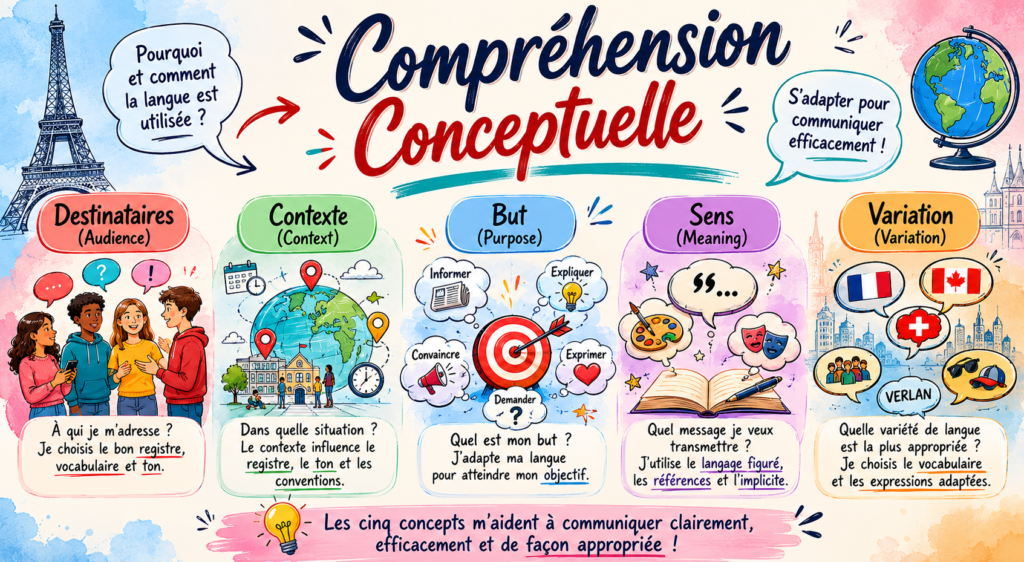
The IB Language B programme identifies five key concepts of communication, which are illustrated in the diagram.
Conceptual understanding is explicitly assessed through Criterion C: Conceptual Understanding in Paper 1 Writing.
The five key Concepts of Communication
The diagram highlights the five concepts that help us understand how communication works.
1. Audience (Destinataires)
What is the concept?
Students understand that language must be adapted to the intended audience of the communication.
Key question
Who is the communication intended for?
What should I ask myself?
- Who is my audience?
- Who is this text intended for?
- How would the text change if the audience were different?
- Is the audience young or adult?
- Is the audience informed about the topic or completely new to it?
- Is the audience specialized or general?
The Audience Influences
- Vocabulary choice
- Level of formality
- Tone
- Style of communication
- Sentence structure
- Amount of detail provided
You should also think about
- What register of language should I use?
- Formal or informal?
- Sophisticated or everyday language?
- Academic or conversational language?
- Should I use humour?
- Should I use repetition?
- Should I use persuasive language?
- Which rhetorical devices would be effective?
- Which sentence structures are most appropriate?
What should I do?
Choose an appropriate register and style:
- Formal language
- Informal language
- Academic language
- Everyday language
- Professional language when required
Consider using:
- Humour
- Repetition
- Persuasive techniques
- Appropriate rhetorical devices
- Appropriate sentence structures
Example
A formal letter to a principal requires different language from a text message to a friend.
An article written for teenagers will be different from an article written for professionals.
2. Context (Contexte)
What is the concept?
Students understand that language must be adapted to the context of communication.
Key question
In what situation does the communication take place?
What should I ask myself?
- In what context is the communication taking place?
- How does the situation influence communication?
- What relationship exists between the sender and receiver?
- How does this relationship influence communication?
- What social conventions should be respected?
- What values are associated with this social context?
- What are the conventions of the text type or media being used?
Context affects
- Register
- Tone
- Vocabulary
- Level of politeness
- Communication conventions
- Cultural expectations
You should also think about
- Is a formal register required?
- Should I avoid using “I”?
- Should I demonstrate respect for social hierarchy?
- Are there conventions associated with the chosen text type?
- What communication codes are socially acceptable in this situation?
- What values are associated with the social context?
What should I do?
Consider:
- Formal or informal register
- Social hierarchy
- Politeness conventions
- Cultural expectations
- Text-type conventions
Examples:
- Formal letter
- Interview
- Speech
- School report
- Article
Example
Writing to a principal requires different language from writing to a friend because the context and relationship are different.
3. Purpose (But)
What is the concept?
Students understand that communication always has a purpose and that language should be adapted to achieve that purpose.
Key question
What is the purpose of the communication?
What should I ask myself?
- What is the purpose of my communication?
- Why am I communicating?
- What do I want to achieve?
- How can I adapt my communication to achieve my goal?
- When I read or listen to a text, how can I identify the author’s intention?
Communication purposes
To Inform
Provide information clearly.
To Explain
Clarify ideas and concepts.
To Describe
Present details about people, places, or situations.
To Narrate
Tell a story or recount events.
To Judge
Evaluate something.
To Argue
Present and defend an opinion.
To Criticize
Evaluate something positively or negatively.
To Persuade
Convince the audience.
To Express Emotions
Share feelings and reactions.
To Evoke Emotions
Create emotional responses in the audience.
To Request
Ask for information, assistance, or action.
What should I do?
Before writing or speaking:
- Identify your communication purpose.
- Choose language that helps you achieve that purpose.
- Adapt your vocabulary and tone accordingly.
Example
If your purpose is to persuade, you should use convincing arguments and persuasive language.
If your purpose is to inform, you should use clear and objective language.
4. Meaning (Sens)
What is the concept?
Students understand that there are different modes and layers of communication and that meaning is not always explicit.
Key question
What message am I trying to communicate?
What should I ask myself?
- What message am I trying to communicate?
- Is my message clear?
- Could my message be misunderstood?
- What creates clarity in a text?
- What creates ambiguity in a text?
- How does figurative language influence meaning?
Students learn to Identify and Use
Figurative language
- Metaphors
- Comparisons
- Symbolism
Allusions
References to people, events, literature, or culture.
Bias
Personal or cultural viewpoints that influence meaning.
Proverbs and Sayings
Cultural expressions that convey shared meanings.
Cultural references
References that rely on cultural knowledge.
Implicit meaning
Messages suggested rather than directly stated.
Visual meaning
The relationship between images and language.
What should I do?
Recognize and use:
- Figurative language
- Allusions
- Cultural references
- Proverbs
- Implicit meaning
- Visual communication
Example
The expression “Il pleut des cordes” does not literally mean that ropes are falling from the sky. It means that it is raining heavily.
5. Variation (Variation)
What is the concept?
Students understand that languages are diverse and that speakers are generally aware of linguistic variation.
Key question
Which language variety is most appropriate for this communication?
What should I ask myself?
- How does language vary from one place to another?
- How does language evolve over time?
- How does language vary among different social groups?
- How does language vary between professional contexts?
- Why do speakers choose different language varieties?
Students explore variation through
Regional language
- Dialects
- Regional expressions
- Local vocabulary
Examples:
- France
- Canada
- Belgium
- Switzerland
- Senegal
Social language
- Youth language
- Slang
- Informal speech
- Verlan
- Language used by different communities
Professional language
- Technical vocabulary
- Specialized terminology
- Professional jargon
Examples:
- Medical language
- Business language
- Legal language
Language evolution
- New words
- Modern expressions
- Changes in pronunciation
- Changes in usage
What should I do?
Recognize and understand:
- Dialects
- Regional language varieties
- Youth language
- Verlan
- Slang
- Professional jargon
- Specialized language
Example
The French spoken in Quebec may contain vocabulary and expressions that differ from those commonly used in France.
Conceptual Understanding
Conceptual understanding is explicitly assessed through:
Criterion C – Conceptual Understanding
Examiners ask:
To what extent does the candidate demonstrate conceptual understanding?
Is the chosen text type appropriate for the task?
Examples:
- Blog
- Article
- Speech
- Interview
- Brochure
- Formal letter
Are the register and tone appropriate?
Does the language match:
- The audience?
- The context?
- The purpose?
Does the response follow the conventions of the chosen text type?
Examples:
- Proper email format
- Correct blog structure
- Appropriate speech conventions
- Correct letter layout
- Appropriate article conventions
Link to Criterion C
Whenever you complete a Paper 1 writing task, ask yourself these five questions:
1. Who am I communicating with?
Audience (Destinataires)
2. In what situation am I communicating?
Context (Contexte)
3. Why am I communicating?
Purpose (But)
4. What message do I want to convey?
Meaning (Sens)
5. What register and language variety should I use?
Variation (Variation)
These five concepts form the foundation of Criterion C: Conceptual Understanding, which is worth 6 marks in Paper 1 Writing and often makes the difference between an average response and an excellent response.
Why Is Conceptual Understanding important?
As French learners, you are not only learning vocabulary and grammar.
You are learning to:
- Adapt language to different audiences.
- Communicate appropriately in different contexts.
- Achieve different communication purposes.
- Interpret meaning beyond individual words.
- Recognize language variation across cultures and communities.
- Choose the most appropriate text type, register, and tone.
Ultimately, conceptual understanding helps you become a more effective communicator, which is the central goal of the IB French ab initio course.