
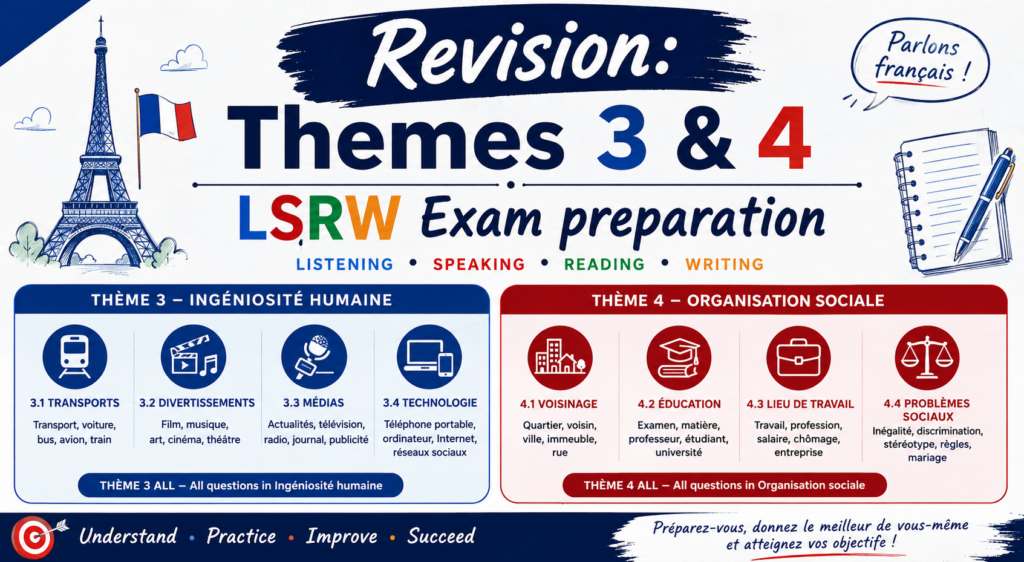
Our upcoming revision programme will focus specifically on Theme 3: Ingéniosité humaine and Theme 4: Organisation sociale.
You have asked for additional practice in these two themes, particularly to strengthen your performance in Listening, Speaking, Reading and Writing (LSRW). Therefore, I have planned a focused three-week revision programme based on the topics included in our course structure.
The aim is not to reteach everything from the beginning, but to help you become more confident in understanding exam questions, developing answers, using appropriate vocabulary, applying grammar accurately and responding according to the requirements of the task.
Revision programme
24 August – 11 September 2026
Our current timetable gives us 9 French revision classes, with a total of 6 hours and 40 minutes of revision time.
| Date | Day | Time | Duration |
|---|---|---|---|
| 25 August | Tuesday | 9:20–10:40 | 80 minutes |
| 27 August | Thursday | 10:00–10:40 | 40 minutes |
| 28 August | Friday | 11:30–12:10 | 40 minutes |
| 1 September | Tuesday | 9:20–10:40 | 80 minutes |
| 3 September | Thursday | 10:00–10:40 | 40 minutes |
| 4 September | Friday | 11:30–12:10 | 40 minutes |
| 8 September | Tuesday | 9:20–10:40 | 80 minutes |
| 10 September | Thursday | 10:00–10:40 | 40 minutes |
| 11 September | Friday | 11:30–12:10 | 40 minutes |
Important: Please come prepared for every lesson. These sessions are designed as active exam revision, so you will be expected to listen, read, speak, write, discuss your answers and reflect on your mistakes.
Theme 3 — Ingéniosité humaine
Our revision of Theme 3: Ingéniosité humaine will follow the four topic areas in our course structure.
3.1 — Transports
Key vocabulary and concepts:
- le transport
- la voiture
- le bus
- l’avion
- le train
We will practise understanding and discussing different forms of transport, while working with exam-style Listening, Speaking, Reading and Writing questions.
Tuesday, 25 August | 9:20–10:40
Focus: 3.1 — Transports
Skills: L + S + R + W
This is our first major revision session, so we will work through the complete activity cycle and focus particularly on how to approach exam questions.
3.2 — Divertissements
This topic includes:
- le film
- la musique
- l’art
- le cinéma
- le théâtre
Thursday, 27 August | 10:00–10:40
Focus: 3.2 — Divertissements
Skills: R + S + W
We will work with a collective stimulus before moving towards individual responses and discussion.
3.3 — Médias
This topic includes:
- les actualités
- la télévision
- la radio
- le journal
- la publicité
Friday, 28 August | 11:30–12:10
Focus: 3.3 — Médias
Skills: L + R + S
We will focus on understanding information, identifying key details and expressing your own ideas about media.
3.4 — Technologie
This topic includes:
- le téléphone portable
- l’ordinateur
- Internet
- les réseaux sociaux
Tuesday, 1 September | 9:20–10:40
Focus: 3.4 — Technologie + Thème 3 All
Skills: L + S + R + W
Additional focus: Exam practice
We will also use this longer Tuesday session to review Thème 3 All, which covers questions across the wider Ingéniosité humaine theme.
This will help you move from practising individual topics to responding to questions where you need to identify the relevant theme and vocabulary yourself.
Theme 4 — Organisation sociale
After completing Theme 3, we will move to Theme 4: Organisation sociale.
Our course structure includes four specific areas:
- 4.1 — Voisinage
- 4.2 — Éducation
- 4.3 — Lieu de travail
- 4.4 — Problèmes sociaux
We will also complete a final Thème 4 All revision session.
4.1 — Voisinage
Key vocabulary:
- le quartier
- le voisin / la voisine
- la ville
- l’immeuble
- la rue
Thursday, 3 September | 10:00–10:40
Focus: 4.1 — Voisinage
Skills: L + R + S
We will practise understanding descriptions and questions related to neighbourhoods, cities and communities and then use the same vocabulary in speaking activities.
4.2 — Éducation
Key vocabulary:
- l’examen
- la matière
- le professeur
- l’étudiant / l’étudiante
- l’université
Friday, 4 September | 11:30–12:10
Focus: 4.2 — Éducation
Skills: R + S + W
You will work with an exam-style stimulus, answer questions independently and then compare your responses with the markscheme.
4.3 — Lieu de travail
Key vocabulary:
- le travail
- la profession
- le salaire
- le chômage
- l’entreprise
Tuesday, 8 September | 9:20–10:40
Focus: 4.3 — Lieu de travail
Skills: L + S + R + W
Because this is our second extended Tuesday session, we will have enough time to complete the full revision cycle and work on all four skills.
Particular attention will be given to:
- understanding the question;
- identifying relevant information;
- developing complete answers;
- using topic-specific vocabulary;
- expressing opinions;
- supporting opinions with reasons and examples;
- checking grammatical accuracy.
4.4 — Problèmes sociaux
Key vocabulary and concepts:
- l’inégalité
- la discrimination
- le stéréotype
- les règles
- le mariage
Thursday, 10 September | 10:00–10:40
Focus: 4.4 — Problèmes sociaux
Skills: L + R + S
We will focus on understanding information and expressing ideas about social issues while developing your ability to give clear, relevant and well-supported responses.
Theme 4 All — Final revision
Friday, 11 September | 11:30–12:10
Focus: Thème 4 — Organisation sociale
Skills: L + S + R + W
Focus: Integrated exam revision
This final lesson will bring together the four areas:
Voisinage → Éducation → Lieu de travail → Problèmes sociaux
Rather than focusing on one individual topic, you will practise identifying the appropriate vocabulary, ideas and response strategies across the whole theme.
Our lesson structure
You specifically asked for a lesson structure that allows you to attempt questions independently before seeing the markscheme. We will therefore follow the same basic process throughout the revision programme.
Step 1 — Collective activity
We will begin with a common stimulus as a class.
Depending on the lesson, this could be:
- a Listening activity;
- a Reading text;
- a Writing task;
- or another exam-style stimulus.
We will first work together to understand the task and identify what the question is asking.
Step 2 — Individual response
You will then work individually.
You may be asked to:
- answer comprehension questions;
- identify specific information;
- write short answers;
- express an opinion;
- justify an idea;
- respond to a speaking prompt;
- or produce a short written response.
The important point is that you should attempt the task yourself before we discuss the answers.
Step 3 — Markscheme review
After completing the questions, we will look at the markscheme together.
We will examine:
- what the examiner is looking for;
- which answers receive credit;
- which details are essential;
- acceptable alternative answers;
- common mistakes;
- and why some answers may not receive marks.
The objective is not simply to know the correct answer.
You need to understand why the answer is correct and how marks are awarded.
Step 4 — Group discussion
We will then discuss the answers as a class.
You will have the opportunity to explain:
Why did you choose this answer?
We will also ask:
- Where did you find the answer?
- What words helped you?
- Did you understand the question correctly?
- Could another answer also be accepted?
- What vocabulary should you remember?
- What grammar could improve the response?
- What would make the answer clearer or more precise?
This discussion is an important part of the revision process because exam preparation is not only about getting the answer right; it is also about understanding how to arrive at the answer.
Step 5 — LSRW application
After reviewing the original task, we will apply the same topic to another skill.
For example:
Reading → Speaking
You read a text about technology and then give your own opinion about the use of technology.
Or:
Listening → Writing
You listen to information about transport and then write a short response using the information you have understood.
This will help you make connections between the four language skills.
Step 6 — Feedback and correction
Finally, we will return to your responses.
You will receive feedback on:
- Content
- Communication
- Vocabulary
- Grammar
- Accuracy
- Organisation
- Relevance to the question
- Exam technique
You will also have the opportunity to correct your own mistakes.
Remember:
A mistake that you understand and correct is part of the learning process.
Past-paper practice
Where appropriate, our revision activities will draw on the past-paper-style questions connected to the topics we are studying.
The purpose is to make your revision as relevant as possible to the type of language and questions you may encounter in your assessment.
We will therefore avoid spending our limited revision time on unrelated activities.
Instead, our focus will be:
Topic vocabulary → Exam question → Individual response → Markscheme → Discussion → LSRW practice → Feedback
Complete revision schedule
| # | Date | Topic | Main Skills |
|---|---|---|---|
| 1 | 25 Aug | 3.1 Transports | L + S + R + W |
| 2 | 27 Aug | 3.2 Divertissements | R + S + W |
| 3 | 28 Aug | 3.3 Médias | L + R + S |
| 4 | 1 Sep | 3.4 Technologie + Thème 3 All | L + S + R + W |
| 5 | 3 Sep | 4.1 Voisinage | L + R + S |
| 6 | 4 Sep | 4.2 Éducation | R + S + W |
| 7 | 8 Sep | 4.3 Lieu de travail | L + S + R + W |
| 8 | 10 Sep | 4.4 Problèmes sociaux | L + R + S |
| 9 | 11 Sep | Thème 4 All | L + S + R + W |
What I expect from you
To make these revision lessons useful, please come prepared to participate actively.
You should:
- revise the vocabulary for each topic before the lesson;
- bring your French notes and course materials;
- attempt every individual question;
- participate in class discussions;
- ask questions when you do not understand something;
- listen carefully to your classmates’ answers;
- compare your answers with the markscheme;
- correct your mistakes;
- and keep track of vocabulary and structures that you need to improve.
Most importantly:
Do not wait for me to give you the answer.
Try first.
Think.
Use the evidence.
Discuss.
Then check the markscheme.
This is how you will become more confident and independent in your IB DP French ab initio exam preparation.
Our goal
By the end of these revision sessions, you should feel more confident working with:
Thème 3 — Ingéniosité humaine
→ Transports
→ Divertissements
→ Médias
→ Technologie
and
Thème 4 — Organisation sociale
→ Voisinage
→ Éducation
→ Lieu de travail
→ Problèmes sociaux
while strengthening your ability to respond effectively in:
Listening | Speaking | Reading | Writing
The objective is not simply to memorise vocabulary. It is to learn how to use what you know in an exam situation.
Let’s use these nine lessons effectively and make every minute of our DP-2 French revision count.