Le Présent (The Present Tense)
Dear Students,
Before we learn difficult grammar such as the Passé Composé or the Future Tense, we must first master the Present Tense (Le Présent). It is one of the most important tenses in French because we use it every day to talk about what we do, what we like, and what happens regularly.
In this unit, we are learning about festivals and traditions. Festivals happen every year, and traditions are repeated regularly. Since they describe habits and repeated actions, we use the Present Tense.
For example:
- Every year, we celebrate Diwali.
- We eat together.
- We watch fireworks.
- We exchange gifts.
All these actions happen regularly, so they are written in the Present Tense.
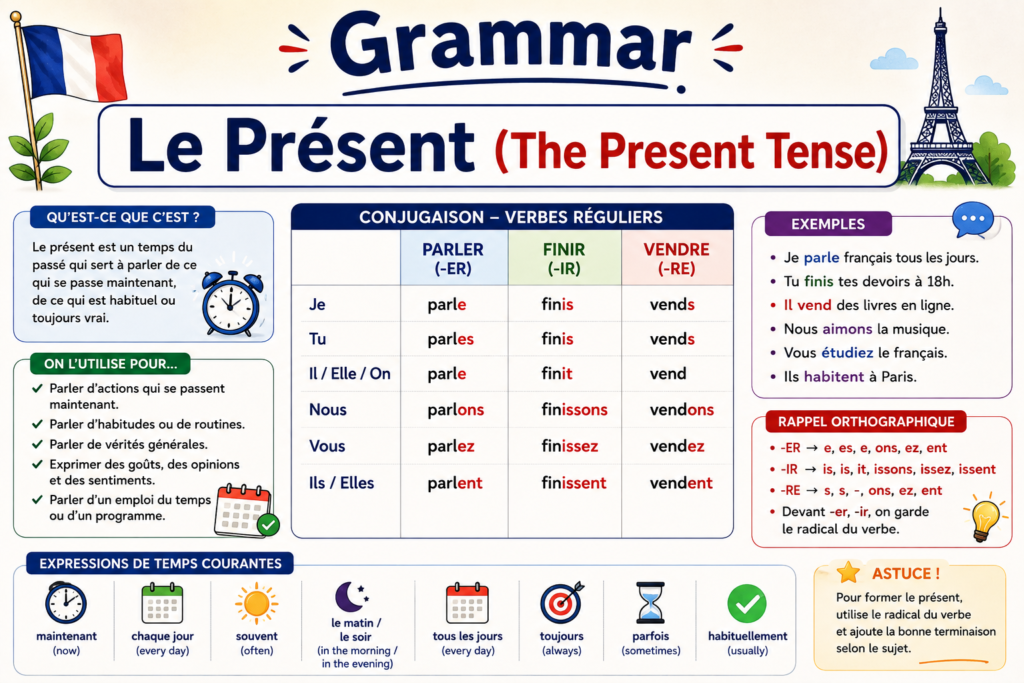
What is the Present Tense?
The Present Tense describes:
- Actions happening now.
- Daily routines.
- Habits.
- Facts.
- General truths.
- Regular celebrations and traditions.
Examples:
Je célèbre Noël.
I celebrate Christmas.
Nous mangeons un grand repas.
We eat a big meal.
Les enfants jouent ensemble.
The children play together.
The Structure
French sentences usually follow this order:
Subject + Verb + Complement
Example:
Je célèbre Noël.
| Subject | Verb | Complement |
|---|---|---|
| Je | célèbre | Noël |
Another example:
Nous regardons les feux d’artifice.
| Subject | Verb | Complement |
|---|---|---|
| Nous | regardons | les feux d’artifice |
French Subject Pronouns
Before learning verbs, you must know who is performing the action.
| French | English |
|---|---|
| Je | I |
| Tu | You (informal) |
| Il | He |
| Elle | She |
| On | We / One / People |
| Nous | We |
| Vous | You (formal or plural) |
| Ils | They (masculine or mixed) |
| Elles | They (feminine) |
Examples
Je célèbre Noël.
Tu aimes Noël.
Elle danse.
Nous mangeons.
Ils chantent.
Regular -ER Verbs
Most French verbs belong to the -ER group.
Examples:
- célébrer
- aimer
- regarder
- écouter
- jouer
- chanter
- danser
To conjugate these verbs, remove -ER and add a new ending.
Example 1 — Célébrer (to celebrate)
Remove -ER
célébrer
↓
célébr-
Now add the endings.
| Subject | Ending | Verb |
|---|---|---|
| Je | -e | célèbre |
| Tu | -es | célèbres |
| Il / Elle | -e | célèbre |
| Nous | -ons | célébrons |
| Vous | -ez | célébrez |
| Ils / Elles | -ent | célèbrent |
Notice that the stem célébr- stays the same. Only the ending changes.
Examples
Je célèbre mon anniversaire.
Tu célèbres Noël.
Il célèbre la Fête Nationale.
Nous célébrons Noël.
Vous célébrez le Nouvel An.
Ils célèbrent Diwali.
Example 2 — Aimer (to like)
| Subject | Verb |
|---|---|
| Je | aime |
| Tu | aimes |
| Il | aime |
| Nous | aimons |
| Vous | aimez |
| Ils | aiment |
Examples
J’aime Noël.
Nous aimons les traditions françaises.
Ils aiment les feux d’artifice.
Example 3 — Regarder (to watch)
| Subject | Verb |
|---|---|
| Je | regarde |
| Tu | regardes |
| Il | regarde |
| Nous | regardons |
| Vous | regardez |
| Ils | regardent |
Examples
Je regarde le défilé.
Nous regardons les feux d’artifice.
Ils regardent un spectacle.
Example 4 — Chanter (to sing)
| Subject | Verb |
|---|---|
| Je | chante |
| Tu | chantes |
| Il | chante |
| Nous | chantons |
| Vous | chantez |
| Ils | chantent |
Example
Nous chantons ensemble.
Example 5 — Danser (to dance)
| Subject | Verb |
|---|---|
| Je | danse |
| Tu | danses |
| Il | danse |
| Nous | dansons |
| Vous | dansez |
| Ils | dansent |
Example
Les enfants dansent pendant la fête.
Example 6 — Jouer (to play)
| Subject | Verb |
|---|---|
| Je | joue |
| Tu | joues |
| Il | joue |
| Nous | jouons |
| Vous | jouez |
| Ils | jouent |
Example
Les enfants jouent dans le jardin.
Example 7 — Écouter (to listen)
| Subject | Verb |
|---|---|
| Je | écoute |
| Tu | écoutes |
| Il | écoute |
| Nous | écoutons |
| Vous | écoutez |
| Ils | écoutent |
Example
Nous écoutons de la musique.
Example 8 — Manger (to eat)
This verb has a small spelling change.
Look carefully.
| Subject | Verb |
|---|---|
| Je | mange |
| Tu | manges |
| Il | mange |
| Nous | mangeons |
| Vous | mangez |
| Ils | mangent |
Notice:
Nous mangeons has an extra e.
Why?
Without the extra e, the letter g would sound like the g in garage. French adds the e to keep the soft g sound.
Examples
Nous mangeons un gâteau.
Nous mangeons avec notre famille.
Useful expressions
Instead of writing only one sentence, connect your ideas.
Examples
Je célèbre Noël avec ma famille.
Nous mangeons ensemble.
Nous regardons les feux d’artifice.
J’aime cette fête parce qu’elle est amusante.
Negative sentences
To say not, use:
ne … pas
Structure:
Subject + ne + verb + pas
Examples
Je célèbre Noël.
↓
Je ne célèbre pas Noël.
Nous mangeons ensemble.
↓
Nous ne mangeons pas ensemble.
Ils dansent.
↓
Ils ne dansent pas.
Asking questions
To ask simple questions, you can begin with a question word.
| French | English |
|---|---|
| Qui ? | Who? |
| Quand ? | When? |
| Où ? | Where? |
| Pourquoi ? | Why? |
| Comment ? | How? |
| Que ? | What? |
Examples
Quand célèbres-tu Noël ?
Pourquoi aimes-tu cette fête ?
Avec qui célèbres-tu Diwali ?
Que fais-tu pendant cette fête ?
Common mistakes
Mistake 1
Wrong: Je aime Noël.
Correct: J’aime Noël.
Why?
When Je is followed by a verb beginning with a vowel or silent h, we shorten it to J’.
Mistake 2
Wrong: Nous mangeons gâteau.
Correct: Nous mangeons un gâteau.
French usually requires an article before a noun.
Mistake 3
Wrong: Je célèbre avec famille.
Correct: Je célèbre avec ma famille.
Possessive adjectives such as mon, ma, and mes are needed to show ownership.
Mistake 4
Wrong: Nous regardons feu d’artifice.
Correct: Nous regardons les feux d’artifice.
Remember the correct expression and article.
Mistake 5
Wrong: Je célébrer Noël.
Correct: Je célèbre Noël.
After the subject, the verb must be conjugated, not left in the infinitive.
Practice Exercise A – Conjugate the Verb
Complete the sentences with the correct form of the verb.
- Je __________ Noël. (célébrer)
- Nous __________ un grand repas. (manger)
- Ils __________ avec leurs amis. (danser)
- Tu __________ les traditions françaises. (aimer)
- Vous __________ les feux d’artifice. (regarder)
- Elle __________ de la musique. (écouter)
Practice Exercise B – Rewrite Correctly
Correct the mistakes.
- Je aime Noël.
- Nous manger un gâteau.
- Ils regarde les feux d’artifice.
- Tu célébrer ton anniversaire.
- Nous danse pendant la fête.
Practice Exercise C – Translate into French
- I celebrate Christmas with my family.
- We eat together.
- They watch the fireworks.
- She likes French traditions.
- We sing and dance.
Challenge activity
Write eight complete French sentences describing a celebration.
Use at least:
- 4 different verbs
- 2 opinion expressions
- 1 connector (et, mais, parce que)
- 1 time expression (Chaque année, Le soir, Pendant la fête)
Example starters:
- Chaque année…
- Ma fête préférée est…
- Nous célébrons…
- Nous mangeons…
- J’aime cette fête parce que…
- À mon avis…
Grammar summary
By the end of this lesson, you should be able to:
- Recognise and use French subject pronouns.
- Conjugate common -ER verbs in the Present Tense.
- Explain why festivals and traditions are described using the Present Tense.
- Build complete French sentences following the pattern Subject + Verb + Complement.
- Form simple negative sentences with ne…pas.
- Ask and answer basic questions about celebrations using the Present Tense.
- Avoid common beginner mistakes when speaking and writing about festivals and traditions.
Next: https://frenchibhub.com/task-3-synthese-et-opinion-personnelle-niveau-c2/