
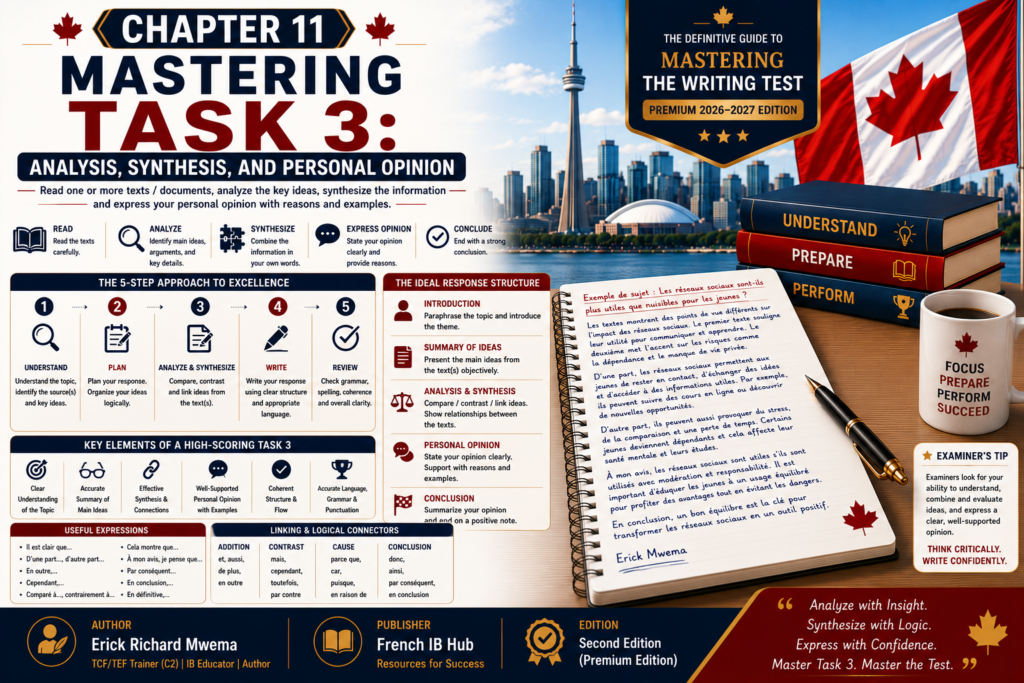
The Ultimate Guide to the Most Challenging Writing Task
“Task 3 does not test whether you have strong opinions. It tests whether you can understand information, organize ideas objectively, and defend your own position logically.”
For many candidates, Task 3 is the most intimidating part of the TCF Canada Expression Écrite examination.
The reason is simple.
Unlike Tasks 1 and 2, Task 3 requires you to combine several advanced skills simultaneously.
You must:
- understand written information;
- identify important ideas;
- compare different viewpoints;
- organize your thoughts logically;
- remain objective when required;
- express and justify your own opinion;
- write clearly within a limited time.
Many candidates immediately begin writing their personal opinion.
Unfortunately, this is one of the biggest mistakes.
Before giving your opinion, you must first demonstrate that you understood the documents.
Think of Task 3 as having two equally important parts:
- Understanding what others say.
- Explaining what you think.
This chapter will teach you a step-by-step system that works regardless of the topic.
Learning objectives
By the end of this chapter, you will be able to:
- Analyze source documents effectively.
- Identify the main ideas quickly.
- Compare different viewpoints objectively.
- Write a concise synthesis.
- Transition smoothly into your own opinion.
- Develop convincing arguments.
- Conclude effectively.
- Avoid the most common Task 3 mistakes.
Understanding the Purpose of Task 3
Task 3 evaluates much more than language.
It measures your ability to think critically.
The examiner wants to know whether you can:
- understand information;
- distinguish facts from opinions;
- organize ideas logically;
- explain different viewpoints fairly;
- justify your own position clearly.
This mirrors real-life situations where people must read, evaluate, and respond to information.
The modern structure of Task 3
Current Task 3 prompts may present two source documents discussing the same topic from different perspectives.
Your response is generally expected to include:
Read the documents

↓

Identify key ideas

↓

Compare viewpoints

↓

Write an objective synthesis

↓

Express your opinion

↓

Support your opinion

↓

Conclude
This sequence should become automatic.
Step 1 – Read the Documents carefully
Do not begin writing immediately.
Instead, read each document actively.
Ask yourself:
- What is the topic?
- What is the author’s main message?
- Which arguments are presented?
- What examples are used?
- Does the author support or criticize the idea?
Avoid focusing on individual vocabulary words.
Instead, understand the overall message.
Step 2 – Identify the main Ideas
Every document contains:
- one central idea;
- several supporting ideas;
- examples.
Example:
Document A
Remote work improves work-life balance.
Supporting ideas:
- saves commuting time;
- increases flexibility;
- reduces transportation costs.
Document B
Remote work creates isolation.
Supporting ideas:
- less teamwork;
- weaker communication;
- reduced social interaction.
Notice that each document presents a different perspective.
Step 3 – Compare the Documents
Many candidates summarize each document separately.
Excellent candidates compare them.
Example:
Les deux documents abordent le télétravail, mais ils adoptent des points de vue différents. Le premier met l’accent sur les avantages liés à la flexibilité, tandis que le second insiste sur les difficultés sociales qu’il peut entraîner.
This demonstrates synthesis rather than simple summary.
The difference between summary and synthesis
Summary
Document A says…
Document B says…
This is acceptable but limited.
Synthesis
Both documents discuss the same issue.
However,
they emphasize different aspects.
This demonstrates deeper understanding.
Step 4 – Write an objective synthesis
This section should remain neutral.
Avoid expressions such as:
❌
Je pense…
À mon avis…
Personnellement…
Instead, use:
Le premier document présente…
Selon le second document…
Les deux auteurs soulignent…
Les textes mettent en évidence…
At this stage,
your opinion does not appear.
Objective language
Useful expressions include:
- Le premier document explique…
- Le second souligne…
- Les deux auteurs s’accordent sur…
- En revanche…
- Contrairement au premier texte…
- Les documents présentent…
These expressions help maintain neutrality.
Step 5 – Transition to your opinion
Once your synthesis is complete,
you may introduce your own perspective.
Useful transitions:
- Pour ma part…
- En ce qui me concerne…
- Quant à moi…
- À mon avis…
- Personnellement…
This transition should be obvious.
The examiner must immediately recognize the shift.
Step 6 – Develop your opinion
Many candidates write:
Je suis d’accord.
and stop.
This is not enough.
Every opinion should include:
Opinion

↓

Reason

↓

Example

↓

Explanation

↓

Mini Conclusion
Example:
Pour ma part, je pense que le télétravail représente une excellente solution lorsqu’il est bien organisé. Il permet de gagner du temps et de mieux concilier vie professionnelle et vie personnelle. Par exemple, de nombreux employés évitent plusieurs heures de transport chaque semaine. Cela améliore leur qualité de vie et leur productivité.
Notice the logical progression.
The three-argument method
A reliable structure is:
Argument 1
↓
Example
↓
Argument 2
↓
Example
↓
Argument 3
↓
Example
Each argument strengthens your position.
Building strong arguments
Weak:
C’est bien.
Better:
Cette solution favorise une meilleure organisation du temps.
Even better:
Cette solution favorise une meilleure organisation du temps, réduit le stress quotidien et améliore l’équilibre entre la vie professionnelle et la vie familiale.
Specific ideas are more persuasive.
Supporting your arguments
Good examples may come from:
- personal experience;
- general observations;
- education;
- technology;
- society;
- work;
- environment.
Examples should be realistic.
They do not need to be scientific.
Step 7 – Write a strong conclusion
Do not introduce new ideas.
Instead:
- summarize your position;
- reinforce your main argument;
- finish naturally.
Example:
En conclusion, je pense que le télétravail offre de nombreux avantages lorsqu’il est utilisé de manière équilibrée.
Simple.
Clear.
Complete.
Complete structure
Introduction

↓

Objective Synthesis

↓

Comparison

↓

Transition

↓

Opinion

↓

Arguments

↓

Examples

↓

Conclusion
This framework works for nearly every Task 3 prompt.
Example prompt
Documents
Document 1
Many companies encourage employees to work remotely because productivity increases.
Document 2
Some experts believe remote work weakens teamwork and professional relationships.
Candidate’s plan
Topic

↓

Advantages

↓

Disadvantages

↓

Comparison

↓

Opinion

↓

Examples

↓

Conclusion
Model response
Les deux documents traitent du télétravail. Le premier met en avant les bénéfices liés à la flexibilité et à l’amélioration de la productivité, tandis que le second souligne les risques d’isolement et la diminution des échanges entre collègues.
Pour ma part, je pense que le télétravail constitue une excellente solution lorsqu’il est bien encadré. Il permet de mieux gérer son temps tout en réduisant les déplacements. Cependant, il est important de maintenir des rencontres régulières afin de préserver la collaboration entre les équipes.
En conclusion, le télétravail présente davantage d’avantages que d’inconvénients à condition qu’il soit organisé efficacement.
Why this Response Works
- Objective synthesis.
- Clear comparison.
- Smooth transition.
- Personal opinion justified.
- Balanced conclusion.
Common mistakes
Mistake 1
Giving your opinion immediately.
Mistake 2
Ignoring one document.
Mistake 3
Copying sentences directly from the documents.
Mistake 4
No comparison.
Mistake 5
Only one argument.
Mistake 6
No examples.
Mistake 7
Weak conclusion.
Useful expressions
Introducing documents
- Le premier document…
- Le second texte…
- Les deux auteurs…
- Les documents abordent…
Comparing
- Tandis que…
- En revanche…
- Contrairement à…
- De la même manière…
- Tous deux…
Giving opinions
- À mon avis…
- Pour ma part…
- Il me semble que…
- Je considère que…
- Je suis convaincu que…
Giving examples
- Par exemple…
- En effet…
- C’est le cas de…
- Prenons l’exemple de…
- Notamment…
Concluding
- En conclusion…
- Pour conclure…
- En résumé…
- Finalement…
- Tout bien considéré…
Examiner’s checklist
Before finishing Task 3, ask yourself:
| Question | ✓ |
|---|---|
| Did I understand both documents? | ☐ |
| Did I summarize objectively? | ☐ |
| Did I compare viewpoints? | ☐ |
| Did I separate my opinion clearly? | ☐ |
| Did I justify my opinion? | ☐ |
| Did I provide examples? | ☐ |
| Did I conclude naturally? | ☐ |
Practice topics
Practice using the framework above with these themes:
Technology
Should artificial intelligence be used in education?
Environment
Should cars be banned from city centers?
Education
Should homework be reduced?
Health
Is working from home better than working in an office?
Society
Should social media be regulated more strictly?
Travel
Is tourism always beneficial for local communities?
Culture
Should traditional festivals receive more government support?
Economy
Should businesses adopt a four-day workweek?
The Golden Formula
If you remember only one thing from this chapter, remember this:
Understand

↓

Summarize

↓

Compare

↓

Transition

↓

Opinion

↓

Arguments

↓

Examples

↓

Conclude
Follow this sequence every time, and you will approach Task 3 with clarity and confidence.
Chapter summary
In this chapter, you learned that:
- Task 3 requires both critical thinking and effective written communication.
- A strong response begins with an objective synthesis before presenting a personal opinion.
- Comparing viewpoints demonstrates deeper understanding than summarizing them separately.
- Every opinion should be supported by clear arguments and relevant examples.
- A structured approach makes even the most complex prompts manageable.
Key takeaways
- Read and understand both documents before writing.
- Keep your synthesis objective.
- Compare ideas instead of listing them.
- Separate your opinion from the summary.
- Support every opinion with reasons and examples.
- Finish with a concise, relevant conclusion.
Coming Up Next: Chapter 12 – Task 3 Masterclass: 50 Real Exam Topics, Advanced Argumentation, and Examiner Corrections
In the next chapter, we’ll take Task 3 to an expert level. You’ll work through 50 realistic Task 3 scenarios, analyze sample documents, study examiner annotations, compare weak and strong responses, learn advanced argumentation techniques, build topic-specific vocabulary, and master the strategies that consistently distinguish B2 and C1 candidates from the rest. This chapter will become the centerpiece of your Task 3 preparation.