
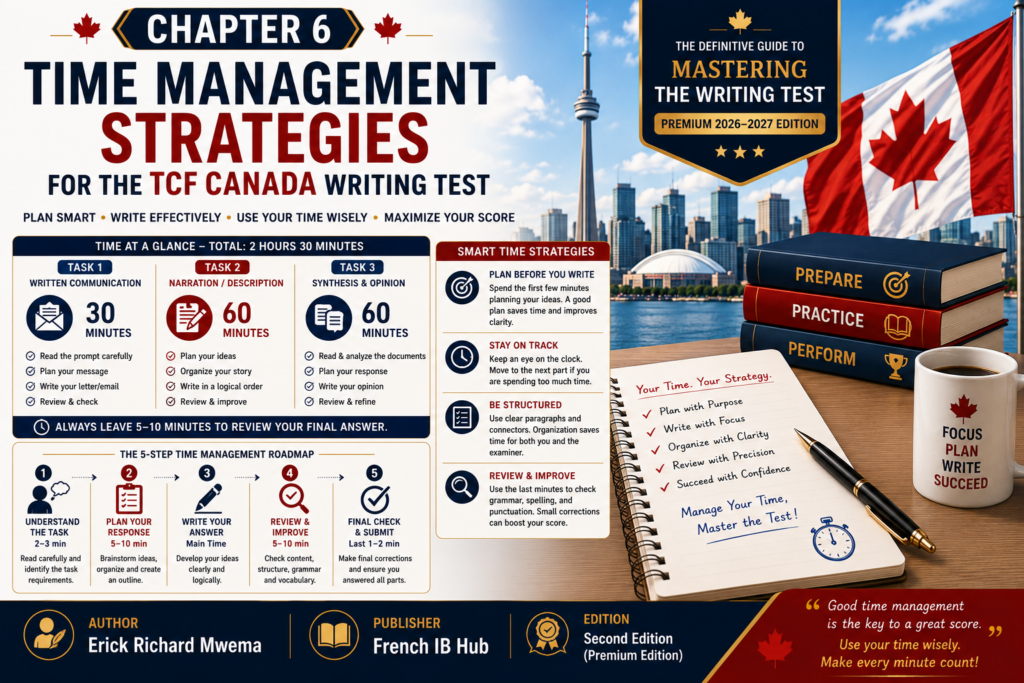
Mastering the Clock without sacrificing Quality
“In the TCF Canada Expression Écrite, your greatest competitor is often not another candidate—it is the clock.”
One of the most common reasons candidates fail to achieve their target score has nothing to do with grammar, vocabulary, or writing ability.
They simply run out of time.
Some spend twenty minutes perfecting the first task.
Others rewrite the same paragraph repeatedly.
Some panic after making a mistake and lose valuable minutes trying to erase or rephrase every sentence.
By the time they reach the final task—the one requiring the highest level of thinking—they are exhausted and rushed.
The good news is that time management is a skill, not a talent.
Just like grammar or vocabulary, it can be learned, practiced, and mastered.
This chapter will teach you how to manage every minute of the writing examination so that you can complete all tasks calmly, confidently, and efficiently.
Learning objectives
By the end of this chapter, you will be able to:
- Understand why time management is essential.
- Divide your available time effectively.
- Develop a writing routine for every task.
- Avoid common time-management mistakes.
- Finish every task with enough time to proofread.
Why Time Management matters
Imagine two candidates.
Candidate A
Excellent French.
Very good grammar.
Strong vocabulary.
Leaves the last task unfinished.
Candidate B
Good French.
Minor grammar mistakes.
Finishes every task.
Reviews every answer.
Who is likely to obtain the better score?
In many cases,
Candidate B.
An unfinished composition cannot demonstrate your true ability.
The examiner can only assess what you actually write.
The Three enemies of good Time Management
Most candidates lose time for one of three reasons.
Enemy 1 – Perfectionism
Many learners believe every sentence must be perfect before moving on.
For example:
Instead of writing continuously, they repeatedly stop to rewrite the same sentence.
Example:
❌
Je pense…
Erase.
À mon avis…
Erase.
Personnellement…
Erase.
Five minutes disappear.
Meanwhile, the composition has barely begun.
Remember:
Finished and good is always better than unfinished and perfect.
Enemy 2 – Poor Planning
Some candidates begin writing immediately without organizing their ideas.
Halfway through, they realize they forgot an important point.
They cross out paragraphs.
Rewrite introductions.
Move ideas around.
All of this wastes valuable time.
Two minutes of planning often saves ten minutes of rewriting.
Enemy 3 – Panic
A small mistake causes some candidates to lose confidence.
Instead of continuing, they begin doubting every sentence.
The clock continues running.
The best strategy?
Keep writing.
Small errors rarely destroy a composition.
Incomplete answers do.
A smart time strategy
Think of every writing task as having four stages.
Read

↓

Plan

↓

Write

↓

Review
This cycle should become automatic.
Stage 1 – Read carefully
Never begin writing immediately.
Read the instructions twice.
Ask yourself:
- Who is my reader?
- What is my objective?
- Which information must I include?
- What register should I use?
Many lost marks result from misunderstanding the instructions—not from weak French.
Stage 2 – Plan
Spend a short amount of time organizing your ideas.
For example:
Task 2
Introduction

↓

Beginning

↓

Main Event

↓

Feelings

↓

Conclusion
A simple outline prevents confusion later.
Stage 3 – Write
Now write confidently.
Do not stop after every sentence.
Allow your ideas to flow.
Remember:
You can improve your writing during proofreading.
You cannot proofread a blank page.
Stage 4 – Review
Always leave time to check:
- spelling
- verb agreement
- missing words
- punctuation
- greetings
- conclusions
- task completion
Many easy marks are gained during the final review.
The Golden Rule
Never spend all your time writing.
Always reserve time for checking.
Many candidates discover simple mistakes only after rereading their work.
Recommended time distribution
Rather than dividing your time equally, distribute it according to the complexity of the tasks.
| Activity | Suggested Focus |
|---|---|
| Read instructions | Carefully before each task |
| Plan | Briefly before writing |
| Write | Most of your available time |
| Review | Final check before moving on |
The exact number of minutes may change if the official exam timing changes, but the principle remains the same:
- Every task deserves planning.
- Every task deserves proofreading.
- The most demanding task should never be rushed because too much time was spent perfecting an easier one.
The Five-Minute rule
Whenever you feel stuck,
follow this strategy.
Stop

↓

Breathe

↓

Read Again

↓

Choose One Idea

↓

Continue Writing
Never sit staring at the page.
Momentum is more important than perfection.
How fast should you Write?
Speed comes from preparation.
Not from rushing.
Candidates who practice regularly:
- organize ideas faster;
- remember vocabulary more easily;
- make fewer corrections;
- write more confidently.
The goal is not writing quickly.
The goal is writing smoothly.
Practicing under Real Conditions
One of the biggest mistakes learners make is practicing without a timer.
Real improvement happens when practice resembles the examination.
During your preparation:
- remove distractions;
- use a timer;
- complete every task without interruption;
- review your writing afterward.
This develops both language skills and exam endurance.
The 80–20 Principle
Not every sentence deserves the same amount of attention.
Spend most of your effort on:
- answering the task;
- organizing ideas;
- communicating clearly.
Do not spend several minutes searching for one “perfect” adjective.
If a simpler word communicates the idea effectively, use it.
What if you make a Mistake?
Do not panic.
Mistakes happen—even to advanced speakers.
If you notice an error:
- correct it quickly.
- continue writing.
Avoid rewriting entire paragraphs unless absolutely necessary.
Remember:
Communication is more important than cosmetic perfection.
Managing stress during the Exam
Stress affects writing speed.
To remain calm:
- sit comfortably;
- breathe slowly before beginning;
- focus only on the current task;
- ignore how quickly other candidates are writing.
Everyone works at a different pace.
Your only objective is to communicate effectively.
Signs you are Managing time Well
You are probably on track if:
- you planned before writing;
- you completed every section;
- you did not rewrite entire paragraphs;
- you reviewed your work before finishing;
- you remained calm throughout the examination.
Common time Management mistakes
- Reading the instructions only once.
- Writing immediately without planning.
- Spending too long on introductions.
- Trying to produce perfect grammar from the first draft.
- Forgetting to review.
- Leaving the final task unfinished.
Most of these problems disappear with regular timed practice.
Building your personal Writing routine
Develop a routine that you repeat every time you practice.
Example:
Read Carefully

↓

Underline Key Information

↓

Plan

↓

Write

↓

Review

↓

Move to Next Task
After several weeks, this routine becomes automatic.
Confidence grows because you always know what to do next.
Practice activity
Choose any writing prompt.
Set a timer.
Without worrying about perfection:
- Read the instructions.
- Create a short outline.
- Write your response.
- Spend the final few minutes reviewing it.
Afterward, ask yourself:
- Did I finish?
- Did I panic?
- Where did I lose time?
- What will I improve next time?
Repeat this exercise regularly.
Expert tip
Many high-scoring candidates follow a simple philosophy:
“Think before you write, write without hesitation, then improve during proofreading.”
This habit saves time while producing more organized compositions.
Chapter summary
In this chapter, you learned that:
- Good time management is essential for success in the TCF Canada writing test.
- Planning, writing, and reviewing should all be part of your routine.
- Perfectionism, poor planning, and panic are the biggest causes of lost time.
- Practicing under timed conditions builds confidence and efficiency.
- Completing every task is far more valuable than producing one perfect response and leaving another unfinished.
Key takeaways
- Read every instruction carefully.
- Plan before writing.
- Keep writing instead of chasing perfection.
- Always reserve time for proofreading.
- Practice with a timer before exam day.
Productivity toolbox – Your personal Time-Management checklist
Before every practice session or exam, ask yourself:
| Question | ✓ |
|---|---|
| Did I read the prompt carefully? | ☐ |
| Did I identify the audience and purpose? | ☐ |
| Did I make a quick plan? | ☐ |
| Did I keep moving while writing? | ☐ |
| Did I leave time to review? | ☐ |
| Did I complete every part of the task? | ☐ |
Print this checklist and use it during your preparation until the process becomes second nature.
Coming Up Next: Chapter 7 – Mastering Task 1: Functional Communication
Now that you understand the examination, the marking process, and how to manage your time, we will begin the practical part of this guide. In the next chapter, you will learn how to master Task 1 step by step, including formal and informal emails, requests, complaints, reservations, invitations, common templates, high-scoring vocabulary, frequent mistakes, and complete model answers with examiner commentary. This is where you will begin transforming theory into real exam performance.