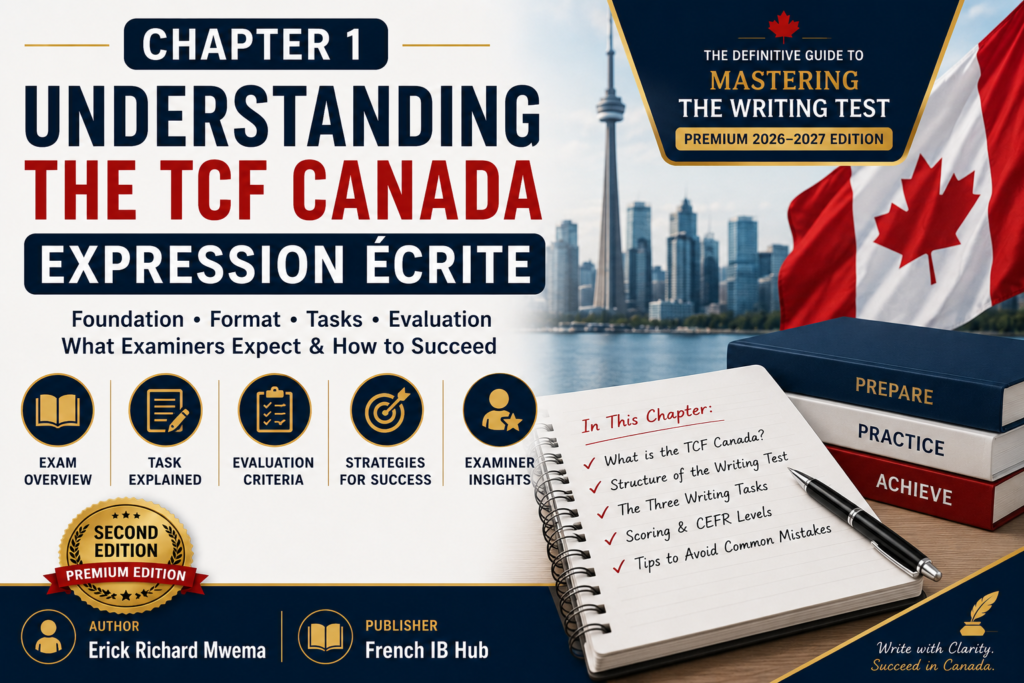
Building the Foundation for Success
“Every successful TCF Canada candidate begins with the same first step: understanding the examination before attempting to master it.”
Preparing for the TCF Canada Expression Écrite is about much more than learning French grammar or memorizing vocabulary. It is about demonstrating your ability to communicate effectively in written French, using language that is clear, appropriate, organized, and adapted to real-life situations.
Many candidates spend months studying verb conjugations, learning long vocabulary lists, and completing grammar exercises. While these are important, they often overlook one essential question:
What exactly is the examiner trying to evaluate?
Without understanding the purpose of the examination, preparation becomes inefficient. Students may focus on the wrong skills, memorize unsuitable templates, or practice writing that does not match the expectations of the test.
This chapter provides the foundation for the rest of this guide. Before learning how to write, you must first understand why the writing test exists and what it is designed to measure.
Learning objectives
By the end of this chapter, you will be able to:
- Explain what the TCF Canada is.
- Understand the purpose of the Expression Écrite component.
- Recognize how the writing test is linked to the CEFR.
- Identify the communication skills assessed by examiners.
- Understand why writing ability matters beyond the examination.
- Avoid common misconceptions that hinder progress.
- Adopt the mindset of a successful candidate.
What is the TCF Canada?
The Test de Connaissance du Français (TCF Canada) is an official French language proficiency examination designed to assess the language skills of non-native French speakers.
Unlike a school examination that measures what you have studied in a specific course, the TCF Canada measures your current level of proficiency in French.
In other words, it answers the question:
“What can this candidate actually do in French today?”
The examination evaluates your ability to use French in practical situations rather than your ability to recall isolated grammar rules.
Why do People take the TCF Canada?
Candidates take the examination for many different reasons.
Some are preparing to immigrate to Canada.
Others require official proof of French proficiency for employment, higher education, or professional certification.
For many candidates, achieving a higher French level can significantly strengthen their immigration profile and open new opportunities.
Regardless of your personal objective, the examination measures the same underlying ability:
Can you communicate effectively in French?
Understanding the Expression Écrite Test
Among all the components of the TCF Canada, the writing test often causes the greatest concern.
Many learners feel confident when speaking but become uncertain when writing.
Why?
Because writing demands several skills simultaneously.
You must:
- understand the instructions;
- organize your ideas logically;
- choose appropriate vocabulary;
- apply grammar accurately;
- respect the required register;
- remain within the word limit;
- communicate clearly under time pressure.
Unlike conversation, writing gives you no opportunity to clarify misunderstandings.
Every sentence must communicate exactly what you intend.
Writing is Communication
A common misunderstanding is that the writing test is primarily a grammar examination.
It is not.
Grammar supports communication.
It does not replace communication.
Imagine receiving two emails.
Email A
Bonjour.
Je voudrais des informations concernant votre formation de français. Pourriez-vous me communiquer les horaires, les tarifs ainsi que les modalités d’inscription ?
Je vous remercie d’avance.
Cordialement,
This message is clear, polite, and achieves its purpose.
Email B
Bonjour.
Formation combien ? Horaires ? Prix ? Réponse vite.
Merci.
Although the second message communicates a basic idea, it lacks politeness, organization, and appropriate language.
Both writers know some French.
Only one demonstrates effective written communication.
That distinction is exactly what the examination evaluates.
Communication before Perfection
Many candidates delay writing practice because they believe they must first master every grammar rule.
This is one of the biggest mistakes in language learning.
Consider these two examples.
Candidate A
Excellent grammar.
Very limited ideas.
Minimal vocabulary.
Poor organization.
Candidate B
Occasional grammar mistakes.
Clear organization.
Logical arguments.
Rich vocabulary.
Effective communication.
In many situations, Candidate B demonstrates stronger overall writing ability because the message is complete, coherent, and easy to understand.
The goal is not perfection.
The goal is successful communication.
The CEFR: The international Standard
The TCF Canada uses the Common European Framework of Reference for Languages (CEFR) to describe language ability.
Rather than assigning marks based solely on correct or incorrect answers, the CEFR describes what a learner can do at different stages of language development.
The six official levels are:
| Level | General Description |
|---|---|
| A1 | Beginner |
| A2 | Elementary |
| B1 | Intermediate |
| B2 | Upper Intermediate |
| C1 | Advanced |
| C2 | Mastery / Near-native proficiency |
Each level represents increasing independence in communication.
What does a Writer at each level look like?
A1
Can write isolated words and very short, simple sentences about familiar topics.
Example:
Je m’appelle Paul. J’habite à Montréal.
A2
Can write simple messages and short descriptions using familiar vocabulary.
Example:
J’aime voyager avec ma famille pendant les vacances d’été.
B1
Can describe experiences, explain opinions, and write connected paragraphs.
Example:
Voyager permet de découvrir de nouvelles cultures et d’améliorer ses compétences linguistiques.
B2
Can produce clear, detailed, and well-organized texts while supporting ideas with examples.
Example:
Les voyages favorisent non seulement l’ouverture d’esprit, mais ils permettent également de mieux comprendre les réalités culturelles d’autres sociétés.
C1
Can write fluently, precisely, and effectively with sophisticated organization and vocabulary.
C2
Can express subtle ideas naturally with complete control of written language.
Which Level should You Aim For?
Your target level depends on your personal objectives.
Many candidates preparing for Canadian immigration aim to achieve at least B2, as it demonstrates the ability to communicate independently in most academic, professional, and everyday situations.
However, remember:
The examination does not ask you to write like a university professor.
It asks you to demonstrate the highest level of communication you can consistently achieve.
The Four Pillars of Successful Writing
Every successful piece of writing rests on four essential pillars.
            Successful Writing
                   │
 ┌─────────────────┼─────────────────┐
 │                 │                 │
Organization   Language         Communication
 │                 │                 │
 └──────────────Grammar──────────────┘
Let us explore each pillar.
1. Organization
Good writing follows a logical sequence.
Readers should never have to guess how one idea connects to another.
Effective organization includes:
- introductions;
- logical development;
- transitions;
- conclusions.
2. Vocabulary
Vocabulary should be:
- accurate;
- varied;
- appropriate to the topic;
- appropriate to the register.
Using one correct word is always better than using three complicated words incorrectly.
3. Grammar
Grammar provides the structure that allows communication to function.
Strong grammar includes:
- correct verb tenses;
- agreement;
- sentence structure;
- punctuation.
Grammar supports your message—it should never overshadow it.
4. Communication
Communication is the ultimate objective.
Every sentence should answer one question:
Will my reader immediately understand what I mean?
If the answer is yes, your writing is moving in the right direction.
Common misconceptions
Many learners begin their preparation with inaccurate assumptions.
Let’s correct some of the most common ones.
Myth 1
“I must use difficult vocabulary.”
Reality: Appropriate vocabulary is more valuable than complicated vocabulary.
Myth 2
“I need perfect grammar.”
Reality: Minor mistakes are acceptable if communication remains clear.
Myth 3
“I should memorize complete model answers.”
Reality: Memorize structures and useful expressions—not entire texts.
Myth 4
“Longer texts always receive higher scores.”
Reality: Quality, organization, and relevance matter more than length.
Myth 5
“The examiner is looking for mistakes.”
Reality: The examiner is looking for evidence of your ability to communicate effectively.
The Mindset of High-Scoring Candidates
High-performing candidates approach preparation differently.
Instead of asking:
“How can I avoid mistakes?”
They ask:
“How can I communicate my ideas more clearly?”
This shift in thinking changes everything.
Successful candidates:
- practice regularly;
- rewrite corrected compositions;
- learn from feedback;
- focus on improvement rather than perfection;
- build confidence through consistency.
Reflection activity
Before continuing to the next chapter, take a few moments to reflect on your own preparation.
Write brief answers to the following questions:
- Why are you taking the TCF Canada?
- Which aspect of writing do you currently find most difficult?
- What is your target CEFR level?
- How many hours each week can you realistically dedicate to writing practice?
- What strengths do you already have in French?
Keep these answers. At the end of this guide, revisit them and evaluate how far you have progressed.
Chapter summary
In this chapter, you learned that:
- The TCF Canada measures your current ability to communicate in French.
- The Expression Écrite test evaluates communication rather than grammar alone.
- The CEFR provides an international framework for describing writing ability.
- Successful writing depends on organization, vocabulary, grammar, and communication working together.
- Clear communication is more valuable than unnecessary complexity.
- Consistent practice and thoughtful reflection lead to long-term improvement.
This foundation will guide every strategy and activity in the chapters ahead.
Key takeaways
- Understand the purpose of the examination before practicing.
- Write to communicate, not simply to impress.
- Build skills progressively rather than chasing perfection.
- Focus on clarity, organization, and relevance.
- Every writing task is an opportunity to demonstrate your ability—not your ability to avoid every minor mistake.
Coming Up Next: Chapter 2 – Understanding the TCF Canada Writing Test in Detail
In the next chapter, we will examine the writing component itself: its structure, objectives, timing, task types, assessment principles, and the specific skills each task is designed to evaluate. This deeper understanding will help you approach every writing activity with confidence and purpose.
Next: https://frenchibhub.com/chapter-2-understanding-the-tcf-canada-writing-test-in-detail/