
Stop Memorizing hundreds of Answers
Hello everyone!
So far, we’ve learned:
- Step 1: Understand the 10 themes.
- Step 2: Learn communication skills.
- Step 3: Build a Theme Folder.
- Step 4: Study one theme across all four skills.
- Step 5: Use mind maps.
- Step 6: Master connectors.
Now we arrive at one of the biggest secrets of TEF success.
Stop memorizing answers. Start memorizing frameworks.
Many students ask me:
“Sir, can you give me a script for Housing?”
“Can you give me a script for Travel?”
“Can you give me a script for Technology?”
If I gave you 100 scripts, would you remember them all?
Probably not.
Even worse, what happens if the examiner gives you a topic you’ve never seen before?
You’ll panic.
Instead of memorizing answers, learn one framework that works for every topic.
Why Frameworks work
Think about cooking.
A chef doesn’t memorize 500 recipes.
A chef understands a cooking method.
Once they know the method, they can cook many different dishes.
French works exactly the same way.
Once you know the structure, you simply replace the vocabulary.
The framework stays the same.
The topic changes.
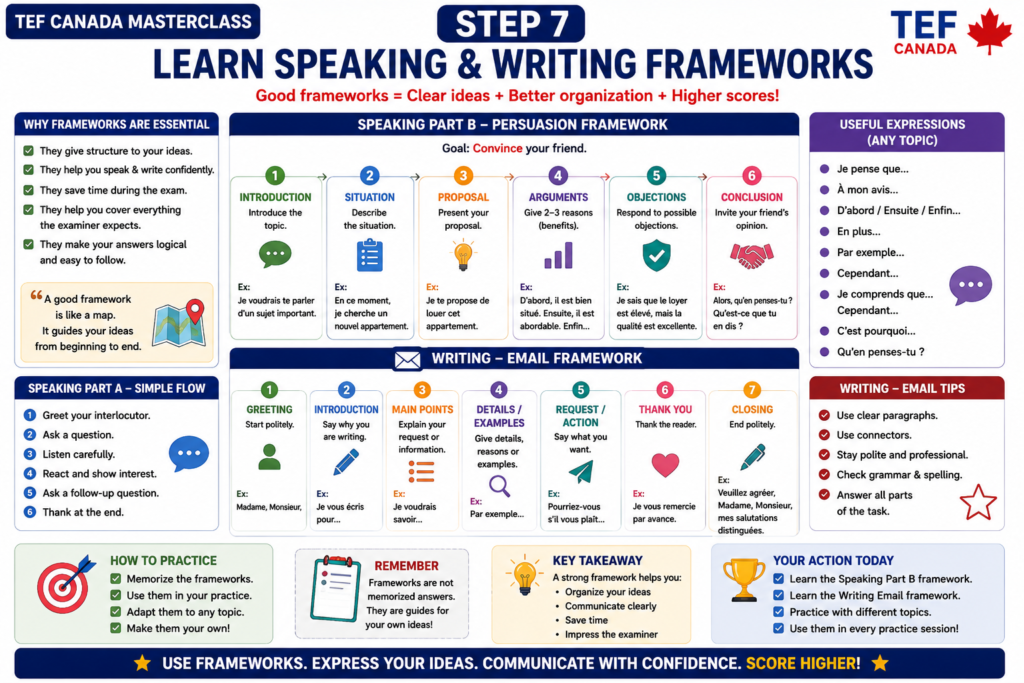
Speaking Section B: One framework for every Advertisement
Remember your task:
You are trying to convince your friend.
No matter what the advertisement is about—a gym, a holiday, a phone, a language course, or an apartment—the conversation follows the same logical order.
Step 1 – Introduce the idea
Start naturally.
Examples:
Salut !
J’ai trouvé quelque chose qui pourrait vraiment t’intéresser.
J’ai vu une annonce intéressante.
Your objective is simply to introduce the topic.
Step 2 – Give your opinion
Tell your friend what you think.
Examples:
Je pense que c’est une excellente idée.
À mon avis, cette offre est très intéressante.
Personnellement, je trouve que c’est une bonne occasion.
The examiner wants to hear your opinion, not just facts.
Step 3 – Give your arguments
Now explain why.
Use at least three reasons.
Examples:
Premièrement…
Deuxièmement…
Enfin…
For example:
Premièrement, ce n’est pas cher.
Deuxièmement, c’est près de chez nous.
Enfin, les avis des clients sont excellents.
Three strong arguments are always more convincing than one.
Step 4 – Anticipate objections
Your friend may disagree.
That’s normal.
The examiner is testing your ability to react.
Imagine your friend says:
“Je n’ai pas le temps.”
Instead of giving up, answer politely.
Examples:
Je comprends, mais…
C’est vrai, cependant…
Tu as raison, mais…
Then explain why your suggestion is still worthwhile.
Step 5 – Finish with encouragement
Invite your friend to make a decision.
Examples:
Alors, qu’en penses-tu ?
Tu devrais essayer.
Fais-moi confiance.
Tu ne le regretteras pas.
Every Speaking Section B conversation should finish positively.
The Speaking Formula
No matter the topic, remember this sequence:
Introduce → Give your opinion → Give three reasons → Respond to objections → Encourage → Conclude
Whether you’re talking about:
- a concert,
- a sports club,
- an online course,
- a holiday package,
- or a new restaurant…
The framework never changes.
Writing: One framework for every Email
Now let’s look at Writing.
Many students become overwhelmed because they don’t know how to begin.
The solution is simple.
Use the same structure every time.
Step 1 – Greeting
Examples:
Bonjour Madame,
Bonjour Monsieur,
Always start politely.
Step 2 – State your purpose
Tell the reader why you’re writing.
Examples:
Je vous écris pour…
Je vous contacte afin de…
Je souhaiterais obtenir des informations concernant…
This sentence immediately introduces your topic.
Step 3 – Explain the situation
Provide the important details.
Examples:
Le problème est que…
En effet…
Par exemple…
Keep your explanation clear and organized.
Step 4 – Make your request
Tell the reader what you want.
Examples:
Je souhaiterais…
Pourriez-vous…
Serait-il possible de…
Always make your objective clear.
Step 5 – Close politely
Finish professionally.
Examples:
Je vous remercie de votre compréhension.
Dans l’attente de votre réponse,
Cordialement,
This ending works for almost every formal email.
Compare these two Students
Student A
Starts writing immediately.
Writes random ideas.
Repeats vocabulary.
Forgets the conclusion.
The email feels disorganized.
Student B
Follows the framework.
Greeting.
↓
Purpose.
↓
Explanation.
↓
Request.
↓
Closing.
Even with simple French, the email is logical and easy to read.
Which student do you think will receive the higher score?
Usually, Student B.
Why?
Because organization is part of communication.
Practise the framework, Not the topic
Let’s say today’s theme is Shopping.
Instead of memorizing one shopping email…
Use the framework.
Tomorrow, change only the vocabulary.
Now it’s about Travel.
The next day, Technology.
The next day, Health.
The structure remains exactly the same.
Within a few weeks, starting a speaking task or writing task will become automatic.
Your weekly Exercise
Choose one theme.
For that theme:
Speaking
Use the framework to convince your friend.
Writing
Use the framework to write one email.
Don’t worry about perfection.
Focus on following the structure.
Repeat this exercise with all 10 themes.
By the end, you’ll notice that you no longer struggle to start speaking or writing.
The framework becomes Automatic
At first, you’ll consciously think about each step.
After enough practice, it becomes natural.
Just like driving a car.
At first, you think about every movement.
Later, you simply drive.
The same thing happens with French.
You stop thinking about the framework.
You simply communicate.
Key takeaway
Successful TEF candidates don’t memorize hundreds of different answers.
They master one strong framework and adapt it to every theme.
Whenever you receive a new task, remember:
- Speaking Section B: Introduce → Opinion → Three arguments → Respond → Encourage → Conclude.
- Writing: Greeting → Purpose → Explanation → Request → Closing.
If you master these two frameworks, you’ll approach every new topic with confidence instead of uncertainty.
That’s one of the biggest differences between candidates who struggle and candidates who succeed on the TEF Canada exam.