The Secret to sounding like a B2–C1 French Speaker
Hello everyone!
Now we’ve reached one of the most important lessons in the entire course.
If I could only teach you one thing that would immediately improve your Speaking and Writing scores, it would be this:
Learn how to use connectors.
Many students believe that advanced French comes from using difficult vocabulary.
That’s not true.
The difference between an A2 student and a B2 student is often how they connect their ideas.
Let’s compare.
Student A
J’aime cette voiture.
Elle est grande.
Elle est économique.
Elle est confortable.
The grammar is correct.
The vocabulary is correct.
But it sounds robotic.
Now listen to Student B.
J’aime cette voiture **parce qu’**elle est grande, économique et, de plus, très confortable.
Can you hear the difference?
The second answer flows naturally.
This is exactly what the examiner wants to hear.
What is a Connector?
A connector is simply a word or expression that links two ideas together.
Think of connectors as bridges.
Without bridges, every sentence stands alone.
With bridges, your ideas become one smooth conversation.
For example:
I like this restaurant.
It is cheap.
It is close to my house.
It has excellent food.
These are four separate ideas.
Now connect them.
J’aime ce restaurant **parce qu’**il n’est pas cher. De plus, il est près de chez moi et la nourriture est excellente.
Much better.
Why are Connectors so important in the TEF & TCF?
Every section of the exam rewards organized communication.
Whether you’re:
- speaking,
- writing,
- explaining,
- convincing,
- comparing,
you need to connect your ideas logically.
The examiner isn’t just listening to what you say.
They’re listening to how you organize your thoughts.
Connectors help you do that.
The six families of Connectors
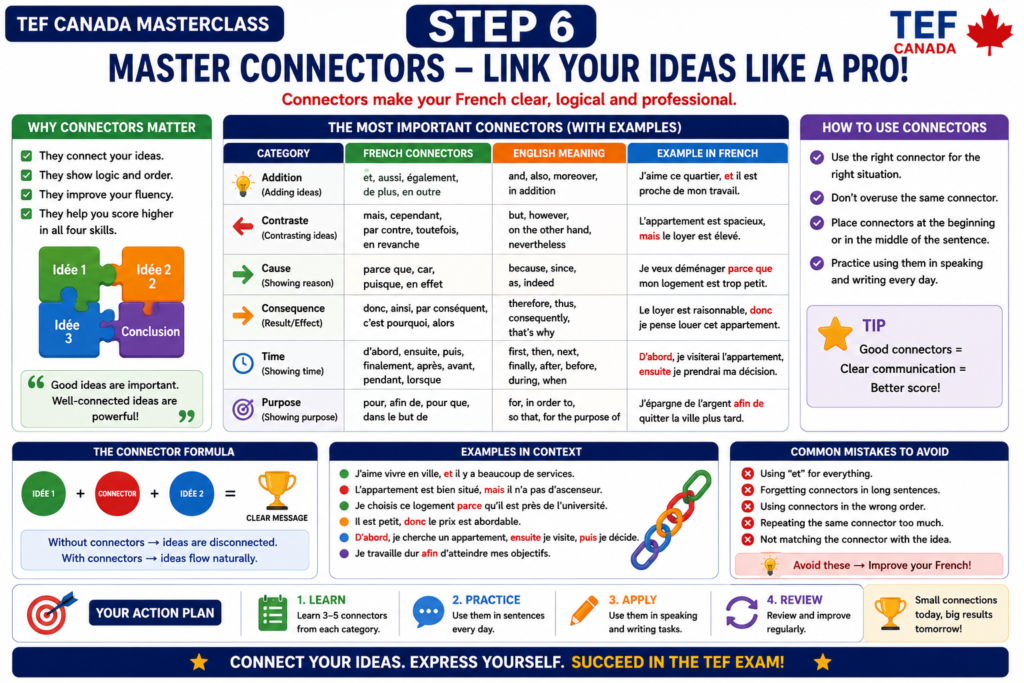
Instead of memorizing a long list, organize connectors into six categories.
1. Adding information
These connectors help you add another idea.
Examples:
- et
- de plus
- en plus
- également
- aussi
- en outre
Example:
Cet appartement est spacieux. De plus, il est très lumineux.
Speaking Section B
Tu devrais acheter ce téléphone. En plus, il est moins cher que les autres.
Writing
Je souhaiterais obtenir des informations. De plus, j’aimerais connaître les horaires.
Use these whenever you want to strengthen your argument.
2. Giving reasons
These explain why.
Examples:
- parce que
- car
- puisque
- en effet
Example:
Je préfère vivre en ville **parce qu’**il y a plus de transports.
Speaking
Tu devrais choisir cette école car elle offre de nombreuses activités.
Writing
Je vous écris parce que j’ai rencontré un problème avec ma commande.
Remember:
An opinion without a reason is weak.
Always explain why.
3. Showing consequences
These explain the result.
Examples:
- donc
- alors
- c’est pourquoi
- par conséquent
Example:
Il pleut, donc nous restons à la maison.
Speaking
Cette offre est limitée, alors il faut réserver rapidement.
Writing
Mon colis n’est jamais arrivé. Par conséquent, je souhaite un remboursement.
These connectors make your reasoning logical.
4. Expressing contrast
Sometimes you agree.
Sometimes you disagree.
Contrast connectors help you show both sides.
Examples:
- mais
- cependant
- pourtant
- toutefois
- en revanche
- par contre
Example:
Cet hôtel est magnifique, mais il est un peu cher.
Speaking
Je comprends ton opinion. Cependant, je pense qu’il existe une meilleure option.
Writing
Le produit est de bonne qualité. En revanche, la livraison a été très lente.
These expressions are especially useful in Speaking Section B when the examiner challenges your opinion.
5. Giving examples
Examples make your arguments stronger.
Useful connectors:
- par exemple
- comme
- notamment
Example:
J’aime les sports, par exemple, le football et la natation.
Speaking
Cette ville propose beaucoup d’activités, comme des festivals et des musées.
Writing
Plusieurs problèmes sont apparus, notamment des retards de livraison.
Whenever possible, support your ideas with examples.
6. Organizing your speech
These connectors help the examiner follow your ideas.
Examples:
- tout d’abord
- premièrement
- ensuite
- puis
- enfin
- pour conclure
Imagine you’re convincing your friend.
Instead of speaking randomly…
Say:
Tout d’abord, cette offre est très intéressante.
Ensuite, elle est moins chère.
Enfin, tu économiseras du temps.
Now your speech sounds organized and professional.
The Magic formula for Speaking Section B
Remember that your goal is to convince your friend.
Connectors help you build a persuasive argument.
For example:
À mon avis, tu devrais choisir cette salle de sport **parce qu’**elle est proche de chez toi. De plus, l’abonnement est moins cher. Cependant, je comprends que tu hésites. En revanche, les équipements sont modernes et les horaires sont très flexibles. Enfin, je suis certain que tu ne le regretteras pas.
Notice how every connector moves the conversation forward.
Without connectors, this argument would sound flat.
The Magic formula for Writing
Imagine you’re writing a complaint email.
Instead of writing:
Mon colis est arrivé en retard.
Il était endommagé.
Je veux un remboursement.
Write:
Je vous écris parce que mon colis est arrivé avec trois jours de retard. De plus, il était endommagé à la réception. Par conséquent, je souhaiterais obtenir un remboursement ou un échange.
The ideas now flow naturally.
Don’t overuse Connectors
Another common mistake is trying to use a connector in every sentence.
For example:
De plus…
Ensuite…
Cependant…
En outre…
Par conséquent…
Too many connectors make your French sound unnatural.
Use them only when they help connect ideas logically.
Quality is much more important than quantity.
Your Connector notebook
I recommend creating one page in your notebook called:
My Connector bank
Organize it into categories.
Addition
- et
- de plus
- également
- en outre
Reason
- parce que
- car
- puisque
- en effet
Consequence
- donc
- alors
- par conséquent
- c’est pourquoi
Contrast
- mais
- cependant
- toutefois
- en revanche
Example
- par exemple
- comme
- notamment
Sequence
- tout d’abord
- ensuite
- puis
- enfin
- pour conclure
Review this page every day.
Soon, these connectors will become automatic.
Daily practice
Choose any theme.
For example:
Technology.
Now challenge yourself.
Describe it using at least:
- one reason connector,
- one addition connector,
- one contrast connector,
- one consequence connector,
- one example,
- and one sequencing connector.
This simple exercise will improve both your Speaking and Writing dramatically.
Final advice
Many students think advanced French means using complicated words.
In reality, advanced French means organizing simple ideas clearly.
You don’t need difficult vocabulary to achieve a good TEF score.
You need to show the examiner that you can:
- explain,
- justify,
- compare,
- persuade,
- and organize your thoughts logically.
Connectors are the tools that make this possible.
Key takeaway
Think of connectors as the glue that holds your French together.
Vocabulary gives you the bricks.
Grammar gives you the structure.
But connectors make everything flow smoothly.
The more naturally you use connectors, the more confident, fluent, and convincing you’ll sound in Speaking Section B, and the clearer and more professional your Writing will become.
Master these connectors, and you’ll take a major step toward achieving a B2 or C1 level in the TEF Canada exam.