The Smartest way to study for the Exam
Hello everyone!
Now that you have created your Theme Folder, it’s time to learn how to use it effectively.
This is where most students make another mistake.
They study one skill at a time.
For example:
- Monday → Vocabulary
- Tuesday → Grammar
- Wednesday → Speaking
- Thursday → Writing
- Friday → Listening
Although this seems organized, it isn’t the most effective way to prepare for the TEF.
Why?
Because the TEF exam doesn’t test skills separately.
The same vocabulary and ideas appear in Listening, Reading, Speaking, and Writing.
So instead of studying one skill at a time…
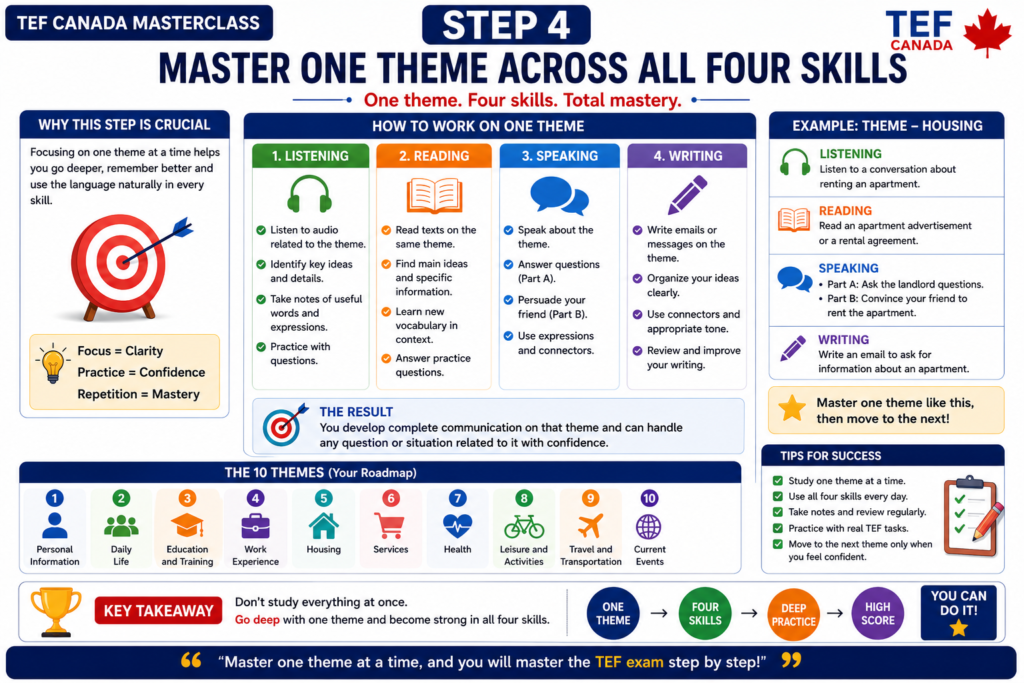
Study one theme through all four skills.
This method helps your brain build stronger connections and improves long-term memory.
The Secret of Efficient learning
Imagine learning the theme Travel.
Many students memorize words like:
- l’aéroport
- le passeport
- le billet
- l’hôtel
- la réservation
Then they move on to another theme.
A week later…
They’ve forgotten half the vocabulary.
Instead…
Use the same vocabulary repeatedly in different activities.
The more times your brain sees the same words in different contexts, the easier they become to remember.
This is called active learning.
Let’s take one theme: Travel
Today, your objective isn’t just to learn travel vocabulary.
Your objective is to use the Travel theme in every section of the exam.
By doing this, you’re preparing for four exam sections at the same time.
Part 1 – Reading (Compréhension Écrite)
When studying a theme, begin with Reading.
Why?
Because reading introduces you to vocabulary naturally.
Instead of memorizing isolated words, you see them used in real sentences.
Look for materials such as:
- Hotel advertisements
- Flight schedules
- Travel blogs
- Tourist brochures
- Online booking pages
- Travel reviews
As you read, don’t translate every word.
Instead, ask yourself:
- What is the text about?
- Who is speaking?
- What information is important?
- What is the writer trying to communicate?
Highlight useful vocabulary and expressions.
For example:
- réserver une chambre
- partir en vacances
- prendre l’avion
- faire une réservation
- séjourner dans un hôtel
These are much more useful than learning individual words.
Part 2 – Listening (Compréhension Orale)
Now move to Listening.
Use the same theme.
Listen to authentic French materials such as:
- Airport announcements
- Hotel reception conversations
- Tourist information
- Travel advertisements
- Train station announcements
- Customer service calls
While listening, don’t try to understand every single word.
Instead, focus on the main message.
Ask yourself:
- Who is speaking?
- Where are they?
- What is happening?
- What information do I need?
This is exactly what you’ll do during the TEF Listening exam.
Part 3 – Speaking (Expression Orale)
Now it’s time to use the same theme actively.
Imagine you’re taking Speaking Section B.
Your friend wants to plan a holiday.
You found an advertisement for a holiday package.
Can you convince your friend?
Use the framework you’ve already learned.
Introduce the idea
J’ai trouvé une excellente offre de voyage.
Give your opinion
Je pense que c’est une très bonne occasion.
Give three arguments
Premièrement, ce n’est pas très cher.
Deuxièmement, l’hôtel est près de la plage.
Enfin, le transport est inclus.
Respond to objections
Friend:
“C’est un peu loin.”
You:
Je comprends, mais le voyage en vaut vraiment la peine.
Conclude
Alors, qu’en penses-tu ?
Notice something?
You’re using the same travel vocabulary you already saw in Reading and Listening.
Nothing is new.
Part 4 – Writing (Expression Écrite)
Finally, use the same theme in Writing.
Possible tasks include:
- Reserving a hotel room.
- Asking for travel information.
- Complaining about a delayed flight.
- Recommending a holiday destination.
- Cancelling a reservation.
Again…
The vocabulary stays the same.
Only the task changes.
For example:
Bonjour,
Je vous écris pour réserver une chambre du 15 au 18 août.
Je souhaiterais connaître vos tarifs.
Dans l’attente de votre réponse,
Cordialement,
Notice how the same expressions appear again.
One theme, Four skills
Let’s summarize what you’ve done with the Travel theme.
Reading
You read:
- advertisements
- travel articles
- booking websites
Listening
You listened to:
- announcements
- conversations
- advertisements
Speaking
You convinced your friend to travel.
Writing
You wrote an email related to travel.
Now ask yourself:
How many times did you use the same vocabulary?
At least four different ways.
That’s exactly why you’ll remember it much better.
Another example: Health
Let’s repeat the same process.
Reading
Read:
- health articles
- pharmacy notices
- doctor’s instructions
Listening
Listen to:
- doctor’s appointments
- pharmacy conversations
- health advice
Speaking
Convince your friend to:
- exercise more
- eat healthier
- visit a doctor
- join a gym
Writing
Write:
- an appointment request
- a complaint
- an email asking for medical information
Again…
One theme.
Four skills.
Why this Method works
Think about learning to drive.
You don’t study the steering wheel one week…
The brakes the next week…
The mirrors the week after…
You use everything together.
French works the same way.
Vocabulary.
Grammar.
Listening.
Speaking.
Writing.
Reading.
They should always work together.
That’s how your brain naturally learns a language.
Your weekly study routine
Here’s a practical plan you can follow for each theme.
Day 1
Build your Theme Folder.
Day 2
Read two texts related to the theme.
Highlight useful expressions.
Day 3
Listen to two recordings.
Write down new vocabulary and useful phrases.
Day 4
Practise Speaking.
Describe.
Explain.
Recommend.
Answer objections.
Day 5
Complete one Writing task.
Use the vocabulary you’ve already learned.
Day 6
Review everything.
Can you:
- describe the theme?
- ask questions?
- express your opinion?
- compare?
- recommend?
- write about it?
If the answer is yes, you’re ready.
The Power of repetition
Here’s one final piece of advice.
Don’t study a word once and expect to remember it.
The goal is to meet the same vocabulary again and again in different situations.
For example, the word réservation can appear:
- in a reading passage,
- in an audio recording,
- in a speaking task,
- in a writing task.
Every time you use it, your confidence grows.
This is called spaced repetition, and it’s one of the most effective ways to retain a language.
Key takeaway
The smartest TEF candidates don’t prepare for Reading, Listening, Speaking, and Writing as four separate exams.
They prepare for one theme and practise it through all four skills.
This approach saves time, strengthens your vocabulary, improves your fluency, and helps you recognize the same language in different contexts.
Remember:
Don’t study skills separately. Study one theme completely.
Once you’ve mastered a theme across all four skills, you’re not just memorizing French, you are learning how to use it confidently in real-life situations and in every section of the TEF Canada exam.