Create One system that Prepares you for All four Skills
Hello everyone!
Now that you understand:
- Step 1: What the 10 themes are.
- Step 2: That communication skills are more important than memorizing vocabulary.
Let’s move to Step 3, which is one of the most powerful study techniques you can use for the TEF Canada exam.
Most students make this mistake:
They have one notebook for vocabulary.
Another notebook for grammar.
Another notebook for writing.
Another notebook for speaking.
A folder for listening.
A folder for reading.
After a few weeks, they have information everywhere.
When it’s time to revise, they don’t know where to start.
Don’t study like that.
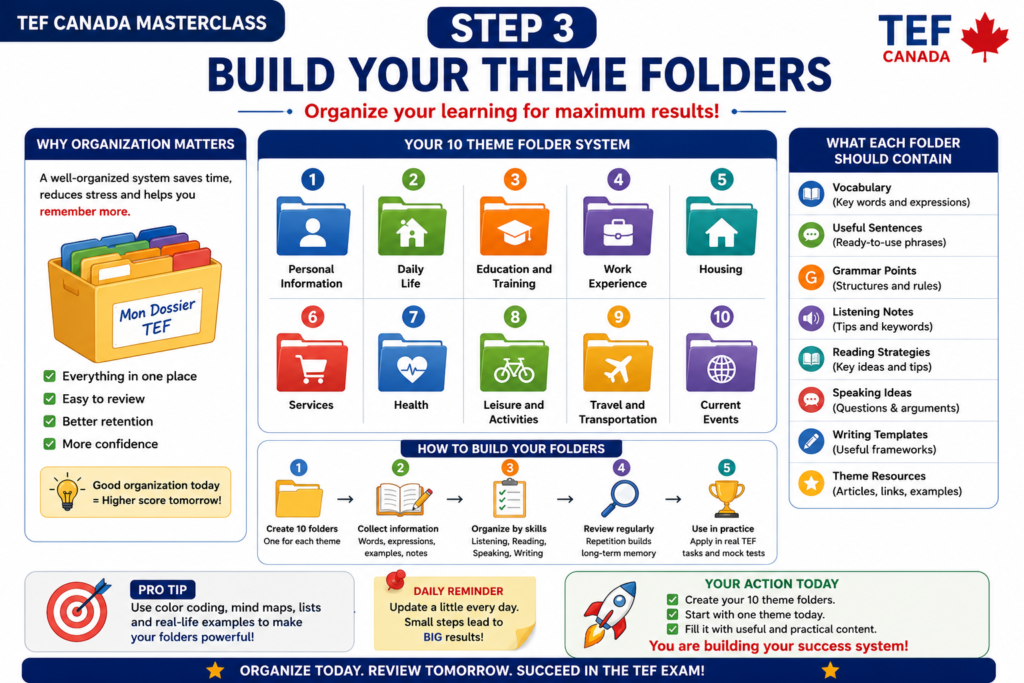
Instead, create one Theme Folder for each of the 10 themes.
This will become your personal TEF reference book.
What is a Theme Folder?
A Theme Folder is a collection of everything you need for one theme.
For example, if today’s theme is Housing, everything related to housing stays together:
- Vocabulary
- Verbs
- Useful expressions
- Questions
- Opinions
- Connectors
- Speaking ideas
- Writing ideas
- Reading practice
- Listening practice
Instead of searching through different notebooks, you’ll have everything in one place.
Imagine opening your “Housing” folder the night before the exam.
Within 20 minutes, you can revise everything related to that theme.
That’s much more effective than reading random vocabulary lists.
How should you Organize your Theme Folder?
For every theme, use the same structure.
I recommend creating 10 sections.
Let’s use the theme Housing as our example.
Section 1 – Essential vocabulary
Start with the most common words.
Don’t try to learn 200 words.
Focus on the words that appear most often.
For example:
Nouns
- un appartement
- une maison
- une chambre
- une cuisine
- un salon
- une salle de bains
- un garage
- un jardin
- un voisin
- un balcon
Verbs
- habiter
- louer
- acheter
- vendre
- déménager
- construire
- chercher
- visiter
Adjectives
- grand
- petit
- moderne
- ancien
- calme
- bruyant
- confortable
- spacieux
Notice that we’re learning vocabulary by category.
This makes it much easier to remember.
Section 2 – Useful expressions
Vocabulary alone isn’t enough.
You need ready-made expressions.
For example:
- Je cherche…
- Je voudrais louer…
- Il y a…
- J’habite dans…
- Je préfère…
- Je suis intéressé par…
- Je pense que…
These expressions become sentence starters.
Instead of building sentences word by word, you simply complete the expression.
For example:
Je cherche un appartement.
Tomorrow:
Je cherche un emploi.
Next week:
Je cherche une école.
One expression.
Many situations.
Section 3 – Questions
Every theme has common questions.
For Housing:
- Quel est le prix ?
- Où est-il situé ?
- Est-ce qu’il est meublé ?
- Y a-t-il un parking ?
- Les animaux sont-ils acceptés ?
- Quelle est la superficie ?
- Les charges sont-elles comprises ?
If you memorize these questions, you’ll be prepared for Speaking Section A, Speaking Section B, Listening, and even Writing.
Questions are one of the most valuable parts of your folder.
Section 4 – Opinions
Learn several ways to express your opinion.
For example:
- Je pense que…
- À mon avis…
- Personnellement…
- Je trouve que…
- Selon moi…
Now combine them with the theme.
Je pense que cet appartement est idéal.
À mon avis, ce quartier est très agréable.
Suddenly your French sounds much more natural.
Section 5 – Advantages
This section is especially useful for Speaking Section B, where you have to convince your friend.
List all the positive points related to the theme.
For example:
- Ce n’est pas cher.
- Il est bien situé.
- Il est lumineux.
- Il est spacieux.
- Le quartier est calme.
- Les transports sont proches.
- Il y a beaucoup de commerces.
These become your arguments.
Section 6 – Problems
The examiner often asks you to discuss disadvantages or solve problems.
Prepare common negative expressions.
For example:
- Le loyer est trop élevé.
- Il est loin du centre-ville.
- Il est trop petit.
- Il n’y a pas de parking.
- Le quartier est bruyant.
- Les transports sont limités.
Notice that these same expressions can also be used in Writing when making a complaint.
Section 7 – Connectors
Without connectors, your French sounds robotic.
Collect useful connectors for every theme.
Examples:
- parce que
- donc
- cependant
- de plus
- par contre
- en revanche
- enfin
- par exemple
Now compare these two answers.
Without connectors:
L’appartement est grand.
Il est moderne.
Il est près du métro.
With connectors:
L’appartement est grand et, de plus, il est moderne. En outre, il est situé près du métro, ce qui est très pratique.
The second answer sounds much more fluent.
Section 8 – Speaking ideas
Ask yourself:
“If this theme appears in Speaking Section B, what could I say?”
Write simple ideas.
For Housing:
Why should your friend rent this apartment?
- Il est moderne.
- Le prix est raisonnable.
- Le quartier est sûr.
- Les transports sont excellents.
- Tu gagneras du temps.
Notice that you’re not writing a script.
You’re collecting ideas.
On exam day, you’ll combine these ideas naturally.
Section 9 – Writing ideas
Now think about Writing.
What could you write?
Examples:
- A request for information about an apartment.
- A complaint about noisy neighbours.
- A message to a landlord.
- An email requesting repairs.
- A letter ending a rental contract.
One theme can generate many writing tasks.
Section 10 – Reading and Listening resources
Finally, expose yourself to authentic French.
Read:
- apartment advertisements
- rental websites
- housing articles
Listen to:
- property advertisements
- customer service calls
- conversations between landlords and tenants
- YouTube videos about renting in Canada
This helps you recognize vocabulary in context rather than in isolation.
Repeat the same Structure for every theme
Now imagine doing the same thing for:
- Family
- Health
- Education
- Shopping
- Travel
- Technology
- Environment
Every folder has the same layout.
The only thing that changes is the topic.
This creates consistency in your study routine.
Why this Method works
Think of your Theme Folder as your personal French toolbox.
Each section contains tools you can use in any exam task.
When you need vocabulary, you know where to find it.
When you need questions, they’re ready.
When you need arguments, they’re waiting.
When you need connectors, they’re already organized.
Instead of searching through different books and notes, everything you need is in one place.
Your weekly Study Plan
Here’s a simple routine you can follow.
Day 1: Build the Theme Folder.
Day 2: Learn the vocabulary and expressions.
Day 3: Practise speaking using the folder.
Day 4: Write one task related to the theme.
Day 5: Read and listen to authentic material.
Day 6: Review everything and test yourself.
By the end of the week, you’ve prepared Listening, Reading, Speaking, and Writing using one single theme.
Key takeaway
The Theme Folder is more than a notebook.
It is your complete preparation system.
Every time you finish a folder, you’re not just learning vocabulary, you are building a complete set of communication tools that can be used across all sections of the TEF Canada exam.
By the time you’ve completed all 10 Theme Folders, you’ll have your own personalized TEF study guide, ready to help you succeed in Listening, Reading, Speaking, and Writing.