Step 1: Understanding the 10 themes
Before you learn French, dnderstand the Exam
Hello everyone!
Welcome to our TEF Canada Masterclass.
Before we start learning vocabulary, grammar, speaking, or writing, I want you to understand how the TEF exam is designed.
This is one of the biggest mistakes students make.
They buy vocabulary books…
They memorize hundreds of words…
They study grammar rules…
But they never stop to ask:
“What is the examiner actually testing?”
Once you understand this, your preparation becomes much easier.
The biggest Misunderstanding
Many students think the TEF Canada exam contains 10 chapters that they have to study.
For example:
- Housing
- Travel
- Health
- Work
- Shopping
They study each chapter separately, memorize vocabulary, and move on to the next one.
This is not how the TEF works.
The examiner is not testing whether you memorized a vocabulary list.
Instead, they are testing whether you can communicate in real-life situations.
Think about your daily life.
Do you spend an entire day talking only about housing?
Of course not.
One moment you’re talking about work.
Then your family.
Then your health.
Then shopping.
Then technology.
Life constantly changes from one topic to another.
The TEF exam is designed exactly the same way.
The themes simply represent the situations you may encounter in everyday life.
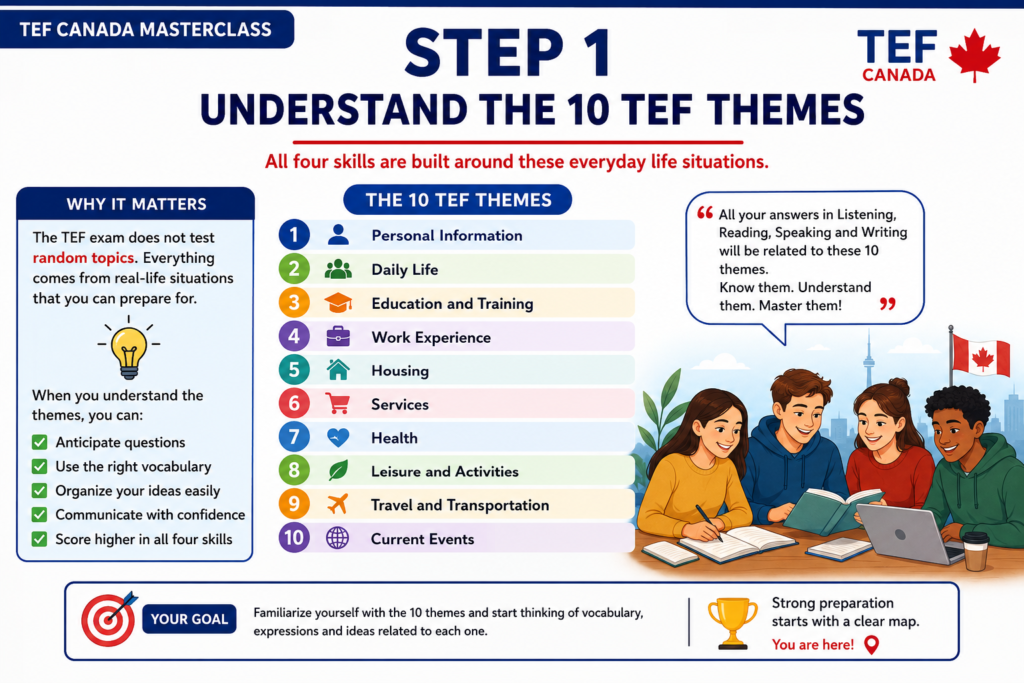
What Exactly are the 10 themes?
Think of the 10 themes as 10 different worlds.
Each world has:
- its own vocabulary,
- its own common expressions,
- its own situations,
- and its own questions.
For example…
Theme 1 – Family and Relationships
You may need to talk about:
- your parents
- your children
- marriage
- friendships
- celebrations
- daily family life
Theme 2 – Housing
You may discuss:
- apartments
- houses
- renting
- buying
- neighbours
- furniture
- moving
Theme 3 – Work
Topics include:
- jobs
- interviews
- salaries
- colleagues
- working hours
- promotions
- responsibilities
Theme 4 – Education
This includes:
- schools
- universities
- courses
- teachers
- exams
- online learning
- qualifications
Theme 5 – Health
You may speak about:
- doctors
- hospitals
- exercise
- healthy eating
- illnesses
- medicine
- appointments
Theme 6 – Shopping and Services
Including:
- supermarkets
- online shopping
- discounts
- customer service
- returns
- restaurants
- banks
- post offices
Theme 7 – Travel and Transportation
Such as:
- airports
- hotels
- trains
- buses
- vacations
- reservations
- directions
Theme 8 – Leisure and Culture
Including:
- sports
- music
- cinema
- books
- hobbies
- festivals
- museums
Theme 9 – Technology and Communication
For example:
- smartphones
- computers
- social media
- artificial intelligence
- emails
- online meetings
Theme 10 – Environment and Society
Topics include:
- recycling
- pollution
- climate change
- volunteering
- public transport
- renewable energy
Why Only these 10 themes?
Many students ask me:
“Why doesn’t TEF ask about politics or advanced economics?”
The answer is simple.
TEF is not testing your academic knowledge.
It is testing whether you can live successfully in a French-speaking environment.
Imagine you move to Canada tomorrow.
During your first month, you’ll probably need to:
- Rent an apartment.
- Open a bank account.
- Visit a doctor.
- Apply for a job.
- Meet new people.
- Shop for groceries.
- Travel by bus or train.
- Register for a course.
- Use technology every day.
These are exactly the situations represented by the 10 themes.
The Secret most Students don’t know
Here’s the secret that changes everything.
The examiner doesn’t care which theme appears.
Why?
Because every theme uses the same communication skills.
For example…
Whether you’re talking about:
- a house,
- a car,
- a job,
- a holiday,
- or a restaurant…
You’ll still need to:
- describe something,
- ask questions,
- express your opinion,
- explain your reasons,
- compare options,
- recommend something,
- and respond naturally.
So, although there are 10 themes, there are only a handful of communication skills you need to master.
This is why successful students don’t study 10 different exams.
They study one communication system that works across all themes.
The Themes Are Connected
Another important point is that the themes are not isolated.
In real life, they often overlap.
For example:
Imagine you receive a new job in Montréal.
Suddenly, several themes come together:
- Work – You start a new job.
- Housing – You need to rent an apartment.
- Transportation – You learn how to use the metro.
- Shopping – You buy furniture and groceries.
- Technology – You set up internet service.
- Health – You register for healthcare.
- Family – Your family moves with you.
One real-life situation naturally combines many themes.
The TEF exam reflects this reality.
The Right Way to Think About the Themes
Instead of asking:
“What vocabulary should I memorize for Housing?”
Ask yourself:
- Can I talk about housing?
- Can I ask questions about housing?
- Can I give my opinion about housing?
- Can I compare two apartments?
- Can I recommend a neighbourhood?
- Can I explain a housing problem?
- Can I write an email about housing?
If the answer is yes, then you are ready for that theme.
Notice that the focus is always on communication, not memorization.
Your Objective
Over the next lessons, we will study each of the 10 themes in depth.
For every theme, you will learn:
- The essential vocabulary.
- The most useful expressions.
- Common verbs.
- Important grammar.
- Questions you can ask.
- Opinions you can express.
- Useful connectors.
- Speaking strategies.
- Writing structures.
- Listening tips.
- Reading techniques.
By the end of the course, you won’t just know French words—you’ll know how to use them confidently in every part of the TEF Canada exam.
Key takeaway
Always remember this:
The 10 themes are not 10 vocabulary lists to memorize.
They are 10 real-life communication situations that prepare you for life in a French-speaking country.
Your goal is not to become a dictionary.
Your goal is to become a confident communicator.
Once you understand this mindset, every lesson that follows will make much more sense, and your preparation for the TEF Canada exam will become more focused, practical, and effective.