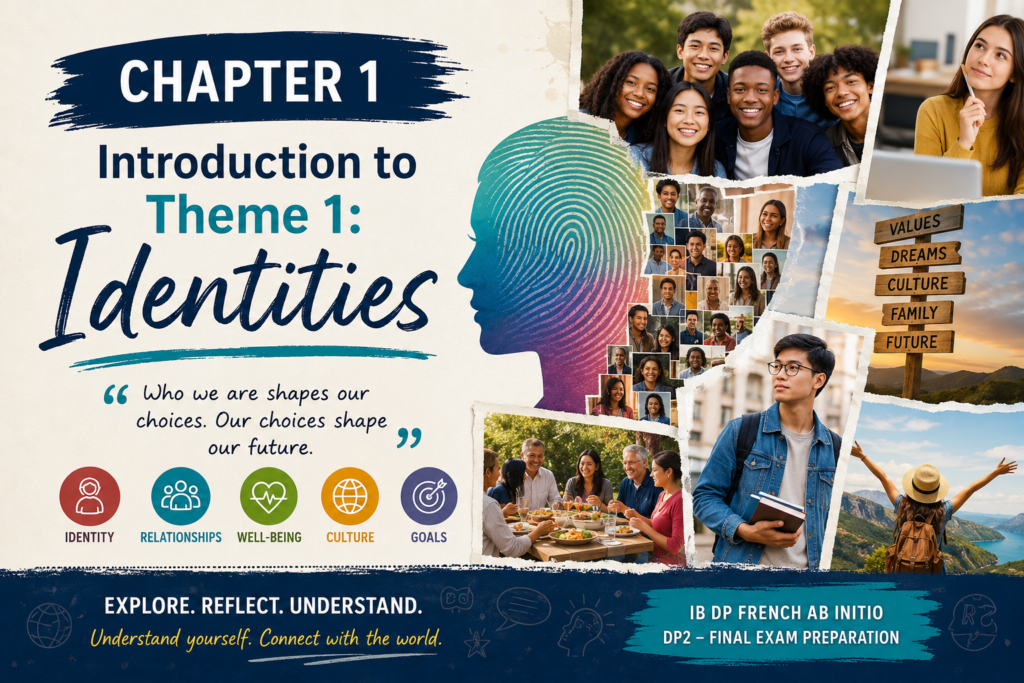
CHAPTER 1
Introduction to Theme 1: Identities
Welcome, Students!
Welcome to the first week of our DP2 Final Examination Preparation Programme.
Over the next ten weeks, we will revise every topic, grammar structure, and examination skill required for success in the IB DP French ab initio Final Examination.
This revision course has been carefully designed to help you prepare for all three components of the IB assessment:
✔ Paper 1 – Writing
✔ Paper 2 – Reading Comprehension
✔ Individual Oral (IO)
Throughout this programme, you will revisit the five prescribed themes, strengthen your grammar, expand your vocabulary, improve your writing, develop your reading skills, and gain confidence when speaking French.
This week focuses on the first prescribed theme:
Theme 1: Identities
Why is this theme important?
The theme Identities is one of the most frequently assessed themes in the IB French Ab Initio course.
Questions about yourself, your family, your daily life, your lifestyle, your health, your personality, and your relationships appear regularly in:
- Individual Oral
- Paper 1
- Paper 2
If you master this theme, you will already feel much more confident during your examinations.
What does “Identities” mean?
Your identity is everything that makes you unique.
It includes:
- who you are;
- where you come from;
- your personality;
- your family;
- your relationships;
- your daily habits;
- your interests;
- your ambitions;
- your values;
- your lifestyle;
- your physical and mental health.
In this theme, you will learn how to communicate naturally about yourself and the people around you.
IB prescribed theme
Identities
Possible IB topics
Throughout your IB course, questions related to Identities may include:
- Personal identity
- Family relationships
- Friendships
- Personal values
- Daily routine
- Lifestyle choices
- Physical health
- Mental health
- Healthy eating
- Sports and leisure
- Personal interests
- Hobbies
- Emotions
- Future aspirations
Essential questions
As you study this theme, think carefully about the following questions.
Factual questions
- Who am I?
- What makes me unique?
- How would I describe my personality?
- What does my daily routine look like?
- What activities do I enjoy?
Conceptual questions
- How does our family influence our identity?
- How do friendships shape our lives?
- Why is a healthy lifestyle important?
- How do our daily habits affect our future?
Debatable questions
- Is physical health more important than mental health?
- Can social media influence our identity?
- Should everyone practise sport regularly?
- Is family more important than friends?
Learning objectives
By the end of this week, you should be able to:
Communication
✔ Introduce yourself confidently.
✔ Describe your personality.
✔ Talk about your family.
✔ Describe your relationships.
✔ Explain your daily routine.
✔ Discuss healthy lifestyles.
✔ Express your opinions about health.
✔ Talk about sports and exercise.
Reading
You will be able to:
✔ understand authentic texts about identity;
✔ identify the writer’s opinion;
✔ infer meaning from context;
✔ locate specific information;
✔ answer IB-style comprehension questions.
Writing
You will practise writing:
✔ Blog
✔ Journal Entry
using the conventions required in IB Paper 1.
Individual oral
You will practise:
✔ describing photographs;
✔ identifying the prescribed theme;
✔ expressing opinions;
✔ making personal connections;
✔ answering follow-up questions confidently.
ATL Skills
During this week, you will develop the following Approaches to Learning (ATL) skills.
Communication Skills
- expressing opinions;
- asking questions;
- giving explanations;
- describing experiences.
Thinking Skills
- comparing ideas;
- analysing texts;
- justifying opinions;
- making connections.
Research Skills
- identifying information;
- analysing authentic resources.
Self-Management Skills
- organising revision;
- setting learning goals;
- reflecting on progress.
IB Learner Profile
This week’s activities will help you become:
Communicators
You will express your ideas clearly in French.
Thinkers
You will analyse information and justify your opinions.
Reflective
You will evaluate your own learning after every lesson.
Balanced
You will understand the importance of maintaining both physical and mental well-being.
Caring
You will appreciate the importance of healthy relationships and respect for others.
Examination connections
Paper 1
Possible writing tasks include:
- Blog
- Journal Entry
Typical topics:
- Mon mode de vie
- Ma journée
- Ma famille
- Pourquoi je fais du sport
- Comment je prends soin de ma santé
Paper 2
Possible reading topics include:
- Healthy lifestyles
- Family life
- Teenagers
- Daily routines
- Friendships
- Mental health
- Sport
Individual oral
Typical photographs include:
- a family meal;
- teenagers playing sport;
- healthy food;
- someone exercising;
- friends spending time together;
- a person following a daily routine.
Weekly overview
This week, we will study the following topics in detail:
A
Personal Identity
B
Personality
C
Family
D
Relationships
E
Lifestyle
F
Daily Routine
G
Physical Well-being
H
Mental Health
I
Healthy Eating
J
Sport and Exercise
Each topic will include:
- extensive vocabulary;
- useful expressions;
- sentence starters;
- grammar in context;
- a model text;
- exam tips;
- writing practice;
- speaking practice;
- reading activities;
- Individual Oral preparation.
Study advice
To get the most out of this revision programme:
- Revise vocabulary every day.
- Read French texts regularly.
- Write at least one short text every week.
- Review grammar before completing exercises.
- Keep a notebook for new vocabulary and expressions.
- Practise speaking French whenever possible.
- Reflect on your progress at the end of each week.
Remember, language learning is a gradual process. Every new word you learn, every grammar rule you master, and every text you write brings you one step closer to success in your IB examinations.
What comes next?
In the next chapter, we will begin Topic A: Personal Identity, where you will learn to introduce yourself confidently, describe who you are, discuss your ambitions and interests, and use a wide range of vocabulary and expressions that are commonly assessed in Paper 1, Paper 2, and the Individual Oral.