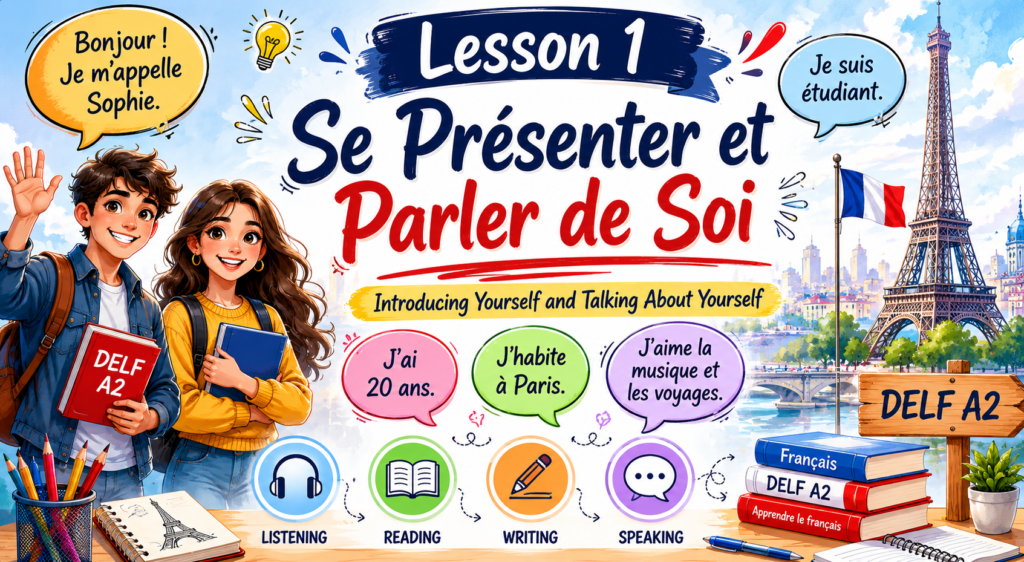
(Introducing Yourself and Talking About Yourself)
1. Introduction to the Lesson
The first DELF A2 lesson is extremely important because it establishes:
- student confidence,
- communication habits,
- speaking participation,
- DELF exam expectations,
- classroom interaction in French.
At the beginning of DELF A2 preparation, many students:
- fear speaking,
- hesitate while answering,
- translate mentally,
- worry about grammar mistakes.
Therefore, the first lesson should:
– reduce anxiety
– encourage communication
– introduce practical French
– build confidence gradually
– create a positive learning environment
The objective is NOT perfection.
The objective is:
COMMUNICATION.
Why “Introducing Yourself” Is the Best First Lesson
“Se présenter” is the ideal first DELF A2 lesson because students immediately learn to:
- communicate,
- answer basic questions,
- interact naturally,
- use practical vocabulary,
- form complete sentences.
This topic appears constantly in:
- DELF oral exams,
- writing tasks,
- listening activities,
- reading exercises,
- role-play situations.
DELF A2 Skills Developed in This Lesson
| Skill | Development |
|---|---|
| Listening | Understanding introductions |
| Reading | Reading short profiles |
| Speaking | Introducing oneself |
| Writing | Writing personal descriptions |
Communication Objectives
By the end of the lesson, students should be able to:
- introduce themselves confidently,
- provide personal information,
- describe hobbies and interests,
- answer personal questions,
- ask simple questions,
- interact politely,
- construct short paragraphs.
Real-Life Communication Situations
This lesson prepares students for:
- meeting someone,
- classroom interaction,
- travel situations,
- interviews,
- social conversations,
- oral exams.
Suggested Lesson Duration
| Activity | Time |
|---|---|
| Warm-Up | 10 min |
| Vocabulary | 15 min |
| Grammar | 20 min |
| Listening | 10 min |
| Speaking | 20 min |
| Reading | 10 min |
| Writing | 15 min |
| Review | 10 min |
Total:
Approximately 90 minutes
2. Warm-Up Activity
The warm-up helps students:
- relax,
- start speaking immediately,
- become comfortable hearing French.
At the beginning:
students should hear simple French naturally.
Teacher Introduction Example
The teacher introduces themselves slowly.
Example
Bonjour !
Je m’appelle Madame Sophie.
Je suis française.
J’habite à Paris.
Je suis professeur de français.
J’aime la musique et les voyages.
Why This Is Important
Students:
– hear authentic French
– observe sentence structure
– identify familiar vocabulary
– gain listening confidence
First Student Interaction
Ask simple questions:
- Comment tu t’appelles ?
- Ça va ?
- Tu habites où ?
- Tu aimes le français ?
Students answer very simply at first.
Important Teaching Principle
DO NOT correct every mistake immediately.
At the beginning:
communication confidence is more important than grammatical perfection.
3. Essential Vocabulary
Students now learn vocabulary related to:
- identity,
- personal information,
- hobbies,
- professions,
- nationality.
A. Personal Information Vocabulary
| French | English |
|---|---|
| le nom | surname |
| le prénom | first name |
| l’âge | age |
| la nationalité | nationality |
| l’adresse | address |
| le téléphone | phone |
| la profession | profession |
Example Sentences
- Mon prénom est Daniel.
- J’ai 19 ans.
- Je suis étudiant.
B. Countries and Nationalities
| Country | Nationality |
|---|---|
| la France | français/française |
| l’Inde | indien/indienne |
| le Canada | canadien/canadienne |
| le Congo | congolais/congolaise |
Practice Activity
Students complete:
- Je suis __________.
- J’habite en __________.
C. Hobbies Vocabulary
| French | English |
|---|---|
| le football | football |
| la musique | music |
| le cinéma | cinema |
| les voyages | travel |
| la lecture | reading |
Useful Expressions
- J’aime…
- Je préfère…
- Je déteste…
- J’adore…
Example Sentences
- J’aime le football.
- J’adore la musique française.
- Je préfère voyager.
4. Grammar Section
The first DELF A2 lesson should revise very essential grammar.
A. Verb ÊTRE
Explain:
Être is used for:
- identity,
- nationality,
- profession,
- description.
Conjugation
\text{Je suis \quad Tu es \quad Il/Elle est \quad Nous sommes \quad Vous êtes \quad Ils/Elles sont}
Example Sentences
- Je suis étudiant.
- Elle est française.
- Nous sommes amis.
B. Verb AVOIR
Explain:
Avoir is used for:
- age,
- possession,
- certain expressions.
Conjugation
\text{J’ai \quad Tu as \quad Il/Elle a \quad Nous avons \quad Vous avez \quad Ils/Elles ont}
Example Sentences
- J’ai 20 ans.
- Nous avons un chien.
C. Regular -ER Verbs
Introduce:
- aimer,
- parler,
- habiter.
Example Conjugation
\text{J’aime \quad Tu aimes \quad Il aime \quad Nous aimons \quad Vous aimez \quad Ils aiment}
Important Explanation
Explain:
Most French verbs end in:
- -er
- -ir
- -re
At beginner DELF A2 level:
focus first on:
regular -ER verbs.
5. Listening Activity
Listening develops:
- pronunciation recognition,
- comprehension,
- confidence.
Listening Text
Teacher reads slowly:
Bonjour !
Je m’appelle Lucas.
J’ai 21 ans.
J’habite à Lyon.
Je suis étudiant.
J’aime le sport et les films.
Listening Questions
- Comment s’appelle-t-il ?
- Quel âge a-t-il ?
- Où habite-t-il ?
- Qu’aime-t-il ?
Listening Answers
- Lucas
- 21 ans
- À Lyon
- Le sport et les films
Listening Teaching Strategy
Students should:
– listen for keywords
– focus on meaning
– avoid translating every word
6. Speaking Activity
Speaking is the MOST important part of the first lesson.
Students must speak immediately.
Model Self-Introduction
Teacher models first.
Example
Bonjour !
Je m’appelle Anita.
J’ai 18 ans.
J’habite à Mumbai.
Je suis étudiante.
J’aime la musique et les voyages.
Pair Work Activity
Students work in pairs.
Student A asks:
- Comment tu t’appelles ?
- Tu habites où ?
- Quel âge as-tu ?
- Qu’est-ce que tu aimes ?
Student B answers.
Then they switch roles.
Why Pair Work Is Important
It:
✅ reduces stress
✅ increases speaking time
✅ improves confidence
✅ encourages interaction
Common Student Errors
Mistake 1
- Je suis 20 ans.
- J’ai 20 ans.
Mistake 2
- Je habite à Delhi.
- J’habite à Delhi.
Mistake 3
- Je suis aimer football.
- J’aime le football.
Teacher Advice
Correct errors gently.
Avoid interrupting fluency constantly.
7. Reading Activity
Students now read a short DELF-style text.
Reading Text
Salut !
Je m’appelle Emma.
Je suis canadienne.
J’habite à Montréal.
Je travaille dans une école.
J’aime lire et voyager.
Reading Questions
- Quelle est sa nationalité ?
- Où habite Emma ?
- Où travaille-t-elle ?
- Quels sont ses loisirs ?
Reading Answers
- Canadienne
- À Montréal
- Dans une école
- Lire et voyager
Reading Objectives
Students learn to:
– identify information
– recognize vocabulary
– understand simple written French
8. Writing Activity
Students write:
“Présentez-vous”
Writing Instructions
Write:
- your name,
- age,
- nationality,
- city,
- profession/studies,
- hobbies.
Target:
50–70 words.
Example Writing
Bonjour,
Je m’appelle David.
J’ai 22 ans.
Je suis congolais.
J’habite à Delhi.
Je suis étudiant.
J’aime le football, la musique et les voyages.
Je parle français et anglais.
Writing Skills Developed
Students practice:
– sentence structure
– vocabulary
– grammar
– organization
9. DELF A2 Communication Functions Introduced
This lesson already develops important DELF A2 communication skills.
Functions Learned
Students learn how to:
- introduce themselves,
- provide information,
- express preferences,
- ask questions,
- answer politely,
- maintain conversation.
10. Pronunciation Practice
Pronunciation should start from Lesson 1.
Focus Areas
Silent Letters
Example:
- parlent
- étudiant
French Sounds
Practice:
- bonjour
- français
- étudiant
Mini Pronunciation Activity
Students repeat:
- Bonjour !
- Je m’appelle…
- J’habite à…
11. Classroom Interaction Expressions
Teach survival classroom French immediately.
Essential Expressions
| French | English |
|---|---|
| Je ne comprends pas | I don’t understand |
| Pouvez-vous répéter ? | Can you repeat? |
| Comment dit-on… ? | How do you say…? |
| Plus lentement, s’il vous plaît | More slowly, please |
Why This Is Important
Students become:
– more independent
– more interactive
– more confident
12. Homework Suggestions
Homework 1 — Self-Introduction Recording
Students record:
a 1-minute introduction.
Homework 2 — Written Paragraph
Topic:
“Présentez-vous”
Target:
60 words.
Homework 3 — Vocabulary Memorization
Learn:
- countries,
- nationalities,
- hobbies,
- professions.
13. Assessment Ideas
At the end of the lesson:
students should successfully:
– introduce themselves
– answer personal questions
– write a short paragraph
– understand simple introductions
Mini Oral Assessment
Ask:
- Comment vous appelez-vous ?
- Quel âge avez-vous ?
- Où habitez-vous ?
- Qu’aimez-vous faire ?
14. Important Teaching Advice for DELF A2 Beginners
A. Encourage Communication First
Confidence before perfection.
B. Avoid Excessive Grammar Explanation
Too much grammar reduces speaking confidence.
C. Create Interaction Constantly
Students should speak frequently.
D. Use Visual Support
Use:
- images,
- gestures,
- flashcards,
- slides.
E. Repeat Frequently
Repetition builds automatic communication.
15. Long-Term Importance of This First Lesson
This lesson becomes the foundation for:
– oral communication
– DELF speaking tasks
– written production
– listening comprehension
– role-play interaction
Almost every future DELF topic connects to:
- introducing oneself,
- expressing preferences,
- discussing daily life,
- interacting socially.
Final Objective of Lesson 1
The true success of the first DELF A2 lesson is NOT:
– perfect grammar
The true success is:
– students speaking confidently
– students interacting naturally
– students enjoying French communication
– students feeling motivated to continue learning French