
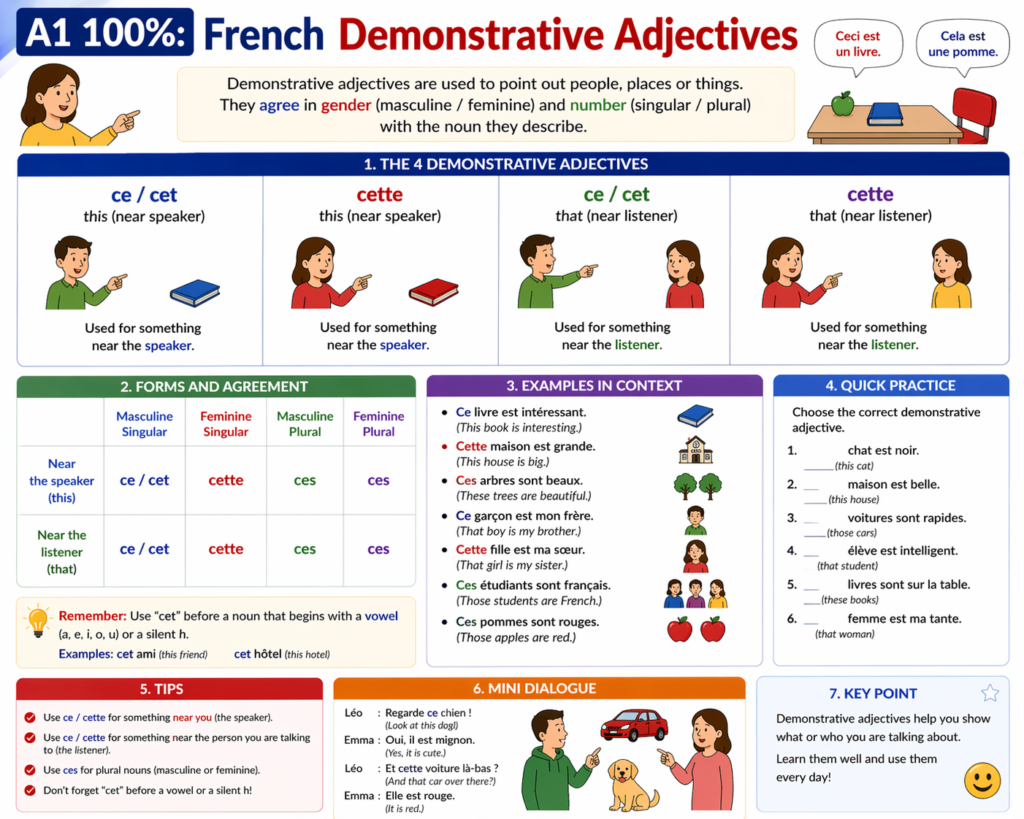
Description
Learn French demonstrative adjectives (ce, cette, cet, ces) with clear rules, examples, and mistakes to avoid. Perfect for A1–A2 learners and TEF Canada.
Introduction: How to Point and Choose in French
In this lesson on French demonstrative adjectives, you will learn how to point, identify, and choose objects correctly in French.
Until now, you used:
- le / la / les (general)
Now, you will use:
– ce, cette, cet, ces (specific choice)
Mastering French demonstrative adjectives is essential if you want to:
- describe places (restaurant, street, apartment)
- choose objects
- compare options
- succeed in TEF Canada speaking
What Are French Demonstrative Adjectives?
French demonstrative adjectives are used to:
- point at something
- identify something specific
- replace le / la / les when selecting
Simple Explanation
Instead of saying:
- le restaurant
You say:
- ce restaurant → this restaurant
1. Forms of French Demonstrative Adjectives
In French demonstrative adjectives, the form depends on:
- gender (masculine/feminine)
- number (singular/plural)
- first letter (vowel or consonant)
Forms Table
- ce → masculine singular
- cette → feminine singular
- cet → before vowel or silent h
- ces → plural
Examples
- ce restaurant
- cette rue
- cet appartement
- ces magasins
2. Grammar Rule (VERY IMPORTANT)
French demonstrative adjectives agree with the noun, NOT the speaker
Examples
- ce restaurant est bon
- cette rue est longue
- cet appartement est grand
- ces magasins sont ouverts
Key Idea
Always look at:
– the noun
NOT the person speaking
3. Special Rule: “cet” Before a Vowel
In French demonstrative adjectives, pronunciation is important.
Rule
Use cet before:
- vowel
- silent “h”
Examples
- cet appartement
- cet hôtel
Incorrect Forms
- ce appartement
- ce hôtel
Why?
To make pronunciation smoother.
4. Using French Demonstrative Adjectives in Sentences
Structure
Demonstrative adjective + noun + adjective
Examples
- ce restaurant est bon
- cette maison est grande
- cet appartement est moderne
- ces rues sont calmes
TEF Insight
These structures are very common in:
- describing a place
- choosing between options
5. Compare: Articles vs Demonstratives
Understanding this difference is key.
Articles (general)
- le restaurant
- la rue
Demonstratives (specific)
- ce restaurant
- cette rue
Key Difference
| Type | Meaning |
|---|---|
| le / la | general |
| ce / cette | specific |
6. Common Mistakes in French Demonstrative Adjectives
Errors
- ce rue
- cette appartement
- ce hôtel
Correct Forms
- cette rue
- cet appartement
- cet hôtel
These mistakes are very common in TEF Canada.
7. TEF Canada Strategy (Exam Focus)
In TEF Canada, French demonstrative adjectives are used when you:
- describe a place
- choose something
- compare options
Example Question
Quel appartement préférez-vous ?
High-Scoring Answer
- Cet appartement est grand
- Cette maison est plus moderne
- Ces magasins sont proches
Clear + correct = higher score
8. Practice (A1 → A2 Progression)
Exercise 1
Choose the correct form:
- ___ restaurant (masculine)
- ___ rue (feminine)
- ___ appartement (vowel)
- ___ magasins (plural)
Exercise 2
Correct the sentence:
- ce rue
- cette appartement
- ce hôtel
Exercise 3 (A2 Level)
Write 3 sentences:
- one with ce
- one with cette
- one with ces
9. Mini TEF Speaking Task
Situation: You choose a place.
Model Answer
Cet appartement est grand.
Cette rue est calme.
Ces magasins sont proches.
Continue Learning French
After mastering French demonstrative adjectives, continue with:
- Learn ordering food in French (je voudrais + partitives)
- Practice French partitive articles (du, de la, de l’, des)
FAQ
What are French demonstrative adjectives?
They are words like ce, cette, cet, ces used to point or identify something.
When do we use “cet”?
Before a vowel or silent “h”.
Do demonstratives agree with the speaker?
No. They agree with the noun.
Is this important for TEF Canada?
Yes. It is used in speaking and description tasks.
Final Tip
To master French demonstrative adjectives, focus on:
- noun gender
- noun number
- first letter (vowel or consonant)
This will eliminate most mistakes instantly.