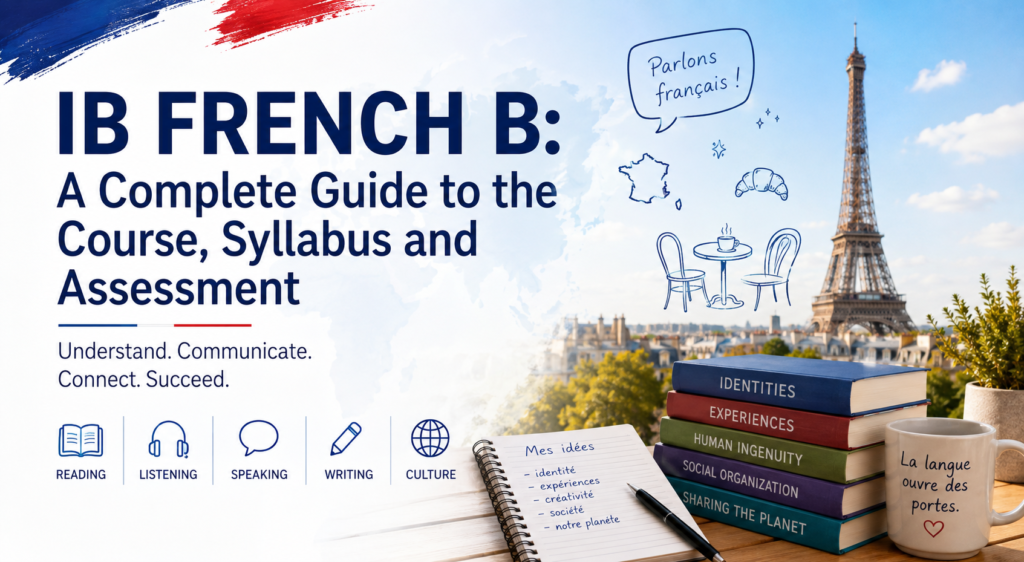
Understanding IB French B for Students, Parents and Teachers
Choosing or studying IB French B can initially seem overwhelming. There are five themes, several types of texts, different examination papers, an Individual Oral, specific assessment criteria and a strong emphasis on culture and communication.
But once the course is understood as a complete system, the structure becomes much clearer.
IB French B is not simply a French grammar course.
It is a language acquisition course designed to help students become increasingly confident and independent communicators who can understand authentic French, express and develop ideas, interact with others and explore different cultural perspectives.
The IB Language B framework places communication, intercultural understanding, authentic texts and higher-order thinking at the centre of the learning experience.
Important: This guide explains the IB Language B specification contained in the uploaded document, which identifies itself as the First Assessment 2020 guide. Students and teachers should always check the official IB documentation applicable to their particular examination session before relying on assessment details.
What is IB French B?
IB French B is intended for students who already have some previous experience with French.
The course takes students beyond basic communication and encourages them to use French in increasingly complex situations.
Students develop three interconnected areas of language ability:
Receptive skills
Students learn to understand French through:
- reading
- listening
- visual material
- audio-visual material
- authentic texts
Productive skills
Students learn to communicate their own ideas through:
- writing
- speaking
- presentations
- descriptions
- narratives
- explanations
- arguments
- opinions
Interactive skills
Students learn to communicate with other people, including:
- responding spontaneously
- maintaining conversations
- asking questions
- answering questions
- expressing opinions
- responding to different perspectives
- negotiating meaning
- adapting language to different audiences and situations
The three areas should not be taught separately. Effective French communication requires students to understand information, produce language and interact with others.
At Higher Level, students are expected to demonstrate greater linguistic, conceptual and analytical sophistication.
French B is more than vocabulary and grammar
One of the most important things students and parents should understand is that knowing French vocabulary and grammar does not automatically mean being successful in IB French B.
A student might know hundreds of French words and understand many grammatical rules but still struggle to achieve a high level if they cannot use that knowledge appropriately.
IB French B asks students to consider five important questions:
Who am I communicating with?
Audience
Where and in what situation am I communicating?
Context
Why am I communicating?
Purpose
What message or effect am I trying to create?
Meaning
How does language change between people, places and situations?
Variation
These concepts influence everything from writing an email to participating in an oral discussion.
For example, the French used when messaging a close friend should not necessarily be the same French used when writing formally to a school director.
This is why register, tone, format and purpose are so important in IB French B.
IB French B SL vs HL
French B is available at:
- Standard Level (SL)
- Higher Level (HL)
The two courses share the same overall philosophy and five prescribed themes, but HL requires greater depth, range and complexity.
French B SL
At SL, students develop the ability to:
- understand authentic written and spoken French
- describe experiences and situations
- express feelings and opinions
- compare ideas and perspectives
- understand straightforward arguments
- infer meaning from context
- communicate for different purposes
- participate in conversations
- give presentations
- respond to questions
- negotiate meaning
French B HL
HL students develop these abilities further.
They are expected to:
- understand more complex texts
- analyse arguments
- interpret ideas
- evaluate perspectives
- construct supported arguments
- communicate at greater length
- use a broader range of vocabulary and structures
- adapt their communication more effectively
- engage with literature
- demonstrate more sophisticated thinking
In simple terms:
HL is not simply “more French”. It is more sophisticated French communication and thinking.
Recommended teaching time
The guide identifies the following recommended course hours:
| Course | Recommended teaching Hours |
|---|---|
| French B SL | 150 hours |
| French B HL | 240 hours |
The greater allocation at HL reflects the additional linguistic, cultural, textual and analytical demands of the course.
The Five IB French B Themes
Everything in the French B course is connected to five prescribed themes:
- Identities
- Experiences
- Human Ingenuity
- Social Organization
- Sharing the Planet
These themes provide the broad contexts through which students develop their French.
Importantly, the themes should not be treated as five vocabulary lists.
A good French B unit uses a theme as a starting point for communication, inquiry, cultural exploration and critical thinking.
Theme 1: Identities
Understanding who we are
The theme of Identities explores the individual and the factors that contribute to who we are.
Possible areas include:
- lifestyles
- health and well-being
- beliefs and values
- subcultures
- language and identity
Students may explore questions such as:
- What makes us who we are?
- How do we express our identity?
- How does culture influence identity?
- How does language contribute to our sense of self?
- What does a healthy lifestyle mean?
The theme provides opportunities for students to begin with personal experiences and gradually move toward broader cultural and social questions.
Theme 2: Experiences
The events and journeys that shape our lives
Experiences focuses on the events, traditions and journeys that influence individuals and communities.
Possible areas include:
- leisure
- holidays
- travel
- life stories
- traditions
- rites of passage
- migration
Students might investigate questions such as:
- How can travel change our perspective?
- Why are traditions important?
- How do different cultures celebrate important moments?
- How does migration influence identity?
- How do our experiences shape our future?
The theme provides particularly strong opportunities for storytelling, narration, comparison and cultural exploration.
Theme 3: Human Ingenuity
Creativity, innovation and technology
Human Ingenuity examines what humans create and how those creations influence society.
Possible areas include:
- entertainment
- arts
- communication
- media
- technology
- scientific innovation
Students may discuss:
- How has technology changed our lives?
- Does social media bring people closer together?
- How does art reflect culture?
- Can technological progress create new problems?
- How does the media influence the way we think?
This theme is particularly useful for developing arguments and discussions because many of its topics have competing perspectives.
Theme 4: Social Organization
How societies function
Social Organization examines how people live together and how societies create systems, relationships and structures.
Possible areas include:
- communities
- social relationships
- education
- employment
- social engagement
- law and order
Students can explore questions such as:
- What responsibilities do individuals have toward their communities?
- Why do societies need laws?
- What makes an effective education system?
- How is the workplace changing?
- What role does language play within society?
This theme naturally lends itself to debates, formal writing and discussions.
Theme 5: Sharing the Planet
Global challenges and our responsibilities
Sharing the Planet deals with many of the major challenges facing individuals and societies.
Possible areas include:
- the environment
- human rights
- equality
- peace and conflict
- globalization
- ethics
- urban and rural environments
Students may investigate:
- How can environmental problems be addressed?
- What responsibilities do individuals have toward the planet?
- How can inequality be reduced?
- What are the advantages and disadvantages of globalization?
- How can societies respond to conflict?
This theme is particularly suitable for developing argumentation, evaluation, problem-solving and global perspectives.
Don’t teach the Five Themes as vocabulary chapters
This is one of the most important principles for effective IB French B teaching.
A weak approach might be:
Technology → learn 30 technology words → complete grammar exercises → test vocabulary.
A stronger IB approach would be:
Technology → investigate an issue → encounter authentic French → develop vocabulary → analyse perspectives → discuss the issue → express an opinion → support arguments → compare cultures → reflect on the consequences.
For example:
Topic
Les réseaux sociaux
Instead of stopping at vocabulary such as:
téléphone, Internet, application, message, réseau social…
students might investigate:
Dans quelle mesure les réseaux sociaux influencent-ils notre identité ?
Now students have a reason to:
- read
- listen
- research
- speak
- write
- compare
- justify
- evaluate
- interact
This approach brings language learning and conceptual learning together.
The importance of Audience, Context and Purpose
One of the biggest differences between traditional language learning and IB French B is the emphasis on communication in context.
Before producing a text, students should ask:
Audience
Who will read or hear this?
Context
What is the situation?
Purpose
Why am I communicating?
Register
How formal or informal should I be?
Format
What type of text am I producing?
Tone
What attitude should my language communicate?
These decisions influence vocabulary, grammar, expressions, organisation and style.
This becomes particularly important in Paper 1, where students must respond to a specific situation and select an appropriate text type.
Understanding text types in IB French B
The word “text” has a broad meaning in IB French B.
Students may work with:
- articles
- emails
- blogs
- interviews
- speeches
- podcasts
- advertisements
- brochures
- reports
- reviews
- websites
- social media
- films
- radio programmes
- posters
- news reports
The guide groups texts broadly into personal, professional and mass-media texts.
Personal texts
Personal texts are generally directed toward individuals or groups with whom the writer has a personal connection or shared interest.
Examples include:
- personal emails
- diaries
- personal letters
- blogs
- social media posts
Possible purposes include:
- describing
- narrating
- entertaining
- recommending
- persuading
Professional texts
Professional texts are generally used in more formal contexts.
Examples include:
- formal emails
- formal letters
- essays
- proposals
- reports
- surveys
- questionnaires
- instructions
Their purposes can include:
- informing
- explaining
- analysing
- instructing
- convincing
- evaluating
Mass-media texts
Mass-media texts are created for larger audiences.
Examples include:
- advertisements
- newspaper articles
- magazine articles
- interviews
- news reports
- opinion columns
- podcasts
- posters
- reviews
- speeches
- travel guides
- web pages
The appropriate language depends heavily on the audience, medium and purpose.
Why text type matters in Paper 1
A student may have excellent French but still lose marks if the response does not effectively address the task.
Students need to understand that:
A formal letter is not simply an informal email with “Dear Sir/Madam” added.
The audience, purpose, register, organisation and tone all need to work together.
For every writing task, students should train themselves to identify:
AUDIENCE → CONTEXT → PURPOSE → TEXT TYPE → REGISTER → CONTENT → ORGANISATION
This should become automatic.
Literature in French B HL
Literature is an important distinction between SL and HL.
According to the guide, HL students are required to study two literary works originally written in the target language.
The purpose is not to transform French B into a traditional literature course.
Students should understand important elements such as:
- characters
- plot
- themes
- ideas
- cultural perspectives
Literature also provides opportunities to develop vocabulary, interpretation and discussion skills.
One of the literary works studied is connected to the HL Individual Oral.
French B and Culture
Language cannot be separated from culture.
Learning French should also help students understand:
- how people communicate
- how societies function
- how traditions develop
- how perspectives differ
- how language reflects identity
- how cultural contexts influence communication
The purpose is not to teach students that one culture is “better” than another.
Instead, students should learn to compare perspectives and understand cultural differences with an open mind.
This is closely connected to the IB emphasis on international-mindedness.
French B and TOK
French B can also provide excellent opportunities for Theory of Knowledge connections.
Language raises important questions about knowledge and perspective.
For example:
- Can we think without language?
- Does language influence the way we understand reality?
- Does speaking more than one language change our perspective?
- Can language influence people’s beliefs?
- Can something be lost when an idea is translated?
- How does culture influence what we consider to be true?
These questions help students move beyond grammar and vocabulary and think about language as a way of constructing and communicating knowledge.
French B and CAS
Language learning can also connect with Creativity, Activity, Service.
Students could use French in authentic contexts through activities such as:
- cultural projects
- community engagement
- environmental initiatives
- multilingual campaigns
- interactions with French speakers
- cultural research
- service activities
The important principle is that language becomes something students use, rather than something they only study.
French B and the Extended Essay
Students interested in French can also explore the language through the Extended Essay.
The guide identifies possibilities relating to:
Language
Students can investigate aspects of French language use.
Culture and Society
Students can investigate an aspect of a French-speaking society or culture.
Literature
Students can investigate literary works originally written in the target language.
This can provide students with an opportunity to pursue a specific question in much greater depth.
IB French B Assessment
For the assessment structure described in the uploaded guide, the final assessment consists of three components:
| Component | SL | HL |
|---|---|---|
| Paper 1 – Writing | 25% | 25% |
| Paper 2 – Listening & Reading | 50% | 50% |
| Individual Oral | 25% | 25% |
| Total | 100% | 100% |
This immediately gives students an important message:
Speaking is not an optional extra. It represents 25% of the final assessment.
Paper 1: Writing
French B SL
Students have:
1 hour 15 minutes
They choose one task from three options, with the tasks based on different themes.
The required response is:
250–400 words
The student must choose an appropriate text type according to the task.
Paper 1 is worth 25% of the final grade.
French B HL
Students have:
1 hour 30 minutes
They choose one of three tasks.
The required response is:
450–600 words
HL writing requires greater complexity and can involve higher-order thinking such as:
- analysis
- evaluation
- synthesis
- interpretation
What makes a strong Paper 1 response?
Students should not approach Paper 1 as:
“Write everything you know about the topic.”
Instead, they should approach it as:
“Respond precisely to this particular communication situation.”
A strong response needs to consider:
Language
Is the vocabulary appropriate and varied?
Are grammatical structures used effectively?
Is the language sufficiently accurate?
Organisation
Are ideas logically organised?
Is there a clear progression?
Are ideas developed rather than simply listed?
Communication
Does the response fulfil the purpose?
Is the register appropriate?
Is the text type appropriate?
Does the response address the intended audience?
The key principle is that content knowledge alone does not guarantee a strong score. The student needs to communicate effectively within the specific task.
Paper 2: Listening and Reading
Paper 2 is the largest component of the assessment.
It represents:
50% of the final grade
It contains two sections:
Listening
Three audio passages.
Reading
Three written passages.
The passages are connected to the five prescribed themes.
Paper 2 SL
Total: 1 hour 45 minutes
- Listening: 45 minutes
- Reading: 1 hour
Paper 2 HL
Total: 2 hours
- Listening: 1 hour
- Reading: 1 hour
What does Paper 2 really test?
Paper 2 is fundamentally about understanding French.
Students are not expected to memorise facts about every possible topic.
Instead, they need to be able to understand information when they encounter it.
Important skills include:
- identifying the main idea
- finding supporting details
- understanding context
- recognising opinions
- identifying attitudes
- interpreting meaning
- understanding implied meaning
- recognising relationships between ideas
- dealing with unfamiliar vocabulary
- identifying register
- understanding different accents and linguistic variation
The guide specifically highlights exposure to linguistic variation and regional accents as part of students’ preparation.
Don’t depend on a dictionary
Students cannot use dictionaries or other reference materials during Papers 1 and 2 under the assessment structure described in this guide.
This means that students need to develop the ability to work with unfamiliar language.
For example, they should learn to use:
- context
- cognates
- prefixes and suffixes
- grammatical clues
- surrounding sentences
- discourse markers
- knowledge of word families
The goal is not to understand every individual word.
The goal is to understand the message.
The individual oral
The Individual Oral is worth:
25% of the final grade
It is conducted by the teacher and is externally moderated by the IB.
The SL and HL formats are different.
SL individual oral
The SL oral is based on a:
Visual stimulus
Students make a presentation connected to the target-language culture or cultures.
This is followed by interaction with the teacher.
The discussion develops beyond the initial stimulus and gives students the opportunity to demonstrate their ability to communicate spontaneously.
The oral lasts approximately:
12–15 minutes
HL individual oral
The HL oral is based on:
A literary extract
The assessment has three broad stages.
Part 1 — Presentation
Approximately:
3–4 minutes
The student presents ideas related to the literary extract.
Part 2 — Follow-up discussion
Approximately:
4–5 minutes
The teacher asks questions designed to encourage:
- explanation
- clarification
- interpretation
- evaluation
- comparison
- cultural connections
Part 3 — General discussion
Approximately:
5–6 minutes
The discussion moves into broader course themes.
The complete oral lasts approximately:
12–15 minutes.
The individual oral should not be memorised
This is one of the most important points for students.
Students should absolutely practise speaking.
They should practise:
- presenting
- describing images
- developing ideas
- giving examples
- expressing opinions
- comparing perspectives
- answering follow-up questions
- responding spontaneously
However, the final Individual Oral should not simply be a memorised speech.
The assessment is designed to evaluate genuine spoken communication and interaction.
Students may prepare brief notes, but the guide limits preparation notes to 10 bullet points and does not permit students to bring materials such as phones, computers, dictionaries, class notes or copies of texts into the preparation/interview process.
What is assessed in speaking?
The oral assesses both productive and interactive communication.
Important aspects include:
- vocabulary
- grammatical structures
- accuracy
- pronunciation
- intonation
- development of ideas
- interaction
- ability to respond
- ability to sustain communication
This means that speaking practice should not consist only of rehearsing presentations.
Students also need regular opportunities for real conversation.
How IB Assessment works
IB assessment is criterion-related.
Students are assessed against defined criteria and level descriptors rather than simply being ranked against classmates.
Teachers use a best-fit approach when deciding which level most accurately describes a student’s performance.
This is important because a student may demonstrate different strengths across different criteria.
For example, a student might demonstrate:
- very strong vocabulary
- good organisation
- but inconsistent grammatical accuracy
Assessment therefore looks at the individual criteria rather than reducing the entire performance to a simple “good” or “bad” judgement.
Formative Assessment matters
Assessment should not happen only when students sit the final examination.
Throughout the course, teachers can use:
- practice tasks
- feedback
- peer assessment
- self-assessment
- drafts
- speaking practice
- reflection
- error analysis
- short comprehension activities
The purpose of formative assessment is to provide information that can be used to improve learning.
A good French B classroom therefore creates a cycle:
Learn → Practise → Receive Feedback → Reflect → Improve → Reapply
How should IB French B be taught?
The Language B framework promotes several important approaches to teaching and learning.
These include:
- Inquiry
- Conceptual understanding
- Local and global contexts
- Collaboration
- Differentiation
- Assessment-informed teaching
Inquiry-based Learning
Students should have opportunities to investigate questions rather than always being given information directly.
For example:
Pourquoi certaines personnes choisissent-elles de vivre à l’étranger ?
Students could investigate:
- migration
- identity
- language
- culture
- employment
- belonging
They then use French to explore the issue.
This turns language learning into an active process of inquiry.
Conceptual Learning
A strong IB unit begins with an idea rather than only a list of vocabulary.
For example:
Vocabulary-focused
Les réseaux sociaux
Concept-focused
Dans quelle mesure les réseaux sociaux influencent-ils notre identité ?
The second approach gives students something to think about, discuss and evaluate.
It also naturally creates opportunities to develop:
- vocabulary
- grammar
- reading
- listening
- speaking
- writing
- critical thinking
The IB guide specifically connects conceptual teaching with higher-order thinking and transfer of learning.
Learning in Local and Global Contexts
French should not exist in isolation from students’ lives.
Students should be encouraged to connect French with:
- their own experiences
- their communities
- their culture
- French-speaking cultures
- global issues
This helps students understand that language is connected to real people and real situations.
It also strengthens intercultural understanding.
Collaboration and Communication
Language is inherently social.
Students need opportunities to use French with other people through:
- pair work
- group work
- debates
- role plays
- presentations
- discussions
- problem-solving activities
The goal is to make students active participants rather than passive recipients of information.
Differentiation
Students do not enter French B classrooms with identical backgrounds.
They may have different:
- levels of French
- first languages
- learning experiences
- cultural backgrounds
- strengths
- challenges
Effective teaching therefore needs to provide appropriate:
- scaffolding
- support
- extension
- resources
- challenge
The IB framework explicitly recognises the importance of designing learning experiences that respond to different learner needs.
Authentic French should be part of the Course
One of the strongest ways to prepare students for IB French B is to expose them regularly to authentic French.
This can include:
- French news
- interviews
- podcasts
- websites
- advertisements
- documentaries
- social media
- blogs
- radio
- public information campaigns
- videos created for French-speaking audiences
Authentic materials expose students to the French they are likely to encounter outside the classroom.
They also introduce:
- different accents
- different registers
- different cultural perspectives
- natural expressions
- real communication patterns
The approaches to Learning
French B also develops skills that students can use well beyond their language classroom.
Thinking skills
Students develop:
- critical thinking
- creative thinking
- reflection
- metacognition
- transfer
Research skills
Students learn to:
- find information
- evaluate sources
- validate information
- analyse information
- paraphrase
- cite sources
- communicate findings
Communication skills
Students learn to communicate effectively with different audiences.
Social skills
Students develop:
- collaboration
- negotiation
- interaction
- intercultural awareness
Self-management skills
Students develop:
- organisation
- planning
- time management
- reflection
- self-correction
- error management
These transferable skills are an important part of the wider IB learning philosophy.
What does a successful IB French B student look like?
A successful student is not necessarily a student who never makes a grammatical mistake.
Instead, successful students gradually become able to:
- communicate clearly
- understand authentic French
- express and develop ideas
- adapt language to different audiences
- use appropriate register
- justify opinions
- provide examples
- compare perspectives
- interpret information
- analyse texts
- participate in conversations
- respond spontaneously
- understand cultural perspectives
- reflect on their own learning
The ultimate objective is effective communication.
Accuracy matters, but accuracy is part of a much bigger picture.
How students should prepare for IB French B
An effective preparation programme should develop four interconnected areas.
1. Build the Language
Students should continuously develop:
- vocabulary
- grammar
- expressions
- connectors
- idiomatic language
- register
- pronunciation
2. Practise communication
Students should regularly:
- speak
- write
- interact
- present
- debate
- respond spontaneously
- ask and answer questions
3. Work with different texts
Students should encounter:
- articles
- interviews
- podcasts
- videos
- advertisements
- blogs
- speeches
- websites
- literary texts at HL
4. Develop thinking
Students should practise:
- explaining
- comparing
- analysing
- interpreting
- justifying
- evaluating
- synthesising
This combination is much more effective than simply memorising vocabulary lists or practising examination questions repeatedly.
The mindset that makes the difference
Perhaps the most important change students can make is to change the way they think about the course.
Instead of thinking:
“I need to learn enough French to pass my exam.”
students should think:
“I am learning to communicate ideas effectively in French.”
That difference affects the way they study.
Instead of asking:
“What vocabulary do I need for this theme?”
they begin asking:
“What can I say about this issue?”
Instead of:
“What grammar will be tested?”
they ask:
“What language will help me communicate this idea clearly?”
Instead of:
“What should I memorise for the Individual Oral?”
they ask:
“How can I develop my ability to respond naturally to questions?”
This is much closer to the philosophy of Language B.
A simple model for understanding IB French B
The entire course can be viewed as a connected learning system:
LANGUAGE
Vocabulary + Grammar + Structures
↓
CONCEPTS
Audience + Context + Purpose + Meaning + Variation
↓
THEMES
Identities + Experiences + Human Ingenuity + Social Organization + Sharing the Planet
↓
TEXTS
Personal + Professional + Mass Media
↓
SKILLS
Reading + Listening + Writing + Speaking + Interaction
↓
THINKING
Analyse + Compare + Interpret + Justify + Evaluate
↓
COMMUNICATION
Understand + Express + Interact
↓
ASSESSMENT
Paper 1 + Paper 2 + Individual Oral
Final thoughts
IB French B is best understood as a communication and intercultural learning course, rather than a traditional French language class.
Grammar and vocabulary remain essential, but they are tools that allow students to communicate meaningfully.
Students are expected to understand and respond to authentic French, communicate with different audiences, explore cultural perspectives, develop arguments, interpret information and participate in meaningful interaction.
For teachers, this means that effective French B teaching should bring together:
language + culture + concepts + authentic texts + communication + inquiry + reflection.
For students, it means that success comes from consistently using French to understand, think, communicate and interact.
The most successful students are therefore not simply those who know the most French words. They are the students who can use the French they know effectively, appropriately and purposefully.
About this Guide
This article is an original explanatory resource based on the IB Diploma Programme Language B Guide (First Assessment 2020). It reorganises and explains the framework in accessible language for students, parents and teachers rather than reproducing the original IB publication.
Source: International Baccalaureate Organization, Diploma Programme Language B Guide — First Assessment 2020.
Please note: IB assessment specifications can change between examination sessions. Always consult the official IB documentation applicable to the student’s assessment session for current examination requirements.