Dear Students,
Welcome to one of the most important sections of the TEF Canada examination: Expression Écrite.
Many candidates believe that this section simply tests their grammar or vocabulary. However, that is far from the truth. The written expression test evaluates your ability to communicate effectively in French, just as you would in real life. Imagine that you are writing for a newspaper, replying to an organization, expressing your opinion in a public forum, or explaining an idea to someone. The examiners are interested in knowing whether you can organize your thoughts logically, write naturally, and adapt your language according to the situation.
Remember, writing is not about using the most difficult words possible. Instead, it is about choosing the right words, constructing clear sentences, and presenting your ideas in a logical and convincing manner.
The examination lasts 60 minutes and is completed entirely on a computer. Time management therefore becomes just as important as your French level. Students who fail this section are often not those with poor French, but those who fail to organize their time or misunderstand the instructions.
Throughout this lesson, I will guide you through every aspect of the examination exactly as I teach my own TEF Canada students.
Overview of the Examination
| Task | Time | Recommended Words | Objective |
|---|---|---|---|
| Task A | 25 minutes | 100–150 words (minimum 80) | Continue a newspaper article (Fait Divers) |
| Task B | 35 minutes | 250–300 words (minimum 200) | Write an argumentative opinion text |
Although both tasks are important, Task B generally contributes more to your overall performance because it demonstrates a wider range of vocabulary, grammar and argumentation skills.
Understanding the Philosophy of the Exam
Before we study each task, I want you to understand something extremely important.
The examiner is not looking for perfection.
Instead, the examiner asks the following questions while reading your work:
Can this candidate communicate effectively?
Does this candidate understand the purpose of the task?
Can this candidate organize ideas logically?
Can this candidate use French naturally?
Many students become obsessed with grammar and spend several minutes thinking about one sentence. This is a mistake.
Good communication is always more valuable than perfect grammar.
Time Management Strategy
Never begin writing immediately.
Professional writers always prepare before writing, and you should do the same.
I recommend the following schedule.
Task A (25 minutes)
• Read the instructions carefully (2 minutes)
• Plan your story (3 minutes)
• Write your article (17 minutes)
• Proofread (3 minutes)
Task B (35 minutes)
• Analyze the topic (3 minutes)
• Prepare your arguments (5 minutes)
• Write (22 minutes)
• Proofread (5 minutes)
Many students lose valuable marks simply because they forget accents, verb agreements, punctuation, or gender agreement. Those final minutes of proofreading often make the difference between a B2 and a C1 score.
TASK A – Le Fait Divers (Newspaper Article)
What exactly is a “fait divers”?
Dear students,
One of the biggest mistakes candidates make is treating Task A like a story or a personal narrative.
It is not a story.
It is not an essay.
It is not your opinion.
A fait divers is a short newspaper article describing a real event.
French newspapers publish these articles every day.
They usually describe:
- accidents
- robberies
- rescues
- fires
- natural disasters
- unusual events
- heroic actions
- public incidents
The journalist simply reports the facts.
Therefore, you become the journalist.
What do you receive?
The examination provides:
• a headline
• the beginning of the article
Your responsibility is to finish it naturally.
Example
Headline
Un chien sauve un enfant de cinq ans
Beginning
Hier après-midi, un incident s’est produit dans un parc de Lyon…
You continue the article as if you were writing for a newspaper.
Imagine You Are a Journalist
Whenever you write Task A, imagine yourself working for Le Monde, Le Figaro, or another French newspaper.
Ask yourself:
Who was involved?
Where did it happen?
When did it happen?
What happened?
Why did it happen?
How did it end?
Would a journalist write “Je pense que…”?
Absolutely not.
The article must remain objective.
Structure of Task A
Paragraph 1
Present the event.
Answer:
Who?
Where?
When?
Example
Hier après-midi, un violent incendie s’est déclaré dans un immeuble situé au centre de Marseille.
Immediately, your reader understands the situation.
Paragraph 2
Develop the event.
Explain:
What happened?
How?
Who reacted?
Were emergency services called?
Were there witnesses?
Remember:
The middle paragraph contains most of the action.
Paragraph 3
Conclude.
Explain:
Were people injured?
Was someone arrested?
Did the police investigate?
What happened afterwards?
A newspaper article always gives closure.
Which Verb Tenses Should You Use?
Task A is an excellent opportunity to demonstrate your mastery of French tenses.
Passé composé
Use it for completed actions.
Examples
Les pompiers sont arrivés rapidement.
La police a arrêté le suspect.
Imparfait
Use it for background information.
Examples
Il pleuvait.
Les enfants jouaient dans le parc.
La circulation était dense.
Plus-que-parfait
Use it to describe an action that happened before another past action.
Example
Le conducteur avait oublié de serrer le frein à main.
A candidate who naturally alternates between these tenses immediately demonstrates a higher level of proficiency.
Journalistic Vocabulary
Instead of repeating:
faire
être
avoir
use richer verbs.
Examples
survenir
se produire
déclarer
intervenir
constater
secourir
évacuer
maîtriser
arrêter
témoigner
signaler
annoncer
confirmer
Useful Journalistic Expressions
Opening
Selon les témoins…
D’après les autorités…
Un incident s’est produit…
Hier matin…
Vers 15 heures…
Sequence
Quelques instants plus tard…
Entre-temps…
Peu après…
Finalement…
Closing
Une enquête est en cours.
Les autorités poursuivent leurs investigations.
La victime est désormais hors de danger.
Aucun blessé n’a été signalé.
TASK B – The Opinion Essay
Dear students,
Task B is where you truly demonstrate your French.
Here, the examiner wants to discover whether you can think critically, organize ideas, defend an opinion and convince your reader.
You are not writing for your teacher.
You are writing for an educated French-speaking audience.
Your opinion must therefore be logical, balanced and well supported.
The Golden Rule
Never write:
“I agree.”
Then stop.
Every opinion needs support.
Think of yourself as a lawyer.
Every argument requires evidence.
Understanding the Prompt
Suppose the topic is:
Les réseaux sociaux présentent plus d’avantages que d’inconvénients.
Do not immediately begin writing.
Instead ask yourself:
What is my opinion?
What are my strongest arguments?
Can I think of examples?
Can I mention a counterargument?
Only then should you begin writing.
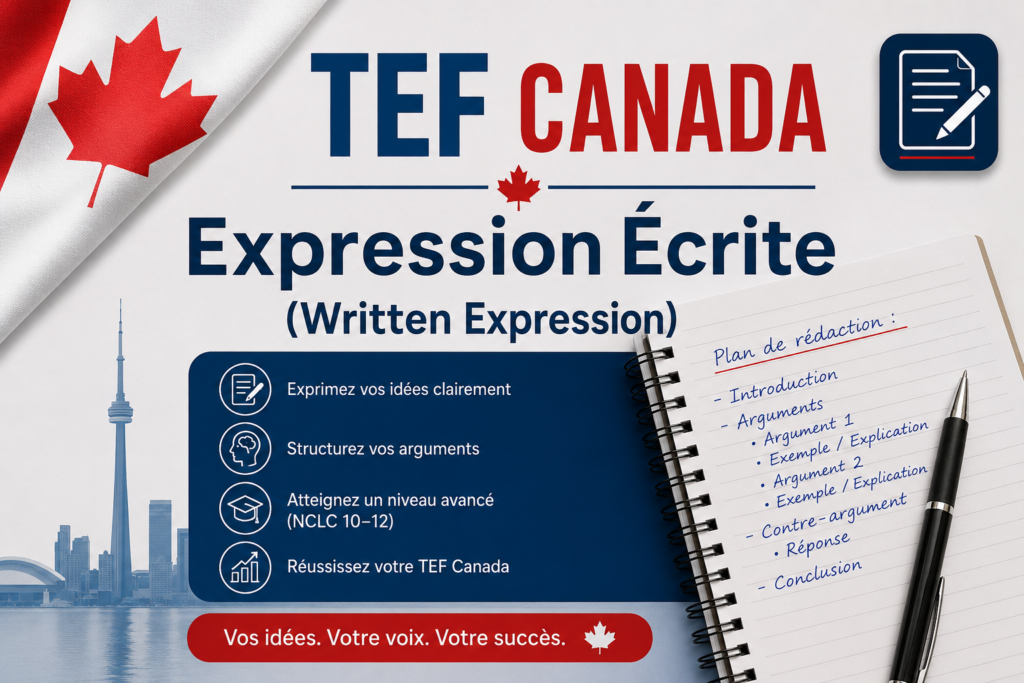
The Perfect Structure
Introduction
The introduction should do three things.
Introduce the subject.
Provide context.
Announce your opinion.
Never begin directly with
Je suis d’accord.
That sounds abrupt.
Instead,
Aujourd’hui, les réseaux sociaux occupent une place importante dans notre quotidien. Bien qu’ils présentent certains risques, je pense qu’ils offrent davantage d’avantages que d’inconvénients.
This sounds natural and sophisticated.
First Argument
State your first reason.
Explain it.
Illustrate it.
Example.
Second Argument
Repeat the same structure.
Argument
↓
Explanation
↓
Example
Never list ideas without developing them.
Counterargument
Strong candidates acknowledge another point of view.
Example
Certes, certaines personnes estiment que les réseaux sociaux favorisent la dépendance.
Cependant, ce problème dépend principalement de la manière dont ils sont utilisés.
This demonstrates maturity and critical thinking.
Conclusion
The conclusion should never introduce a new idea.
Instead,
summarize,
reaffirm,
finish elegantly.
Example
En conclusion, les réseaux sociaux représentent un outil extrêmement utile lorsqu’ils sont utilisés avec responsabilité. Il appartient donc à chacun d’en faire un usage réfléchi afin de profiter pleinement de leurs avantages.
Common Topics
The TEF frequently explores contemporary themes.
Education
Artificial Intelligence
Remote work
Environment
Health
Tourism
Technology
Culture
Transportation
Social media
Family
Work-life balance
The topic changes every session, but the underlying skills remain exactly the same.
Connectors – Your Secret Weapon
Dear students,
Many candidates know grammar.
Many candidates know vocabulary.
Very few candidates know how to connect ideas naturally.
This is what separates a B2 candidate from a C1 candidate.
Instead of always writing
et
mais
parce que
learn richer connectors.
To organize
Tout d’abord
Premièrement
Ensuite
Par ailleurs
En outre
Enfin
To illustrate
Par exemple
En effet
À titre d’exemple
Ainsi
Notamment
To oppose
Cependant
Toutefois
Néanmoins
En revanche
Pourtant
To conclude
En conclusion
En somme
En définitive
Pour conclure
Grammar Expected
To reach C1, you should comfortably use:
Present
Passé composé
Imparfait
Plus-que-parfait
Futur simple
Conditionnel
Subjonctif
Passive voice
Relative pronouns
Indirect speech
Complex sentences
Sentence variety demonstrates linguistic maturity.
What the Examiners Really Evaluate
The examiner is not counting difficult words.
Instead, they ask:
Did the candidate answer the question?
Is the text coherent?
Are ideas developed?
Is the vocabulary appropriate?
Is the grammar accurate?
Does the writing sound natural?
Can this person function effectively in French?
These are the qualities that distinguish a high-scoring candidate.
The Most Common Mistakes
- Ignoring the instructions.
- Writing far below the minimum word count.
- Forgetting paragraph structure.
- Repeating the same connectors.
- Repeating basic verbs such as faire and être.
- Giving personal opinions in Task A.
- Writing disconnected ideas without examples.
- Introducing new ideas in the conclusion.
- Using English sentence structure translated directly into French.
My Advice as Your Teacher
Dear students,
If there is one lesson I want you to remember, it is this:
Do not memorize complete essays.
The examiners read hundreds of papers every month. They immediately recognize memorized texts.
Instead, memorize:
- connectors
- advanced vocabulary
- useful sentence structures
- introductions
- conclusions
- opinion expressions
Then adapt them naturally to the topic.
Remember that successful candidates are not necessarily those with the largest vocabulary. They are the ones who communicate clearly, organize their ideas logically, and write with confidence.
Every practice essay you write brings you one step closer to your target score. Treat each writing exercise as if it were the real examination, and over time you will develop the fluency, precision, and confidence required to achieve NCLC 10–12.
In the following lessons, we will study high-scoring model answers, advanced vocabulary by theme, sophisticated introductions and conclusions, and examiner techniques that consistently help candidates achieve top results in the TEF Canada Expression Écrite.
Part II – C2 Sentence Patterns, Model Essays & Guided Writing Exercises