50 High-Scoring Narratives, Descriptions, and Examiner Corrections
“Good writers describe events. Excellent writers make the reader experience them.”
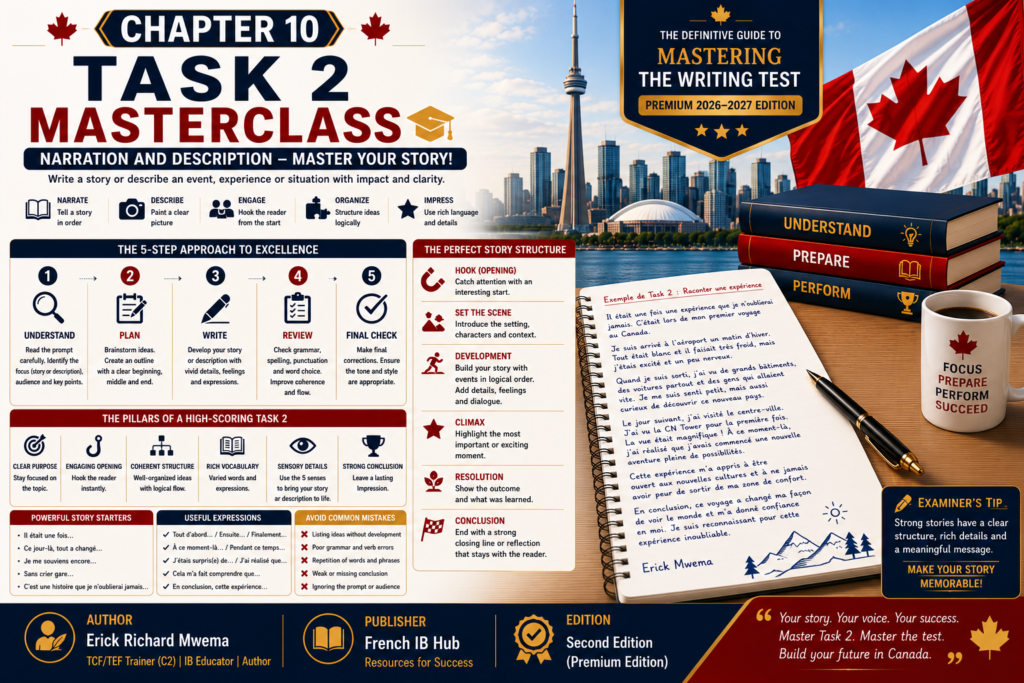
By now, you understand the structure of Task 2.
You know how to:
- organize a narrative;
- use chronological connectors;
- describe people, places, and events;
- express emotions;
- conclude naturally.
However, understanding a writing technique is only the beginning.
Real improvement comes from practice.
This chapter is designed as your Task 2 workshop.
Instead of simply reading explanations, you will learn by analyzing authentic-style examination tasks, comparing weak and strong responses, studying examiner comments, and practicing with increasingly challenging situations.
By the end of this chapter, you will have a complete toolkit for handling almost any Task 2 prompt with confidence.
Learning objectives
After completing this chapter, you will be able to:
- respond confidently to common Task 2 topics;
- develop ideas naturally;
- write coherent narratives;
- enrich descriptions;
- avoid repetitive vocabulary;
- recognize examiner expectations;
- improve your own writing through self-correction.
The seven families of Task 2
Although Task 2 prompts vary, they generally fall into one of seven categories.
                 TASK 2

        ┌─────────┼─────────┐
        │         │         │
 Experiences   People   Places
        │         │         │
 Celebrations Journeys Memories
              │
           Challenges
If you identify the category first, organizing your ideas becomes much easier.
Family 1 – Memorable experiences
Common topics
- first job
- first trip abroad
- first day at university
- volunteer work
- sporting event
- competition
- language exchange
Universal structure
Context

↓

What Happened

↓

Feelings

↓

Lessons Learned
Example prompt
Describe your first visit to a French-speaking country.
Candidate’s plan
- destination
- reason for travelling
- activities
- challenges
- personal growth
High-Scoring model answer
L’année dernière, j’ai eu la chance de visiter Montréal pour la première fois. Ce voyage avait pour objectif d’améliorer mon français et de découvrir la culture québécoise.
Pendant mon séjour, j’ai visité plusieurs musées, participé à des activités culturelles et discuté avec des habitants. Au début, j’étais un peu nerveux à l’idée de parler uniquement en français, mais les gens étaient très accueillants.
Cette expérience m’a permis de gagner en confiance et de progresser considérablement en communication.
Depuis ce voyage, je suis encore plus motivé à perfectionner mon français.
Examiner’s comments
- Strong introduction
- Logical sequence
- Rich vocabulary
- Personal reflection
- Natural conclusion
Family 2 – Describing people
Typical prompts include:
- a teacher
- a friend
- a family member
- a colleague
- an inspiring person
Universal structure
Introduction

↓

Appearance

↓

Personality

↓

Influence

↓

Conclusion
Strong description
Ma professeure de français est une personne très dynamique. Elle explique les leçons avec patience et encourage toujours ses élèves à participer activement.
Notice that the description focuses on both physical and personal qualities.
Family 3 – Describing places
Common prompts:
- hometown
- favorite city
- dream destination
- school
- neighborhood
- national park
Structure
Location

↓

Description

↓

Activities

↓

Recommendation

↓

Conclusion
Example
Québec est une ville magnifique située dans l’est du Canada. Son architecture historique, ses rues pavées et son ambiance chaleureuse attirent des visiteurs du monde entier.
Family 4 – Celebrations
Examples:
- birthdays
- weddings
- national festivals
- graduation
- cultural celebrations
Planning
Occasion

↓

Participants

↓

Activities

↓

Feelings

↓

Importance
High-Level Vocabulary
- la cérémonie
- les invités
- la décoration
- la tradition
- l’ambiance
- les festivités
- les souvenirs
Family 5 – Journeys
Travel prompts appear frequently.
Useful organization:
Destination

↓

Preparation

↓

Journey

↓

Activities

↓

Reflection
Useful expressions
- Nous sommes partis…
- À notre arrivée…
- Pendant le séjour…
- Ce voyage m’a permis de…
- Je recommande vivement…
Family 6 – Challenges
Candidates may describe:
- learning French
- moving abroad
- finding a job
- overcoming fear
- adapting to a new culture
Structure
Problem
↓
Difficulty
↓
Solution
↓
Result
↓
Lesson Learned
Example
Au début, il était difficile de comprendre les conversations rapides en français. Cependant, grâce à une pratique quotidienne, j’ai progressivement gagné en confiance.
Family 7 – Important memories
Examples:
- childhood
- family vacation
- graduation
- first success
- unforgettable meeting
Structure
Memory
↓
Description
↓
Emotions
↓
Importance Today
Expanding your ideas
Weak writing often lists events.
Example:
Nous sommes arrivés.
Nous avons mangé.
Nous avons visité un musée.
Nous sommes rentrés.
Better writing develops each idea.
Après notre arrivée, nous avons dégusté des spécialités locales dans un petit restaurant traditionnel. Ensuite, nous avons visité un musée consacré à l’histoire de la ville, où nous avons découvert de nombreuses œuvres fascinantes.
The second version gives the reader a much richer experience.
Vocabulary upgrade
Instead of…
beau
Use:
- magnifique
- splendide
- impressionnant
- pittoresque
- remarquable
grand
Use:
- immense
- spacieux
- vaste
- considérable
content
Use:
- ravi
- enchanté
- satisfait
- heureux
- comblé
intéressant
Use:
- captivant
- fascinant
- enrichissant
- stimulant
difficile
Use:
- exigeant
- complexe
- délicat
- éprouvant
Examiner correction Workshop
Student version
Je suis allé à Paris.
C’était beau.
J’ai mangé.
J’ai acheté des choses.
C’était bien.
Examiner comments
Problems:
❌ repetitive
❌ no details
❌ weak vocabulary
❌ no reflection
❌ abrupt ending
Improved version
L’été dernier, j’ai eu l’occasion de visiter Paris avec ma famille. Dès notre arrivée, nous avons été impressionnés par la beauté des monuments historiques et l’atmosphère animée de la ville.
Nous avons dégusté plusieurs spécialités françaises, découvert des musées renommés et exploré différents quartiers.
Ce séjour m’a permis de mieux comprendre la culture française et de pratiquer la langue dans des situations authentiques.
Je garderai toujours un excellent souvenir de cette expérience.
Why it Scores Higher
| Weak Response | Improved Response |
|---|---|
| Very short | Fully developed |
| Simple vocabulary | Rich vocabulary |
| No organization | Clear structure |
| No emotions | Reflection included |
| Abrupt ending | Meaningful conclusion |
Sentence transformation Practice
Transform each sentence into a richer version.
Basic
J’étais content.
Improved
J’étais extrêmement heureux de pouvoir enfin réaliser ce projet.
Basic
Le voyage était intéressant.
Improved
Ce voyage a été particulièrement enrichissant, car il m’a permis de découvrir une nouvelle culture.
Basic
La ville était belle.
Improved
Cette ville possède une architecture remarquable et une ambiance très accueillante.
Advanced connectors
Time
- Dès que…
- Pendant que…
- Lorsque…
- Avant de…
- Après avoir…
Contrast
- Malgré…
- Bien que…
- Même si…
- Pourtant…
Cause
- Grâce à…
- En raison de…
- Puisque…
- Étant donné que…
Result
- Ainsi…
- Par conséquent…
- C’est pourquoi…
- De ce fait…
Self-Assessment Rubric
After every Task 2, evaluate yourself.
| Criterion | Excellent | Good | Improve |
|---|---|---|---|
| Introduction | □ | □ | □ |
| Organization | □ | □ | □ |
| Chronology | □ | □ | □ |
| Vocabulary | □ | □ | □ |
| Verb Tenses | □ | □ | □ |
| Connectors | □ | □ | □ |
| Reflection | □ | □ | □ |
| Conclusion | □ | □ | □ |
20 Practice topics
Experiences
- My first international trip
- My first French lesson
- My dream job
- A difficult exam
- An unforgettable concert
Places
- My hometown
- My favorite restaurant
- A beautiful beach
- A historic city
- My school
People
- My best friend
- My teacher
- My grandmother
- An inspiring athlete
- A famous person I admire
Events
- A family celebration
- A sports competition
- A cultural festival
- My graduation
- An unforgettable weekend
Weekly practice Plan
| Day | Task |
|---|---|
| Monday | Describe a person |
| Tuesday | Describe a place |
| Wednesday | Narrate an experience |
| Thursday | Rewrite yesterday’s text |
| Friday | Timed writing |
| Saturday | Vocabulary review |
| Sunday | Self-assessment and corrections |
Following this routine consistently will steadily improve both your fluency and your confidence.
Expert advice
Professional writers rarely produce a perfect first draft.
High-scoring TCF candidates also improve through revision.
A useful habit is to:
- Write your first version.
- Leave it aside for 15–20 minutes.
- Read it again with fresh eyes.
- Improve vocabulary, connectors, and sentence variety.
This process develops the self-editing skills that examiners reward.
Chapter summary
In this chapter, you learned how to:
- recognize the seven major Task 2 families;
- organize narratives and descriptions effectively;
- enrich simple ideas with details and reflection;
- upgrade your vocabulary;
- analyze examiner corrections;
- transform average writing into high-scoring compositions.
You also built a collection of reusable structures and practice activities that you can apply to almost any Task 2 prompt.
Key takeaways
- Expand ideas instead of listing events.
- Combine narration with personal reflection.
- Use varied vocabulary and connectors.
- Revise your first draft before considering it complete.
- Practice regularly with different Task 2 topics.
Coming Up Next: Chapter 11 – Mastering Task 3: Analysis, Synthesis, and Personal Opinion
This is the most advanced chapter in the practical section of the book. You’ll learn how to analyze source documents, identify key ideas, compare viewpoints objectively, write a clear synthesis, transition naturally into your own opinion, and support your arguments with convincing examples. Because Task 3 carries the highest cognitive demand, we’ll break it down into a simple, repeatable method that you can apply confidently on exam day.