Learn to tell Stories that impress the Examiner
“Task 2 is where the examiner discovers whether you can transform simple ideas into meaningful communication.”
If Task 1 evaluates your ability to solve practical communication problems, Task 2 evaluates something entirely different:
Can you write an engaging, coherent, and well-organized text describing an experience, an event, a place, or a person?
Many candidates believe that Task 2 is simply “telling a story.”
It is much more than that.
A high-scoring response is not judged because it tells an exciting story.
It is judged because it demonstrates:
- logical organization;
- appropriate vocabulary;
- accurate use of verb tenses;
- coherent development of ideas;
- natural transitions;
- personal reflection.
The examiner wants to see whether you can guide the reader through your writing smoothly, making every paragraph contribute to the overall message.
Learning objectives
By the end of this chapter, you will be able to:
- Understand the purpose of Task 2.
- Organize a narrative logically.
- Describe people, places, and experiences effectively.
- Use chronological sequencing naturally.
- Express emotions and opinions appropriately.
- Select suitable verb tenses.
- Avoid the most common mistakes.
What is Task 2?
Task 2 requires you to write a connected text based on a personal or imaginary situation.
Unlike Task 1, which usually involves writing to someone, Task 2 focuses on developing a complete narrative or description.
You may be asked to:
- describe an unforgettable holiday;
- narrate an important experience;
- present your hometown;
- explain a memorable celebration;
- describe a person who inspired you;
- recount an unexpected event;
- explain a challenge you overcame.
What does the Examiner want?
The examiner is not looking for an extraordinary story.
A simple event, well written, always scores better than an exciting story that lacks organization.
The examiner asks questions such as:
- Does the story follow a logical order?
- Are ideas connected smoothly?
- Does the writer explain rather than simply list events?
- Are verb tenses used appropriately?
- Is the conclusion satisfying?
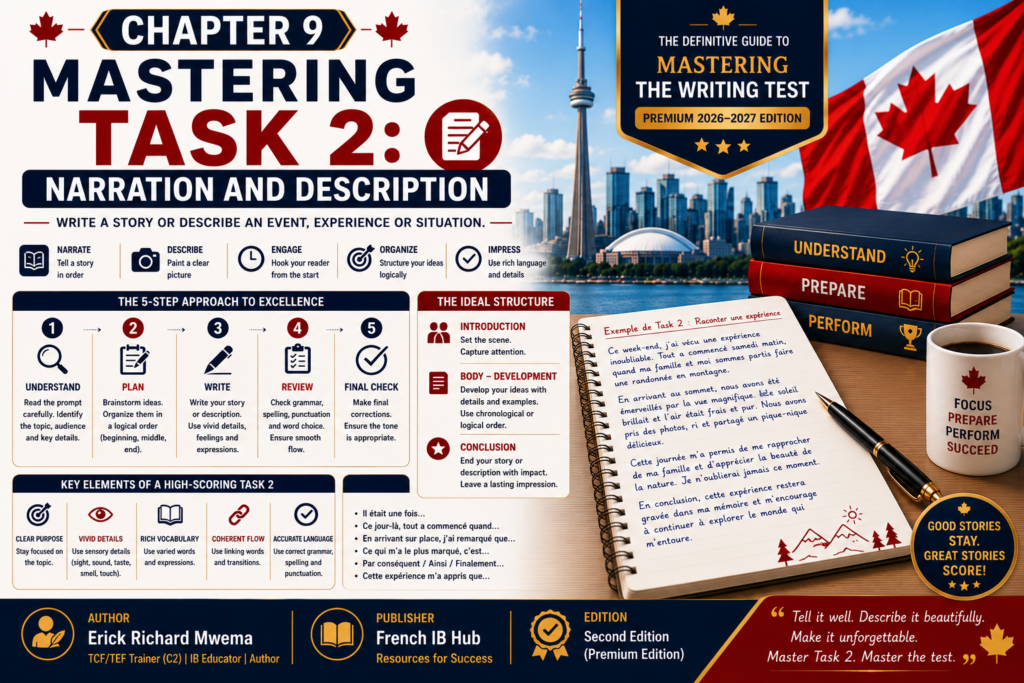
The Four-Part structure
Every excellent Task 2 follows a simple structure.
Introduction

↓

Development

↓

Personal Reflection

↓

Conclusion
This structure works for almost every Task 2 topic.
Part 1 – Introduction
Introduce the situation.
Answer basic questions:
- Who?
- Where?
- When?
- What?
Example:
L’été dernier, j’ai passé deux semaines à Québec avec ma famille pour découvrir la culture francophone.
The reader immediately understands the context.
Part 2 – Development
This is the heart of your composition.
Explain:
- what happened;
- who was involved;
- why it was important;
- what you saw;
- what you learned.
Instead of writing:
Nous avons visité plusieurs endroits.
Write:
Nous avons visité le Vieux-Québec, admiré son architecture historique et découvert plusieurs musées qui racontaient l’histoire de la ville.
Specific details make your writing richer.
Part 3 – Personal reflection
Many candidates forget this section.
This is your opportunity to explain:
- how you felt;
- what surprised you;
- what you learned;
- why the experience mattered.
Example:
Cette expérience m’a permis de devenir plus autonome et d’apprécier davantage la culture canadienne.
Reflection demonstrates maturity in writing.
Part 4 – Conclusion
Finish naturally.
Avoid ending suddenly.
Examples:
Je garderai toujours un excellent souvenir de ce voyage.
or
Si j’en ai l’occasion, j’aimerais revivre cette expérience.
A good conclusion leaves the reader with a complete impression.
Building a story chronologically
Readers should never feel lost.
Your story should progress naturally.
Beginning

↓

Situation

↓

Main Events

↓

Result

↓

Reflection
Chronology is one of the easiest ways to improve coherence.
Time expressions
Chronological writing depends on good connectors.
Beginning
- Au début…
- Tout d’abord…
- Un jour…
- L’année dernière…
- Le week-end dernier…
- En 2025…
Sequence
- Ensuite…
- Puis…
- Après cela…
- Quelques heures plus tard…
- Pendant ce temps…
Ending
- Finalement…
- À la fin…
- Depuis ce jour…
- En conclusion…
- Pour terminer…
These expressions guide the reader naturally.
Describing people
When describing a person, move from general to specific.
Good order:
Who?

↓

Appearance

↓

Personality

↓

Relationship

↓

Why important?
Example:
Mon grand-père est une personne très généreuse. Il est toujours prêt à aider les autres et m’a appris l’importance du respect et du travail.
Describing places
A place description should answer:
- Where is it?
- What does it look like?
- What can people do there?
- Why is it special?
Example:
Le village est situé au bord d’un magnifique lac entouré de montagnes. Les visiteurs peuvent faire de longues promenades et profiter d’un environnement calme.
Describing experiences
A complete experience includes:
- context;
- action;
- emotions;
- result.
Example:
Au début, j’étais très inquiet car c’était mon premier voyage seul. Cependant, j’ai rapidement gagné en confiance grâce aux personnes que j’ai rencontrées.
Expressing feelings
Instead of always writing:
J’étais content.
Use richer vocabulary.
| Basic | Better Alternatives |
|---|---|
| content | heureux, ravi, enchanté |
| triste | déçu, bouleversé, découragé |
| peur | inquiet, anxieux |
| surpris | étonné, impressionné |
| fatigué | épuisé, exténué |
| fier | satisfait, honoré |
Vocabulary variety creates a stronger impression.
Choosing the Right verb tense
Task 2 often requires more than one tense.
| Situation | Common Tense |
|---|---|
| Describe past events | Passé composé |
| Give background | Imparfait |
| Describe habits | Imparfait |
| Express future plans | Futur proche / Futur simple |
| State opinions | Présent |
Example:
Quand j’étais enfant (imparfait), je passais beaucoup de temps chez mes grands-parents.
L’été dernier, nous avons visité Montréal (passé composé).
The combination of tenses creates a more natural narrative.
Common connectors
Addition
- de plus;
- également;
- en outre.
Contrast
- cependant;
- pourtant;
- en revanche.
Cause
- parce que;
- puisque;
- grâce à.
Consequence
- donc;
- ainsi;
- c’est pourquoi.
Conclusion
- enfin;
- finalement;
- pour conclure.
Example prompt
Situation
Describe a celebration that was important to you.
Explain:
- what happened;
- where it took place;
- who participated;
- why it was memorable.
Planning
Celebration

↓

Location

↓

Participants

↓

Activities

↓

Feelings

↓

Conclusion
Planning takes less than two minutes.
Model answer
L’année dernière, ma famille a organisé une grande fête pour célébrer le mariage de ma sœur. La cérémonie a eu lieu dans une magnifique salle près de notre ville.
Toute la famille était présente, ainsi que de nombreux amis. Nous avons partagé un excellent repas, dansé toute la soirée et pris beaucoup de photos.
Ce qui m’a le plus marqué, c’est l’ambiance chaleureuse et la joie que tout le monde ressentait. Cette journée m’a rappelé l’importance de la famille et du partage.
Je garderai toujours un souvenir inoubliable de cette célébration.
Why this Response Works
- Clear introduction.
- Logical chronology.
- Specific details.
- Personal reflection.
- Natural conclusion.
The Ten most common mistakes
❌ Listing events without explanation.
❌ No paragraphs.
❌ No conclusion.
❌ Repeating the same vocabulary.
❌ Only using the passé composé.
❌ Forgetting feelings.
❌ Weak organization.
❌ Short undeveloped sentences.
❌ No connectors.
❌ Ending abruptly.
Examiner’s checklist
Before submitting your response, ask yourself:
| Question | ✓ |
|---|---|
| Did I introduce the situation? | ☐ |
| Did I organize events chronologically? | ☐ |
| Did I use appropriate connectors? | ☐ |
| Did I include personal reflection? | ☐ |
| Did I conclude naturally? | ☐ |
| Did I vary my vocabulary? | ☐ |
| Did I use suitable verb tenses? | ☐ |
Practice activities
Exercise 1
Describe your first day in a new school.
Include:
- your feelings;
- new classmates;
- teachers;
- what you learned.
Exercise 2
Describe a journey that changed your perspective.
Explain:
- where you went;
- why you travelled;
- what happened;
- what you learned.
Exercise 3
Describe someone who has influenced your life.
Explain:
- who the person is;
- their qualities;
- what they taught you;
- why they are important.
Exercise 4
Describe your favorite place in your city.
Include:
- location;
- activities;
- atmosphere;
- reasons for recommending it.
Vocabulary Bank
| Theme | Useful Words |
|---|---|
| Travel | le voyage, la découverte, le paysage, la destination |
| Feelings | la joie, la peur, la surprise, la fierté |
| Family | les proches, les parents, les cousins, les grands-parents |
| Events | la cérémonie, la fête, le festival, la compétition |
| Nature | la montagne, la forêt, la rivière, la plage |
Advanced Writing tip
Many candidates describe what happened.
Excellent candidates explain why it mattered.
Compare these two endings.
Basic:
J’ai beaucoup aimé ce voyage.
Advanced:
Ce voyage m’a permis de découvrir une nouvelle culture, de gagner en confiance et de comprendre l’importance de communiquer dans une langue étrangère.
The second ending demonstrates deeper reflection and stronger communication.
Chapter summary
In this chapter, you learned that:
- Task 2 evaluates your ability to narrate and describe effectively.
- A strong composition follows a logical structure: introduction, development, reflection, and conclusion.
- Chronological organization and clear connectors improve coherence.
- Personal reflection transforms a simple description into a meaningful text.
- Rich vocabulary and varied verb tenses strengthen your writing.
Key takeaways
- Organize your ideas chronologically.
- Describe, don’t simply list events.
- Explain your feelings and reflections.
- Use varied connectors and vocabulary.
- Finish with a meaningful conclusion.
Coming Up Next: Chapter 10 – Task 2 Masterclass: 50 High-Scoring Narratives, Descriptions, and Examiner Corrections
In the next chapter, you’ll move beyond strategy into intensive practice. You’ll explore dozens of realistic Task 2 prompts, complete model answers, examiner annotations, common mistakes, vocabulary expansion, and rewritten examples that show exactly how an average response can be transformed into a high-scoring composition. This chapter will become your practical workbook for mastering Task 2.