50 Real Exam Scenarios, Reusable Templates, and High-Scoring Model Answers
“The best way to master Task 1 is not by memorizing answers—it is by mastering patterns.”
After understanding the structure of Task 1, the next step is deliberate practice.
Many candidates search online for “model answers” and try to memorize them.
Unfortunately, this strategy rarely works.
Why?
Because the examination changes.
The names change.
The situations change.
The questions change.
However, the communication patterns remain the same.
Once you master those patterns, you can confidently respond to almost any Task 1 prompt.
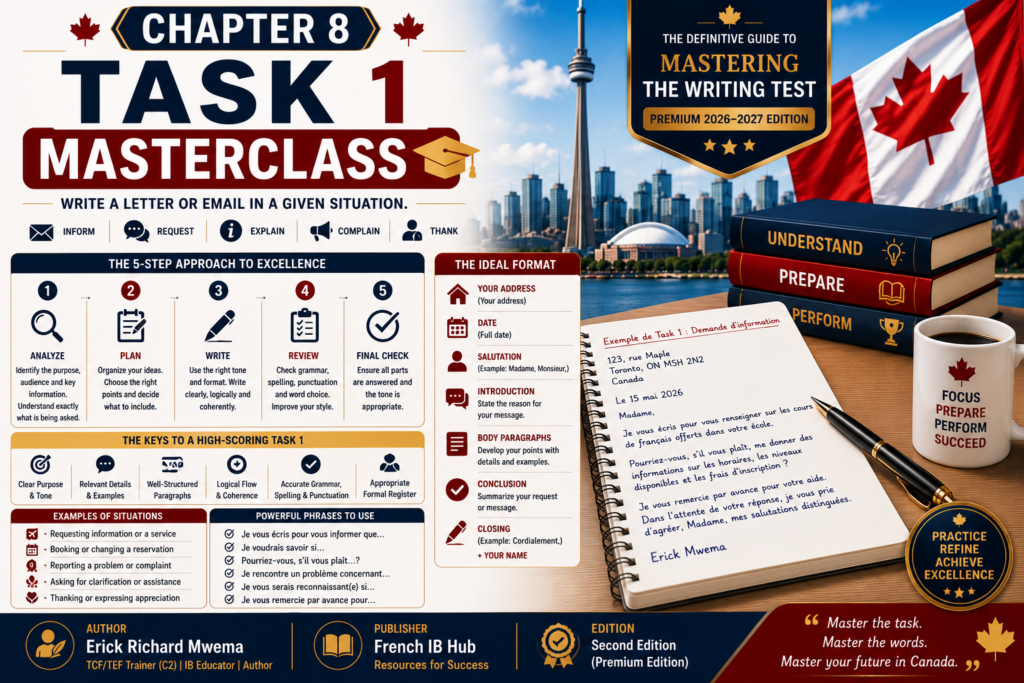
This chapter is your Task 1 Masterclass.
Instead of memorizing isolated examples, you will learn reusable templates, adaptable sentence structures, examiner-approved language, and complete model answers based on realistic examination scenarios.
Learning objectives
By the end of this chapter, you will be able to:
- Recognize the most common Task 1 situations.
- Adapt one template to many different prompts.
- Write formal and informal emails confidently.
- Use natural French expressions.
- Avoid repetitive language.
- Produce complete responses under exam conditions.
The Six Families of Task 1
Nearly every Task 1 prompt belongs to one of these communication families.
                 TASK 1

      ┌──────────┼──────────┐
      │          │          │
 Request    Reservation   Complaint
      │          │          │
 Invitation Information Confirmation
Once you know the family,
you already know the structure.
Family 1 – Requesting information
Typical situations
- language course
- university
- sports club
- driving school
- gym membership
- music lessons
- training program
Universal opening
Madame, Monsieur,
Je vous écris afin d’obtenir quelques renseignements concernant…
Useful questions
Quels sont les horaires ?
Quel est le prix ?
Comment puis-je m’inscrire ?
Y a-t-il des réductions ?
Quelle est la durée de la formation ?
Universal closing
Je vous remercie d’avance pour votre réponse.
Cordialement,
Model answer
Situation
You would like information about a photography course.
Madame, Monsieur,
Je souhaite suivre votre formation en photographie et je voudrais obtenir quelques renseignements.
Pourriez-vous m’indiquer les horaires des cours ainsi que leur durée ? J’aimerais également connaître les tarifs et savoir s’il existe des réductions pour les étudiants.
Enfin, pourriez-vous m’expliquer la procédure d’inscription ?
Je vous remercie d’avance pour votre réponse.
Cordialement,
Marie Dupont
Examiner’s comments
- Clear objective
- Complete information
- Appropriate register
- Excellent organization
Family 2 – Reservations
Common topics:
- hotel
- restaurant
- conference
- campsite
- event
- museum visit
Template
Madame, Monsieur,
Je souhaiterais effectuer une réservation…
Pourriez-vous me confirmer…
Je vous remercie…
Model answer
Situation
Reserve a hotel room.
Madame, Monsieur,
Je souhaiterais réserver une chambre double pour les 12 et 13 septembre.
Pourriez-vous me confirmer vos disponibilités ? J’aimerais également savoir si le petit-déjeuner est inclus et si un parking est disponible.
Je vous remercie pour votre aide.
Cordialement,
Jean Martin
Examiner’s comments
✔ Clear reservation
✔ Appropriate questions
✔ Polite tone
Family 3 – Complaints
Many candidates become too emotional.
Remember:
Professional complaints remain polite.
Good language
Instead of:
Je suis très fâché !!
Write:
Je souhaite vous signaler un problème concernant…
Useful expressions
- Malheureusement…
- J’ai constaté que…
- Le produit est arrivé…
- Je souhaiterais obtenir…
- Pourriez-vous me proposer une solution ?
Model answer
Situation
Your online order arrived damaged.
Madame, Monsieur,
J’ai reçu ma commande hier, mais malheureusement le produit est arrivé endommagé.
L’écran présente plusieurs fissures et l’appareil ne fonctionne pas correctement.
Pourriez-vous m’indiquer la procédure à suivre afin d’obtenir un remplacement ou un remboursement ?
Je vous remercie de votre aide.
Cordialement,
Ahmed Benali
Examiner’s comments
- Problem clearly explained
- Solution requested politely
- Formal register respected
Family 4 – Invitations
Usually informal.
Template
Salut…
Merci pour ton invitation.
Je serais ravi de…
Malheureusement…
À bientôt !
Model answer
Situation
Your friend invites you to a birthday party.
Salut Emma,
Merci beaucoup pour ton invitation !
Je serai très heureux de participer à ton anniversaire samedi prochain.
Est-ce que je peux apporter quelque chose pour la fête ?
J’ai vraiment hâte de te voir.
À bientôt !
Lucas
Examiner’s comments
- Friendly tone
- Appropriate vocabulary
- Natural ending
Family 5 – Confirmations
Examples:
- internship
- interview
- appointment
- reservation
- meeting
Template
Madame,
Je vous remercie pour votre message.
Je vous confirme…
Je reste à votre disposition.
Cordialement,
Model answer
Situation
Confirm a job interview.
Madame,
Je vous remercie pour votre invitation à un entretien.
Je vous confirme ma présence le lundi 15 septembre à 10 heures.
Je me réjouis de vous rencontrer.
Cordialement,
Pierre Laurent
Family 6 – Cancelling or Changing Plans
Useful situations:
- appointments
- reservations
- travel
- interviews
- meetings
Universal expressions
Malheureusement…
En raison de…
Je souhaiterais reporter…
Serait-il possible de…
Model answer
Madame,
En raison d’un problème familial, je ne pourrai malheureusement pas assister au rendez-vous prévu le mardi 10 juin.
Serait-il possible de fixer une nouvelle date la semaine prochaine ?
Je vous remercie pour votre compréhension.
Cordialement,
Sophie Bernard
20 Essential opening sentences
| French | Use |
|---|---|
| Je vous écris afin de… | Formal |
| Je souhaiterais… | Request |
| Je voudrais obtenir… | Information |
| Je me permets de vous contacter… | Formal |
| Je vous remercie pour… | Reply |
| Merci beaucoup pour… | Informal |
| J’aimerais savoir… | Questions |
| Je souhaite réserver… | Reservation |
| Je voudrais signaler… | Complaint |
| Je confirme… | Confirmation |
| Je vous informe que… | Information |
| Je vous contacte au sujet de… | General |
| Je fais suite à votre annonce… | Advertisement |
| Je suis intéressé(e) par… | Courses |
| Je souhaite participer… | Events |
| Je voudrais modifier… | Changes |
| Je tiens à vous remercier… | Thanks |
| Je suis désolé(e) de… | Apology |
| Je regrette de vous informer… | Bad news |
| Je vous serais reconnaissant(e)… | Polite request |
20 Essential closing sentences
Formal
- Je vous remercie de votre attention.
- Merci pour votre réponse.
- Dans l’attente de votre réponse.
- Veuillez agréer…
- Cordialement.
- Bien cordialement.
- Respectueusement.
Informal
- À bientôt !
- À très vite !
- Amitiés.
- Bisous.
- À la prochaine !
- Merci encore.
- Donne-moi de tes nouvelles !
25 High-Frequency Verbs
| French | English |
|---|---|
| demander | to ask |
| réserver | to reserve |
| confirmer | to confirm |
| modifier | to change |
| annuler | to cancel |
| expliquer | to explain |
| répondre | to reply |
| remercier | to thank |
| informer | to inform |
| signaler | to report |
| participer | to participate |
| recevoir | to receive |
| envoyer | to send |
| acheter | to buy |
| retourner | to return |
| aider | to help |
| contacter | to contact |
| proposer | to propose |
| organiser | to organize |
| visiter | to visit |
| apprendre | to learn |
| commencer | to begin |
| terminer | to finish |
| payer | to pay |
| attendre | to wait |
Examiner’s secret
Examiners notice candidates who answer every point in the prompt.
A useful strategy is to underline each instruction before you start writing.
Example:
Prompt
- introduce yourself
- ask about prices
- ask about schedules
- ask about accommodation
Checklist:
☑ Introduction
☑ Prices
☑ Schedules
☑ Accommodation
Before finishing, verify that each item appears in your email.
Self-Assessment Rubric
Evaluate your response after every practice task.
| Criterion | Excellent | Good | Needs Improvement |
|---|---|---|---|
| Task completed | □ | □ | □ |
| Register | □ | □ | □ |
| Organization | □ | □ | □ |
| Vocabulary | □ | □ | □ |
| Grammar | □ | □ | □ |
| Politeness | □ | □ | □ |
| Overall communication | □ | □ | □ |
Challenge Zone – 10 Practice Scenarios
Write a complete response for each situation.
- Request information about a cooking course.
- Reserve a campsite for a weekend.
- Complain about delayed luggage.
- Cancel a doctor’s appointment.
- Confirm attendance at a conference.
- Thank a host family after your stay.
- Ask a landlord about an apartment.
- Request information about a volunteer program.
- Report a lost passport to the embassy.
- Invite a friend to visit your city.
Practice these under timed conditions and compare your work against the checklist.
Task 1 Quick Reference Sheet
Greeting

↓

Purpose

↓

Answer EVERY instruction

↓

Ask required questions

↓

Polite closing

↓

Signature

↓

Proofread
If you follow this sequence every time, you’ll avoid the majority of Task 1 errors.
Chapter summary
In this chapter, you learned to:
- Identify the six most common Task 1 communication families.
- Adapt reusable templates to different exam situations.
- Use formal and informal registers correctly.
- Write effective openings and closings.
- Build a practical library of vocabulary and expressions.
- Evaluate your own responses using an examiner-style rubric.
By mastering these communication patterns, you’ll be able to handle almost any Task 1 prompt with confidence rather than relying on memorized answers.
Key takeaways
- Learn communication patterns, not memorized essays.
- Always identify the task family first.
- Keep your message clear, complete, and polite.
- Reuse adaptable sentence structures naturally.
- Check that every instruction in the prompt has been answered.
Coming Up Next: Chapter 9 – Mastering Task 2: Narration and Description
Task 2 requires a completely different skill set. You’ll learn how to tell engaging stories, describe experiences vividly, organize ideas chronologically, express emotions naturally, and use a wider range of tenses and connectors. We’ll also explore common Task 2 themes, examiner expectations, model answers, and strategies that transform simple descriptions into high-scoring compositions.