The Complete Guide to Writing High-Scoring Emails, Messages, and Formal Requests
“Task 1 is not about writing beautifully—it is about communicating effectively.”
Many candidates underestimate Task 1.
They look at the shorter word count and assume it is the easiest part of the examination.
Unfortunately, this assumption often leads to careless mistakes.
Candidates forget to answer one question.
They use the wrong greeting.
They write to a company as if they were writing to a friend.
They forget a polite closing.
These mistakes are completely avoidable.
Task 1 is your opportunity to demonstrate that you can function confidently in everyday French.
Whether you are writing to a hotel, a school, a company, a landlord, or a friend, the examiner wants to see one thing:
Can this candidate communicate clearly and appropriately in a real-life situation?
In this chapter, you will learn everything you need to master Task 1, from understanding the prompt to producing polished, professional responses.
Learning objectives
By the end of this chapter, you will be able to:
- Understand the purpose of Task 1.
- Recognize different types of communicative situations.
- Choose the correct register.
- Organize your message effectively.
- Use appropriate greetings and closings.
- Write clear and complete responses.
- Avoid the most common mistakes.
- Evaluate your own work using an examiner’s checklist.
What is Task 1?
Task 1 assesses your ability to communicate in practical, everyday situations.
You are placed in a realistic context and asked to write a short message or email to achieve a specific purpose.
The goal is not literary creativity.
The goal is effective communication.
Examples include:
- requesting information;
- making a reservation;
- cancelling an appointment;
- reporting a problem;
- asking for clarification;
- thanking someone;
- inviting a friend;
- confirming participation.
The Golden Rule of Task 1
Always remember:
Every instruction in the prompt must appear somewhere in your response.
Missing even one required point can lower your score.
The Four essential questions
Before writing anything, answer these four questions.
Who am I writing to?

↓

Why am I writing?

↓

What information must I include?

↓

Should my language be formal or informal?
If you answer these questions correctly, you have already completed half the task.
Understanding the Register
One of the first decisions you must make is the register.
French distinguishes clearly between formal and informal communication.
Choosing the wrong register immediately weakens your response.
Formal register
Used when writing to:
- a company;
- a university;
- a hotel;
- an employer;
- a government office;
- customer service;
- someone you do not know.
Typical Greeting
Madame, Monsieur,
or
Monsieur,
or
Madame,
Formal Closing
Je vous remercie de votre attention.
Dans l’attente de votre réponse, veuillez agréer, Madame, Monsieur, l’expression de mes salutations distinguées.
Cordialement,
Informal register
Used when writing to:
- friends;
- classmates;
- family members;
- close colleagues.
Informal Greeting
Salut Julie,
Bonjour Marc,
Cher Paul,
Informal Closing
À bientôt !
Amitiés,
Bisous,
À très vite !
Never mix Registers
Incorrect:
Salut Madame,
Incorrect:
Cordialement, mon pote !
Once you choose a register, remain consistent throughout the message.
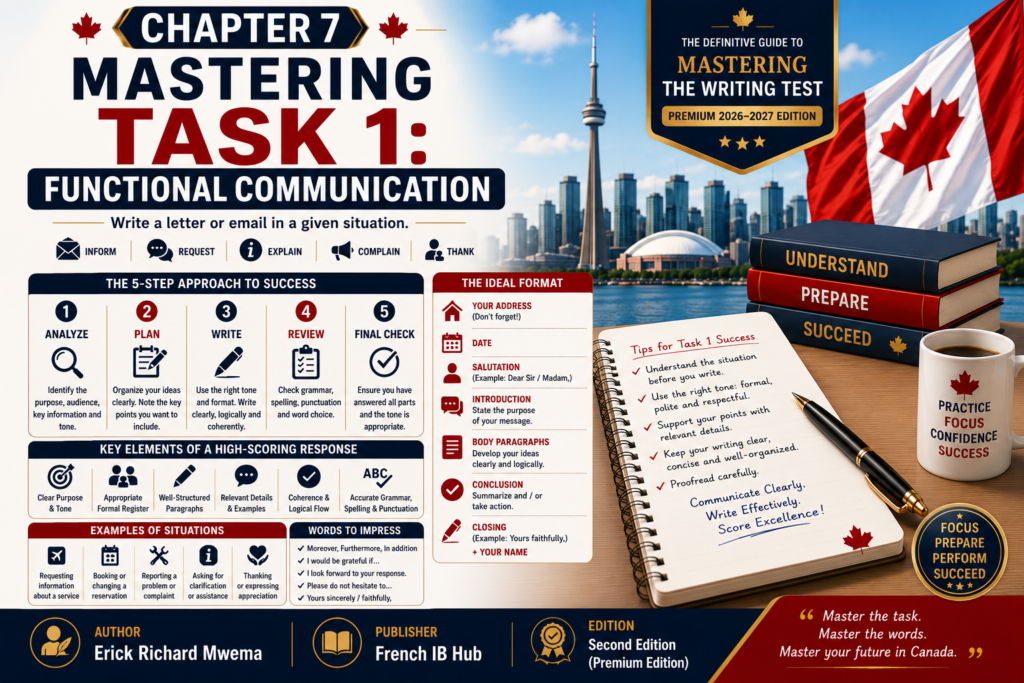
The structure of a High-Scoring Response
Regardless of the topic, every successful Task 1 follows a logical structure.
Greeting

↓

Reason for Writing

↓

Required Information

↓

Polite Closing

↓

Signature
Simple.
Logical.
Professional.
Step 1 – Greeting
Always begin appropriately.
Formal
Madame, Monsieur,
Informal
Salut Thomas,
Never begin immediately with your request.
Step 2 – State your Purpose
Within the first two sentences, explain why you are writing.
Examples:
Je vous écris afin d’obtenir des renseignements concernant…
Je souhaiterais réserver une chambre…
Je vous contacte au sujet de…
Merci pour ton invitation.
Je voulais te parler de…
The reader immediately understands the purpose.
Step 3 – Develop your Message
This is the heart of the email.
Include every point requested.
Suppose the prompt asks you to:
- ask about prices;
- request schedules;
- inquire about registration.
Your email must include all three.
Example:
Pourriez-vous m’indiquer les tarifs ?
Quels sont les horaires des cours ?
Comment puis-je m’inscrire ?
Notice how every question directly answers the prompt.
Step 4 – Polite Closing
Never stop immediately after your final question.
Instead, finish naturally.
Formal:
Je vous remercie d’avance pour votre réponse.
Informal:
J’espère avoir de tes nouvelles bientôt.
Step 5 – Signature
Examples:
Formal:
Cordialement,
Erick Mwema
Informal:
À bientôt !
Pierre
Example Prompt
Situation
You have seen an advertisement for a French language course.
Write an email to the language center.
You must:
- introduce yourself;
- ask about course schedules;
- ask about fees;
- ask about registration.
Candidate planning
Greeting

↓

Introduce myself

↓

Schedules

↓

Fees

↓

Registration

↓

Thank you

↓

Closing
Planning takes less than one minute.
Model answer
Madame, Monsieur,
Je m’appelle Erick Mwema et je souhaite améliorer mon niveau de français. J’ai vu votre annonce concernant vos cours et je voudrais obtenir quelques renseignements.
Pourriez-vous m’indiquer les horaires des cours ? J’aimerais également connaître les frais d’inscription ainsi que le prix de la formation.
Enfin, pourriez-vous m’expliquer la procédure d’inscription ?
Je vous remercie d’avance pour votre réponse.
Cordialement,
Erick Mwema
Why this Response Works
- Appropriate greeting.
- Purpose stated immediately.
- Every instruction answered.
- Polite language.
- Logical organization.
- Formal register maintained.
Useful expressions
Requesting information
- Je souhaiterais obtenir…
- Pourriez-vous me renseigner sur…
- J’aimerais savoir…
- Auriez-vous l’amabilité de…
- Serait-il possible de…
Asking questions
- Quels sont…
- Quand…
- Où…
- Combien coûte…
- Comment puis-je…
Making requests
- Je vous serais reconnaissant(e) de…
- Pourriez-vous…
- Je souhaiterais…
- Je vous prie de…
- Merci de bien vouloir…
Thanking
- Merci beaucoup.
- Je vous remercie.
- Je vous remercie d’avance.
- Merci pour votre aide.
- Je vous suis reconnaissant(e).
Closing
Formal:
- Dans l’attente de votre réponse…
- Veuillez agréer…
- Cordialement.
Informal:
- À bientôt !
- À très vite !
- Amitiés.
The most common Task 1 Situations
During your preparation, expect prompts related to:
Education
- language courses;
- universities;
- scholarships;
- registration.
Travel
- hotels;
- flights;
- reservations;
- tourist information.
Work
- interviews;
- internships;
- schedules;
- training.
Daily Life
- repairs;
- neighbours;
- complaints;
- appointments.
Shopping
- damaged products;
- refunds;
- deliveries;
- customer service.
Health
- appointments;
- pharmacies;
- medical information.
The Ten most common Mistakes
❌ Forgetting the greeting.
❌ Forgetting the closing.
❌ Missing one required point.
❌ Wrong register.
❌ No introduction.
❌ Asking only one question.
❌ Writing unnecessary details.
❌ Repeating vocabulary.
❌ Forgetting polite expressions.
❌ Ending abruptly.
Every one of these mistakes is preventable.
Examiner’s checklist
Before moving to the next task, ask yourself:
| Question | ✓ |
|---|---|
| Did I answer every instruction? | ☐ |
| Did I use the correct register? | ☐ |
| Did I greet the reader properly? | ☐ |
| Did I explain my purpose? | ☐ |
| Did I organize my ideas logically? | ☐ |
| Did I end politely? | ☐ |
| Did I sign my message? | ☐ |
Practice exercise 1
Situation
You booked a hotel room for next month.
Unfortunately, you must change your travel dates.
Write an email to the hotel.
Include:
- your reservation number (invent one);
- explain why you need to change the dates;
- ask whether the modification is possible;
- ask if there will be additional charges.
Practice exercise 2
Situation
You recently bought a laptop online.
It arrived damaged.
Write to customer service.
Include:
- describe the problem;
- explain when you received the package;
- request a replacement;
- ask how the return process works.
Practice exercise 3
Situation
Your French friend has invited you to spend a weekend in Québec.
Reply to the invitation.
Include:
- thank your friend;
- accept or decline the invitation;
- explain your reason;
- ask one question about the weekend plans.
Mini vocabulary Bank
| English | French |
|---|---|
| schedule | l’horaire |
| registration | l’inscription |
| reservation | la réservation |
| fee | les frais |
| information | les renseignements |
| complaint | la réclamation |
| refund | le remboursement |
| replacement | le remplacement |
| appointment | le rendez-vous |
| confirmation | la confirmation |
Challenge activity
Choose one of the three situations above.
Complete it under exam conditions.
Then evaluate your work using the examiner’s checklist.
Next, rewrite the same email without looking at your first version.
Compare both drafts.
You will often notice that your second version is clearer, more organized, and more natural.
Chapter summary
In this chapter, you learned that:
- Task 1 evaluates practical written communication.
- Every prompt has a specific audience, purpose, and register.
- A successful response follows a clear structure: greeting, purpose, development, closing, and signature.
- Completing every instruction is more important than using complex vocabulary.
- Politeness, clarity, and organization are essential for a high score.
Key takeaways
- Read the prompt carefully before writing.
- Identify the audience and choose the correct register.
- Follow a logical email structure.
- Answer every required point.
- End your message politely and professionally.
Coming Up Next: Chapter 8 – Task 1 Masterclass: 50 Real Exam Scenarios, Templates, and High-Scoring Model Answers
In the next chapter, we move from theory to intensive practice. You’ll work through dozens of realistic Task 1 situations—including hotels, jobs, universities, travel, customer service, healthcare, housing, and daily life—supported by reusable templates, examiner commentary, vocabulary banks, and model responses that demonstrate exactly what high-scoring candidates do differently. This chapter will become your practical handbook for mastering Task 1 under real exam conditions.