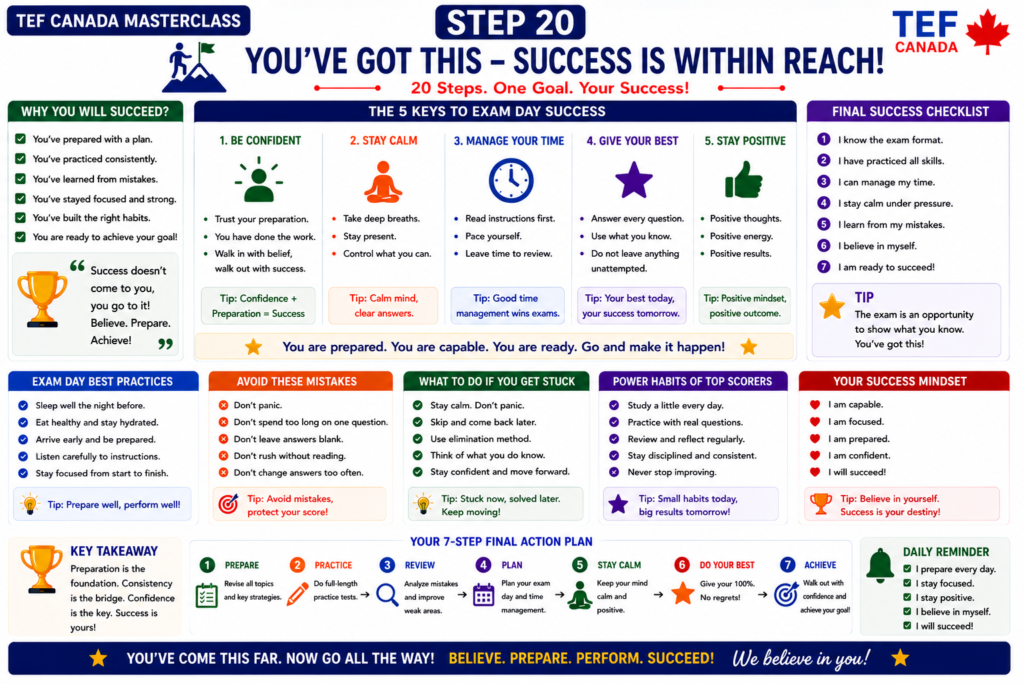
Your roadmap from beginner to your target CLB score
Congratulations!
If you’ve reached this point, you’ve completed the 20-Step TEF Canada Masterclass.
This final chapter is not about learning new grammar or vocabulary.
Instead, it brings everything together into one practical action plan.
Think of this chapter as your GPS for TEF & TCF success.
It will show you exactly what to do, when to do it, and how to prepare until exam day.
The TEF success formula
Throughout this course, you’ve learned that success does not come from one single skill.
It comes from combining several elements consistently.
The complete formula is:
Success = Knowledge + Practice + Strategy + Consistency + Confidence
Let’s understand each element.
1. Knowledge
Know the grammar, vocabulary, and communication skills required for everyday French.
2. Practice
Use the language every day through listening, reading, speaking, and writing.
3. Strategy
Approach each TEF section with the correct techniques instead of relying on luck.
4. Consistency
Study regularly, even if only for 30–60 minutes a day.
5. Confidence
Trust your preparation and communicate naturally during the exam.
The four pillars of TEF & TCF success
Every successful candidate develops four balanced skills.
Listening
Listen for meaning.
Not for every word.
Reading
Read for information.
Not for translation.
Speaking
Communicate naturally.
Not perfectly.
Writing
Write clearly.
Not impressively.
When these four pillars are equally strong, your overall score improves significantly.
A 12-Week study plan
If your exam is about three months away, this plan will help you organize your preparation.
Weeks 1–4: Build the Foundation
Focus on:
- The 10 TEF themes
- Essential grammar
- Core vocabulary
- Language chunks
- Connectors
- Pronunciation
Daily Goal:
- 20 new words or expressions
- 30 minutes of listening
- 20 minutes of reading
- 15 minutes of speaking
- 15 minutes of writing
Weeks 5–8: Develop the Skills
Begin working on complete TEF tasks.
Focus on:
- Listening exercises
- Reading passages
- Speaking Part A
- Speaking Part B
- Writing tasks
Review your mistakes every day.
Weeks 9–11: Simulate the Exam
Now practise under real exam conditions.
Use official time limits.
Complete full sections without interruption.
After each practice:
Ask yourself:
- What went well?
- What slowed me down?
- Which grammar mistakes did I make?
- Which vocabulary did I need?
Week 12: Final preparation
Do not learn large amounts of new material.
Instead:
Review.
Practise.
Sleep well.
Build confidence.
The final week should strengthen what you already know.
A Daily study routine
You don’t need to study for six hours every day.
Consistency matters more than long sessions.
10 Minutes
Vocabulary review
10 Minutes
Grammar review
15 Minutes
Listening
15 Minutes
Reading
15 Minutes
Speaking
15 Minutes
Writing
Total:
About 80 minutes of focused study.
If you have less time, shorten each activity—but try to practise every skill regularly.
Weekly Goals
Every week, aim to complete:
- One full listening practice
- One full reading practice
- Three speaking simulations
- Three writing tasks
- Vocabulary review
- Grammar revision
- Pronunciation practice
Small improvements every week create significant progress over time.
How to review your mistakes
Your mistakes are valuable.
Create a notebook divided into four sections.
Grammar
Record grammar errors and correct versions.
Vocabulary
Write new expressions and example sentences.
Pronunciation
Note difficult sounds and words to practise.
Communication
Write down situations where you struggled to explain an idea.
Review this notebook every week.
You’ll notice that the same mistakes gradually disappear.
Exam week checklist
Seven days before the exam:
- Review vocabulary.
- Review grammar.
- Complete one or two full practice tests.
- Sleep well.
- Stay hydrated.
- Prepare your identification documents.
- Confirm your exam time and location.
Avoid studying late into the night.
A rested brain performs much better than a tired one.
Exam day strategy
Before entering the exam room:
Take a deep breath.
Remind yourself:
I have prepared for this.
During the exam:
- Read instructions carefully.
- Stay calm.
- Manage your time.
- Focus on one question at a time.
- Don’t panic after a mistake.
Remember:
One mistake never determines your final score.
During speaking
Smile.
Speak naturally.
Use simple, accurate French.
If you forget a word:
Explain it differently.
Never remain silent.
Communication is always more important than perfection.
During writing
Before you start:
Plan your ideas.
While writing:
Use paragraphs.
Use connectors.
Check the task instructions.
Before finishing:
Review your grammar, spelling, and punctuation.
During listening
Focus on the message.
Ignore isolated unknown words.
Keep moving forward.
During reading
Read the questions first.
Identify keywords.
Use context.
Manage your time carefully.
What happens if you feel nervous?
Feeling nervous is completely normal.
Even experienced speakers feel nervous during important exams.
Use this simple routine.
Stop.
Breathe slowly.
Read the question carefully.
Begin with a simple sentence.
Once you start speaking or writing, your confidence usually grows naturally.
What if you don’t reach your target?
Remember something important.
Learning French is a journey.
The TEF measures your ability on one particular day.
It does not define your intelligence.
If you don’t achieve your target immediately:
Review your results.
Identify weak areas.
Practise intentionally.
Try again.
Every successful French speaker has made mistakes along the way.
Beyond the TEF & TCF
The purpose of learning French is not only to pass an exam.
French can help you:
- study abroad,
- immigrate,
- build an international career,
- travel,
- make friends,
- access new cultures,
- and open new opportunities.
The TEF is one milestone—not the final destination.
Your personal commitment
Before you finish this course, make a promise to yourself.
“I will practise consistently.
I will learn from my mistakes.
I will communicate with confidence.
I will enjoy the learning process.
I will never stop improving.”
This mindset will serve you far beyond the exam.
If you’ve completed all 20 steps of this Masterclass, you have built much more than French knowledge.
You have learned:
- how to learn effectively,
- how to communicate naturally,
- how to solve problems,
- how to think in French,
- how to approach the TEF strategically,
- and how to become an independent language learner.
Remember:
Fluency is not achieved in one day.
It is the result of hundreds of small efforts repeated consistently.
Trust the process.
Stay disciplined.
Believe in your progress.
The 20-Step Journey (Quick review)
- Understand the 10 TEF Themes
- Learn the Skills, Not Just the Themes
- Build Your Theme Folders
- Master One Theme Across All Four Skills
- Build Mind Maps
- Master Connectors
- Learn Speaking & Writing Frameworks
- Learn Language Chunks
- Think in French
- Practise Actively
- Master Essential Grammar
- Build Vocabulary Smartly
- Master Listening
- Master Reading
- Master Speaking Part A
- Master Speaking Part B
- Master Writing
- Master Time Management
- Avoid Common Mistakes
- Follow the Success Blueprint
Each step builds upon the previous one. Together, they create a complete preparation system for the TEF Canada exam.
Final key takeaway
Remember these five principles above everything else:
- Communicate before you translate.
- Think before you speak.
- Organize before you write.
- Practise before you panic.
- Be consistent before you expect results.
And leave this course with one sentence in your mind:
French is not learned by waiting. It is learned by using it every single day.
Bonne chance et à bientôt !